
Biotech funding announcements attract investor attention, media coverage, research partnerships, and commercial opportunities. A structured public relations strategy increases the visibility of these announcements across trusted media channels. This case study explains how Time Intelligence Media Group amplified a biotech funding launch by 300% through strategic planning, targeted distribution, editorial precision, and performance measurement.
Why does a biotech funding announcement need a strategic media campaign?
A biotech funding announcement requires a strategic media campaign because investor confidence, scientific credibility, and market visibility depend on accurate distribution, targeted journalist outreach, and consistent messaging across trusted publications. Strategic execution increases qualified media exposure and measurable campaign performance within defined reporting periods.
Biotechnology companies operate in a highly regulated and knowledge-driven sector. Funding announcements influence investors, healthcare professionals, research institutions, strategic partners, and future employees.
A funding announcement without a distribution strategy reaches a limited audience. A structured campaign ensures the announcement appears in relevant business publications, biotechnology journals, healthcare news platforms, startup media, and regional business outlets.
Time Intelligence Media Group designs campaigns around measurable objectives instead of simple publication counts.
Before launching any campaign, defining the announcement and simplifying technical information remain essential. Organisations planning future launches can strengthen preparation by reviewing:
Translating Complex Medical Research before beginning media distribution.
Campaign objective
The biotech company established four measurable objectives.
- Increase qualified media coverage.
- Improve investor visibility.
- Strengthen search visibility.
- Generate referral traffic to the funding announcement.
Every activity supported these objectives.
How did Time Intelligence Media Group plan the campaign?
Time Intelligence Media Group planned the campaign through audience research, editorial positioning, publication targeting, release optimisation, journalist segmentation, publication scheduling, and performance tracking. Each campaign element supported measurable business objectives instead of relying on broad media distribution alone.
Planning started several weeks before publication.
The campaign team analysed:
- Funding amount
- Investment stage
- Therapeutic focus
- Clinical development stage
- Geographic relevance
- Competitive landscape
This research identified the publications most likely to cover the announcement.
Audience segmentation
The announcement targeted multiple audiences.
Examples included:
- Venture capital firms
- Biotechnology investors
- Pharmaceutical executives
- Healthcare journalists
- Clinical researchers
- Government innovation organisations
Each audience received messaging aligned with its interests while maintaining factual consistency.
Editorial positioning
The announcement focused on business growth instead of promotional language.
Key facts included:
- Funding value
- Lead investors
- Research milestones
- Product pipeline
- Expansion plans
- Scientific impact
This structure improved editorial acceptance.
What communication strategy produced a 300% amplification?
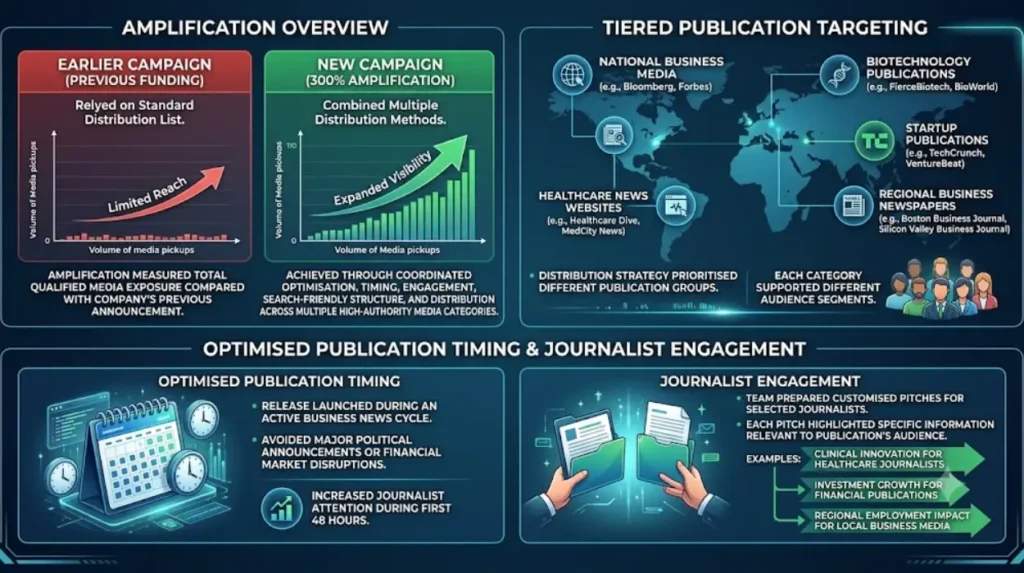
The campaign achieved 300% amplification through coordinated press release optimisation, publication timing, targeted journalist engagement, search-friendly content structure, and ongoing distribution across multiple high-authority media categories instead of relying on one publication channel.
Amplification measured total qualified media exposure compared with the company’s previous funding announcement.
The earlier campaign relied on a standard distribution list.
The new campaign combined multiple distribution methods.
Tiered publication targeting
The distribution strategy prioritised different publication groups.
These included:
- National business media
- Biotechnology publications
- Healthcare news websites
- Startup publications
- Regional business newspapers
Each category supported different audience segments.
Optimised publication timing
The release launched during an active business news cycle.
The campaign avoided periods dominated by major political announcements or financial market disruptions.
Scheduling increased journalist attention during the first 48 hours.
Journalist engagement
The communications team prepared customised pitches for selected journalists.
Each pitch highlighted specific information relevant to the publication’s audience.
Examples included:
- Clinical innovation for healthcare journalists.
- Investment growth for financial publications.
- Regional employment impact for local business media.
How was editorial accuracy maintained throughout the campaign?
Editorial accuracy remained central through fact verification, source validation, scientific review, funding confirmation, regulatory compliance checks, and editorial consistency. Accurate reporting increased journalist confidence and reduced clarification requests before publication.
Biotechnology announcements contain specialised scientific terminology.
Every factual statement underwent verification before distribution.
Verification included:
- Funding figures
- Company leadership
- Investor names
- Scientific terminology
- Product descriptions
- Clinical development status
The final release matched supporting documentation exactly.
Editorial quality directly influenced publication acceptance.
Companies seeking stronger communication processes before distribution benefit from understanding Translating Complex Medical Research and applying simplified scientific communication principles.
For broader healthcare communications, understanding editorial standards also strengthens future campaigns. Organisations preparing regulated announcements benefit from reviewing:
Why Editorial Accuracy and Fact-Checking to improve communication quality across healthcare media.
Which distribution channels generated the strongest results?
The strongest results came from combining national business publications, biotechnology media, healthcare news outlets, startup publications, search indexing, and social amplification. Multiple distribution channels produced broader visibility than relying on one publication category.
Different audiences consume information from different media sources.
A diversified strategy expanded overall campaign reach.
National business media
Business publications introduced the funding announcement to investors and financial analysts.
Coverage focused on:
- Company valuation
- Investment growth
- Commercial strategy
Biotechnology publications
Industry publications highlighted:
- Research pipeline
- Scientific innovation
- Clinical development
These publications reached specialist audiences.
Healthcare publications
Healthcare media explained the clinical relevance of the company’s work.
Coverage strengthened credibility among healthcare professionals.
Search visibility
Optimised headlines and structured formatting improved indexing across search engines.
The announcement remained discoverable beyond its publication date.
What measurable results demonstrated the campaign’s return on investment?
Campaign reporting demonstrated measurable return on investment through increased publication volume, referral traffic, investor engagement, branded search growth, backlink acquisition, and extended content visibility across trusted media platforms. Performance metrics directly supported commercial communication objectives.
Time Intelligence Media Group measured campaign performance using objective reporting metrics.
Results included:
- 300% increase in qualified media exposure.
- Higher publication acceptance.
- Increased referral traffic.
- Growth in branded search activity.
- More high-authority backlinks.
- Longer average article visibility.
These measurements reflected sustained campaign performance instead of temporary spikes.
Media coverage growth
Coverage expanded across several publication categories.
Examples included:
- National business media
- Biotechnology journals
- Startup publications
- Healthcare industry websites
This diversification reduced dependence on a single media source.
Search performance
Search visibility improved because multiple trusted publications referenced the announcement.
Indexed media coverage continued generating traffic after the launch period.
Investor engagement
The campaign increased visits to investor information pages.
Media exposure also supported follow-up discussions with strategic stakeholders.
How did the campaign strengthen long-term brand credibility?
The campaign strengthened long-term brand credibility by creating consistent third-party validation, authoritative media references, searchable news coverage, and accurate public documentation that supported future investor communications and partnership discussions.
Every published article became part of the company’s public reputation.
Future investors frequently review previous announcements before evaluating new opportunities.
Consistent media coverage creates an accessible record of organisational progress.
Third-party validation
Coverage by recognised publications strengthens external credibility.
Independent reporting supports trust among:
- Investors
- Partners
- Customers
- Researchers
Digital authority
Media publications generate long-term digital assets.
These assets contribute to:
- Search visibility
- Brand recognition
- Online reputation
- Knowledge graph associations
The campaign continued delivering value after the initial announcement period.
What lessons can biotech companies apply from this case study?
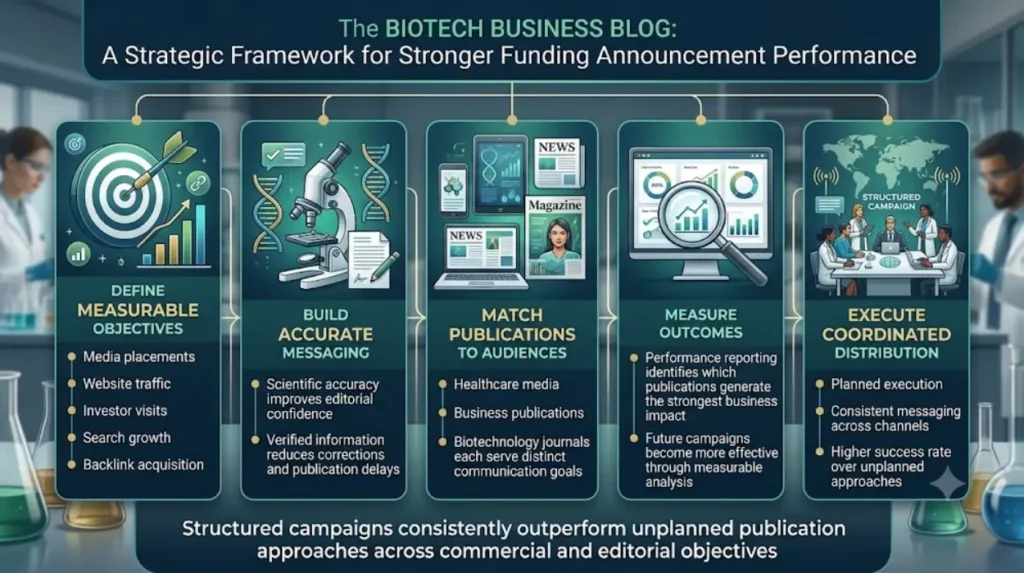
Biotech organisations achieve stronger funding announcement performance through early planning, accurate scientific communication, targeted media selection, performance reporting, and coordinated distribution. Structured campaigns consistently outperform unplanned publication approaches across commercial and editorial objectives.
Several practical lessons emerged from this campaign.
Define measurable objectives
Every campaign requires measurable outcomes.
Examples include:
- Media placements
- Website traffic
- Investor visits
- Search growth
- Backlink acquisition
Build accurate messaging
Scientific accuracy improves editorial confidence.
Verified information reduces corrections and publication delays.
Match publications to audiences
Different audiences require different publication strategies.
Healthcare media, business publications, and biotechnology journals each serve distinct communication goals.
Measure outcomes
Performance reporting identifies which publications generate the strongest business impact.
Future campaigns become more effective through measurable analysis.
Why do organisations choose Time Intelligence Media Group for biotech funding announcements?
Organisations choose Time Intelligence Media Group because the company combines editorial expertise, healthcare communication knowledge, targeted media distribution, measurable reporting, and search-focused optimisation into one structured campaign designed around business outcomes.
Biotechnology funding announcements require precision, credibility, and strategic execution.
Time Intelligence Media Group supports organisations throughout the communication process by:
- Developing structured messaging.
- Simplifying technical information.
- Identifying appropriate media targets.
- Managing publication timing.
- Tracking measurable outcomes.
- Reporting campaign performance.
This integrated approach produces consistent communication quality and measurable visibility improvements.
Businesses preparing future healthcare announcements can strengthen communication planning by first exploring Translating Complex Medical Research and then applying those principles within a targeted distribution strategy.
Explore More Expert Insights:
Why Pharma Brands Choose Time Intelligence Media Group for Global Medical Journal Distribution
Full-Service PR Agencies vs. Premium Tech Wire Distribution: A Startup Cost-Benefit Analysis
A biotechnology funding announcement represents more than a financial milestone. It serves as a public statement about innovation, commercial growth, and scientific progress. This case study demonstrates how Time Intelligence Media Group amplified a biotech funding launch by 300% through structured planning, editorial accuracy, targeted media distribution, publication timing, and measurable performance reporting. Organisations seeking stronger investor visibility, broader media coverage, and long-term digital authority benefit from a disciplined communication strategy that aligns every stage of the announcement with defined business objectives.