
Artificial intelligence has changed how technical information is created, discovered, and evaluated. Search engines, AI assistants, and business decision-makers now prioritize content supported by expertise, evidence, and original insights. As a result, tech thought leadership has become a strategic communication approach that builds credibility through knowledge instead of promotion.
Organizations, researchers, developers, and executives publish thought leadership to explain emerging technologies, interpret industry changes, and share original findings. This content influences discussions across technology communities, media publications, and business networks.
What is tech thought leadership in the AI era?
Tech thought leadership in the AI era means consistently publishing original, evidence-based technology knowledge that demonstrates expertise, explains industry developments, and contributes valuable insights. It builds credibility through factual analysis, research, technical experience, and informed perspectives rather than promotional messaging or advertising alone.
Thought leadership is a communication strategy focused on knowledge sharing. In technology, it involves presenting expert understanding of subjects such as artificial intelligence, cybersecurity, cloud computing, software engineering, data science, and digital infrastructure.
The AI era has changed the standards for valuable content. AI systems summarize publicly available information quickly. Content that repeats existing facts adds little value. Original research, technical analysis, practical experience, and unique datasets receive greater attention because they introduce information that does not already exist elsewhere.
What defines thought leadership?
Thought leadership includes several defining characteristics:
- Original research supported by verifiable data
- Technical expertise demonstrated through detailed explanations
- Industry analysis based on evidence
- Clear definitions of complex technologies
- Practical examples from real implementations
- Transparent methodology and sources
For example, a report analysing 5,000 enterprise AI deployments provides original industry insight. A detailed explanation of a new machine learning framework also contributes technical knowledge.
Why has artificial intelligence changed thought leadership?
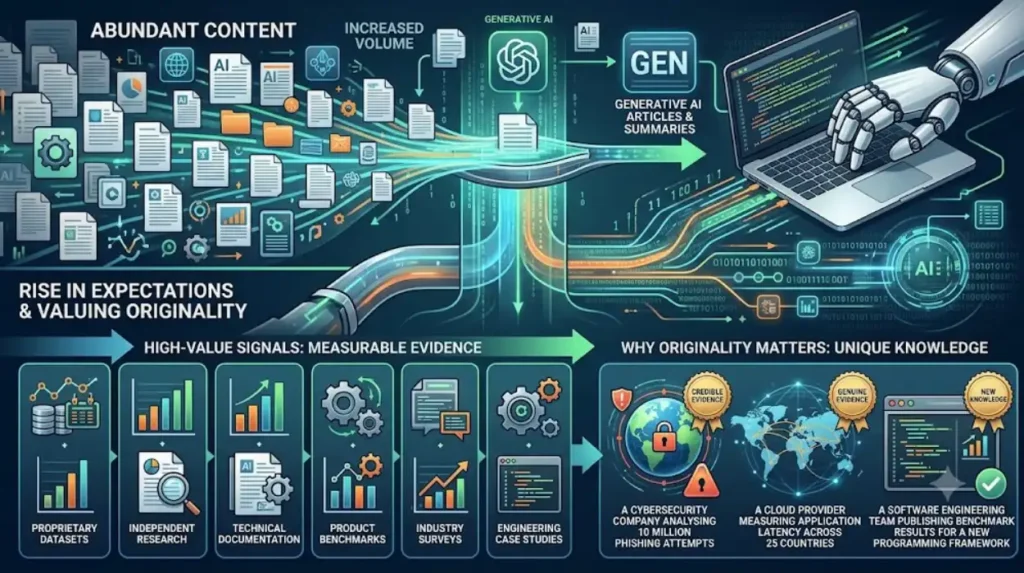
Artificial intelligence has increased the volume of online content while raising expectations for originality, expertise, and factual accuracy. Decision-makers, search engines, and AI systems now distinguish between repeated information and genuinely new knowledge supported by credible evidence and practical experience.
Generative AI produces articles, summaries, and documentation within seconds. This has created an environment where information is abundant.
As information becomes easier to generate, original expertise becomes more valuable.
Technology professionals increasingly evaluate content using measurable signals such as:
- Proprietary datasets
- Independent research
- Technical documentation
- Product benchmarks
- Industry surveys
- Engineering case studies
These sources introduce information that AI systems cannot invent independently.
Why does originality matter?
Original information contributes new knowledge.
Examples include:
- A cybersecurity company analysing 10 million phishing attempts.
- A cloud provider measuring application latency across 25 countries.
- A software engineering team publishing benchmark results for a new programming framework.
These publications become reference points because they contain unique evidence.
What are the core components of effective tech thought leadership?
Effective tech thought leadership combines technical expertise, original evidence, structured communication, consistent publishing, and factual accuracy. These elements establish authority by helping audiences understand technology trends, implementation methods, operational challenges, and measurable industry developments through reliable educational content.
Successful thought leadership includes multiple complementary components.
Original data
Original datasets create information unavailable elsewhere.
Examples include:
- Annual technology adoption surveys
- Infrastructure performance reports
- Developer productivity studies
- AI model benchmarking
Technical expertise
Experts explain technical concepts accurately.
Examples include:
- Neural network optimisation
- Cloud architecture design
- Zero-trust security frameworks
- Distributed databases
Industry analysis
Analysis explains what changes mean.
Rather than listing announcements, analysis interprets market developments, regulatory updates, adoption trends, and implementation outcomes.
Educational content
Educational resources improve understanding through:
- Technical guides
- Research papers
- Industry reports
- Frequently asked questions
- Product architecture explanations
How does tech thought leadership differ from traditional marketing?
Tech thought leadership educates audiences through evidence and expertise, while traditional marketing promotes products, services, or commercial offers. Thought leadership focuses on explaining technology and industry developments instead of encouraging immediate purchasing decisions or highlighting promotional benefits directly.
Marketing communicates commercial value.
Thought leadership communicates knowledge.
The primary objective differs.
Marketing often discusses:
- Product features
- Pricing
- Customer offers
- Competitive positioning
Thought leadership explains:
- Technology evolution
- Industry challenges
- Engineering practices
- Market research
- Technical standards
Educational articles remain useful regardless of purchasing decisions.
How does AI search influence thought leadership?
AI search systems identify reliable information by analysing factual accuracy, structured content, original insights, and authoritative expertise. Well-organised educational resources with clear definitions and evidence are easier for AI systems to interpret, summarise, and reference accurately across different platforms.
AI search systems process content differently from traditional keyword-based search.
Structured explanations improve understanding.
Content benefits from:
- Clear definitions
- Logical headings
- Entity-based language
- Direct answers
- Supporting evidence
- Consistent terminology
For example, defining “large language model,” “retrieval-augmented generation,” and “vector database” helps both readers and AI systems interpret technical relationships.
What formats support technology thought leadership?
Technology thought leadership appears across multiple content formats including research reports, technical blogs, white papers, conference presentations, benchmark studies, webinars, documentation, and educational videos. Different formats communicate expertise for different audiences and technical complexity levels effectively.
Different communication formats serve different purposes.
Industry reports
Reports analyse large datasets and identify measurable trends.
Examples include annual AI adoption reports and cloud infrastructure surveys.
Technical articles
Technical blogs explain implementation methods.
Examples include Kubernetes deployment strategies and API security practices.
White papers
White papers examine technologies in greater technical depth.
Topics include enterprise AI governance, edge computing, and data privacy.
Conference presentations
Presentations communicate research findings, engineering lessons, and technical innovation.
Documentation
Technical documentation explains architecture, workflows, APIs, and implementation processes using precise language.
Readers exploring practical research development can continue with:
Why does thought leadership matter for the technology industry?
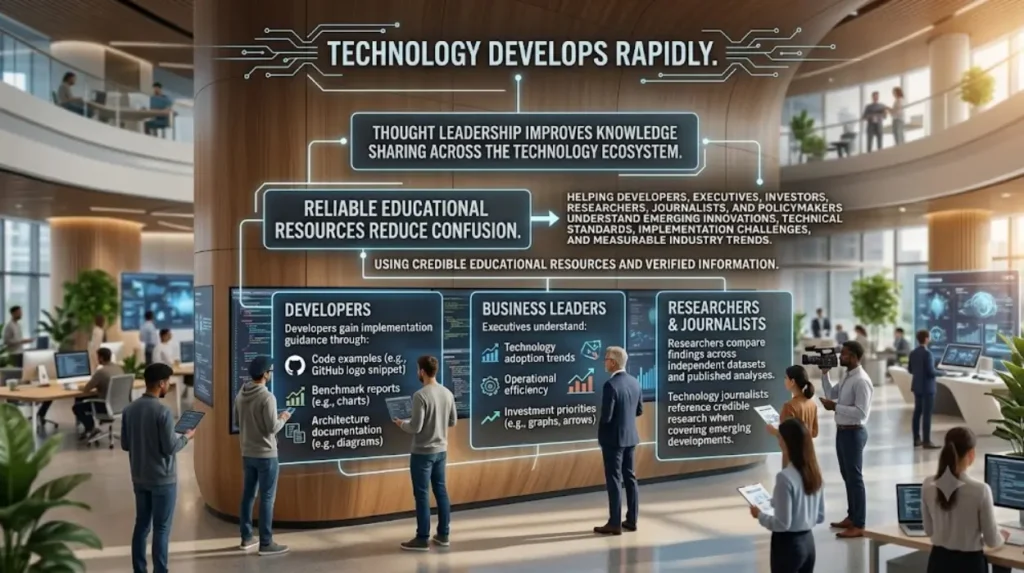
Thought leadership improves knowledge sharing across the technology ecosystem by helping developers, executives, investors, researchers, journalists, and policymakers understand emerging innovations, technical standards, implementation challenges, and measurable industry trends using credible educational resources and verified information.
Technology develops rapidly.
Reliable educational resources reduce confusion.
Different stakeholders benefit in different ways.
Developers
Developers gain implementation guidance through:
- Code examples
- Benchmark reports
- Architecture documentation
Business leaders
Executives understand technology adoption trends, operational efficiency, and investment priorities.
Journalists
Technology journalists reference credible research when covering emerging developments.
Researchers
Researchers compare findings across independent datasets and published analyses.
How can organisations create credible thought leadership content?
Credible thought leadership begins with genuine expertise, measurable evidence, structured research, accurate technical explanations, transparent methodology, and consistent publication. Each publication contributes documented knowledge that supports broader understanding of technology rather than repeating existing online information without additional value.
The process follows a structured sequence.
Define the research topic
Select a focused technology subject.
Examples include:
- AI governance
- Cloud security
- Software performance
- Digital transformation
Collect original evidence
Gather measurable information through:
- Surveys
- Product usage data
- Performance testing
- Technical experiments
Analyse findings
Interpret patterns using statistical or technical methods.
Explain significant results clearly.
Publish structured content
Organise information using:
- Definitions
- Findings
- Methodology
- Examples
- Conclusions
Update information regularly
Technology evolves continuously.
Updated research maintains factual relevance over time.
What challenges affect tech thought leadership in the AI era?
The largest challenges include information overload, declining originality, factual verification, rapid technological change, AI-generated duplication, and maintaining technical accuracy. High-quality research, transparent evidence, and consistent expertise help distinguish valuable educational content from repetitive information.
AI-generated content has increased publication volume across every technology topic.
Readers face greater difficulty identifying reliable expertise.
Several challenges have become more significant.
Content saturation
Thousands of similar articles discuss identical subjects.
Original research stands apart because it introduces new information.
Technical accuracy
Rapid innovation requires continuous updates.
AI models, software frameworks, and regulations evolve frequently.
Verification
Reliable publications explain:
- Research methodology
- Data collection
- Technical assumptions
- Evidence sources
Verification increases trust.
Explore More Expert Insights:
Why Backlinks from High-Authority Tech Sites Matter for Software SEO
How Do SaaS Startups Get Noticed by TechCrunch and VentureBeat?
What is the future of tech thought leadership?
The future of tech thought leadership centres on original research, transparent evidence, technical expertise, structured knowledge, and human analysis. AI systems distribute information efficiently, while expert contributors remain responsible for producing verified knowledge and meaningful industry insights that advance technology understanding.
Artificial intelligence will continue changing how information is discovered and summarised.
Human expertise remains responsible for creating original knowledge.
Future thought leadership will increasingly include:
- Proprietary research
- Interactive datasets
- Technical benchmarking
- AI transparency reporting
- Engineering case studies
- Industry measurement frameworks
Organisations and experts producing measurable evidence will contribute valuable educational resources for both human audiences and AI-powered knowledge systems.
Readers interested in enterprise implementation approaches can explore:
Enterprise Tech PR Distribution for decision-stage guidance.
Tech thought leadership in the AI era combines expertise, original evidence, technical accuracy, and structured communication to educate audiences about emerging technologies. As AI increases access to information, independently researched knowledge, verified data, and clear explanations become the defining characteristics of authoritative technology content.