
Software companies compete in search results where authority, trust, and relevance influence rankings. Backlinks remain one of the strongest signals search engines use to evaluate websites. Links from respected technology publications carry greater weight because they connect software businesses with trusted sources that publish original, editorial content.
Understanding why these backlinks matter helps software companies build sustainable organic visibility instead of relying only on paid acquisition.
Why do backlinks from high-authority tech sites matter for software SEO?
Backlinks from high-authority tech sites improve website authority, strengthen topical relevance, increase search engine trust, support faster content discovery, and generate qualified referral traffic. Editorial links from respected technology publications signal that software content deserves greater visibility within search engine results and industry discussions.
A backlink is a hyperlink from one website to another. Search engines use backlinks to understand relationships between websites.
A high-authority tech site is an established technology publication with strong editorial standards, consistent readership, and significant domain authority. Examples include software review publications, developer news platforms, cybersecurity magazines, cloud computing journals, and enterprise technology news websites.
When these websites link to a software company’s content, search engines receive additional evidence that the linked resource provides valuable information.
Editorial backlinks differ from paid advertisements because editors choose to include the link within relevant content.
How search engines evaluate backlinks
Search engines evaluate several factors, including:
- Source website authority
- Topical relevance
- Editorial placement
- Anchor text
- Link context
- Overall link profile diversity
A single editorial backlink from a respected technology publication often provides greater SEO value than dozens of links from unrelated websites.
What is a high-authority tech website?
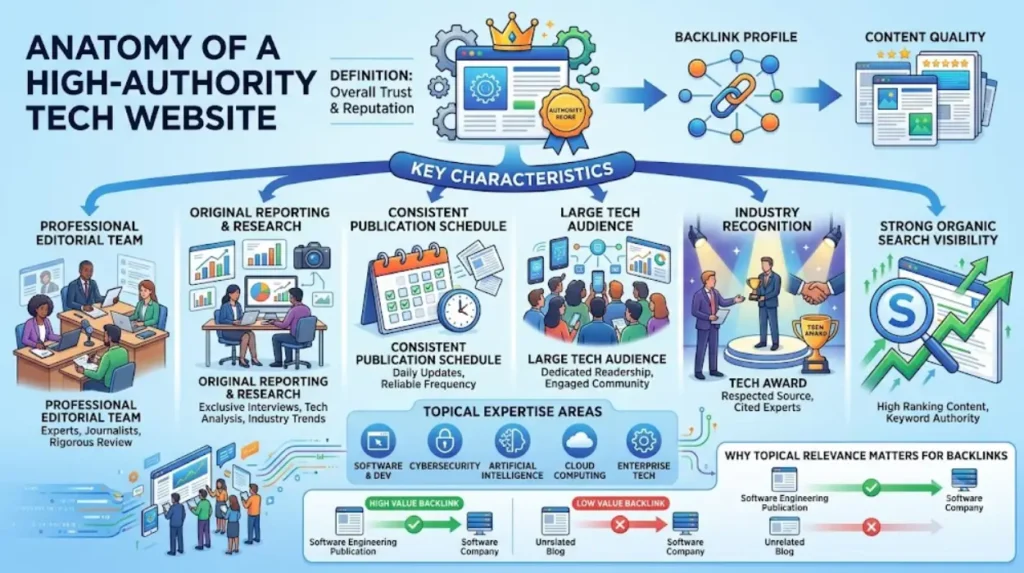
A high-authority tech website publishes original technology content, follows strict editorial standards, attracts consistent industry audiences, earns trusted backlinks, and demonstrates expertise across software, cybersecurity, artificial intelligence, cloud computing, enterprise technology, or software development topics through sustained publication quality and credibility.
Website authority describes the overall trust and reputation of a website based on its backlink profile and content quality.
Technology websites become authoritative by publishing accurate reporting, expert interviews, research, product analysis, and technical education over many years.
Common characteristics
High-authority technology websites typically include:
- Professional editorial teams
- Original reporting
- Regular publication schedules
- Strong organic search visibility
- High-quality backlink profiles
- Industry recognition
- Large technology-focused audiences
These characteristics help search engines identify trusted sources within the software industry.
Why topical relevance matters
Authority alone does not determine backlink value.
A software company benefits more from a backlink on a respected software engineering publication than from an unrelated website with similar authority.
Topical alignment strengthens semantic relevance between the linking page and the destination page.
How do backlinks influence software search rankings?
Backlinks strengthen ranking signals by transferring authority, reinforcing topical relationships, improving crawl efficiency, supporting content indexing, and validating expertise. Search engines combine backlink signals with content quality, user experience, technical SEO, and relevance when determining search result positions for software-related queries.
Search engines analyze the entire backlink ecosystem instead of counting links alone.
Multiple authoritative websites discussing the same software topic create stronger evidence that the linked website contributes useful information.
Authority transfer
Editorial backlinks pass authority through hyperlinks.
Pages receiving authoritative links often gain stronger ranking potential for relevant keywords.
Improved crawling
Search engine crawlers discover new pages through links.
A backlink from a frequently crawled technology publication helps search engines locate new software resources more quickly.
Better keyword relevance
Relevant anchor text helps search engines understand page topics.
For example, a link using “API documentation” supports topical relevance for documentation pages.
Why is editorial context more valuable than link quantity?
Editorial context gives backlinks greater meaning because links appear naturally within relevant articles written for readers. Search engines evaluate surrounding content, publication quality, author credibility, and topical alignment instead of rewarding large numbers of unrelated or low-quality backlinks.
Thousands of unrelated backlinks do not outperform a smaller number of trusted editorial references.
Context explains why the destination page deserves attention.
Example
A cybersecurity publication discussing endpoint protection software links to an in-depth malware detection guide.
The surrounding article establishes topical relevance between both websites.
That context provides stronger signals than a random directory listing.
Editorial links support expertise
Editorial references often indicate that journalists, analysts, or technical writers used a resource during research.
These citations reinforce credibility across software topics.
How do high-authority backlinks benefit software companies beyond rankings?
High-authority backlinks improve brand visibility, referral traffic, industry recognition, audience trust, content discovery, and long-term organic growth. These benefits extend beyond rankings because trusted technology publications expose software content to relevant professional audiences and industry researchers.
SEO benefits represent only one outcome.
Editorial visibility also influences business awareness.
Increased referral traffic
Technology readers often follow links to learn more about software products, research, documentation, or technical resources.
These visitors already have interest in technology topics.
Stronger industry credibility
Repeated citations across respected technology publications demonstrate consistent expertise.
Journalists and researchers frequently review existing industry coverage before referencing software companies.
Improved content visibility
Authoritative publications expose educational resources to audiences that search engines alone cannot reach.
This broader exposure often leads to additional editorial citations over time.
Which types of software content naturally earn authoritative backlinks?
Original research, technical documentation, industry reports, developer resources, benchmark studies, security analysis, open-source projects, product data, and educational guides consistently attract editorial backlinks because they provide unique information that journalists, developers, researchers, and analysts reference in their work.
Content earns backlinks by providing information unavailable elsewhere.
Research reports
Original surveys containing measurable software trends receive frequent citations.
Example topics include:
- SaaS adoption statistics
- Cloud migration research
- Developer productivity reports
Technical resources
Developers regularly reference:
- API documentation
- SDK documentation
- Integration tutorials
- Performance benchmarks
Original datasets
Technology journalists often cite:
- Software usage statistics
- Security vulnerability databases
- Infrastructure performance measurements
These resources support factual reporting.
How can software businesses build backlink-worthy content?

Backlink-worthy software content answers technical questions, presents original evidence, explains complex processes clearly, maintains factual accuracy, and remains regularly updated. Valuable resources solve real problems instead of focusing exclusively on product promotion or marketing language.
Creating valuable content begins with understanding user needs.
Educational resources consistently outperform promotional pages when attracting editorial attention.
Focus on information gaps
Useful content includes:
- Technical implementation guides
- Industry definitions
- Software architecture explanations
- Compliance checklists
- Performance comparisons
Each resource addresses a specific topic thoroughly.
Publish original information
Original evidence attracts citations.
Examples include:
- Internal benchmark testing
- Product usage statistics
- Industry surveys
- Engineering research
Unique information provides reasons for other websites to reference the content.
Readers seeking practical strategies for earning editorial links after major announcements can explore:
What backlink practices harm software SEO?
Low-quality backlinks, paid link schemes, irrelevant directories, automated link building, excessive anchor text manipulation, and private blog networks reduce backlink quality. Search engines reward natural editorial references instead of artificial attempts to influence ranking algorithms.
Quality matters more than volume.
Artificial link patterns create inconsistent backlink profiles.
Examples of poor backlink practices
Avoid relying on:
- Link farms
- Automated blog comments
- Irrelevant directories
- Excessive reciprocal linking
- Keyword-stuffed anchor text
- Spam forum signatures
These links provide little editorial value.
Explore More Expert Insights:
How Do SaaS Startups Get Noticed by TechCrunch and VentureBeat?
Build a balanced backlink profile
Healthy backlink profiles contain links from different sources, including:
- Technology publications
- Industry blogs
- Educational resources
- Research citations
- Open-source communities
- Professional associations
Diversity reflects natural growth.
How do backlinks support long-term software SEO performance?
Authoritative backlinks continue supporting organic visibility because they reinforce trust, strengthen topical authority, increase discovery opportunities, and contribute lasting ranking signals. Long-term editorial references create sustainable search performance instead of temporary visibility gains driven by short-term tactics.
Software markets evolve continuously.
Evergreen educational resources continue attracting backlinks long after publication.
This creates cumulative authority over time.
Long-term benefits
Consistent editorial backlinks help support:
- Higher keyword visibility
- Better indexing
- Stronger topical authority
- Increased referral traffic
- Greater industry recognition
These outcomes compound as additional trusted websites reference valuable resources.
Supporting broader SEO strategies
Backlinks work alongside:
- Technical SEO
- High-quality content
- Website performance
- Internal linking
- Structured data
- User experience
Together, these elements strengthen overall software search visibility.
Readers interested in measurable outcomes from editorial backlink strategies can explore:
Backlinks from high-authority tech sites play a central role in software SEO because they strengthen authority, reinforce topical relevance, and improve search engine trust. Editorial links from respected technology publications also increase referral traffic, industry visibility, and long-term organic performance.
Software companies earn these backlinks by publishing original research, technical resources, educational content, benchmark studies, and reliable data that technology journalists, developers, and researchers reference naturally. Sustainable backlink growth depends on relevance, editorial quality, factual accuracy, and consistent publication of valuable information rather than artificial link-building tactics.