Traditional flyer and local ad campaigns provide physical visibility but lack the measurable reach, audience intelligence, and scalable awareness required by new entertainment concepts entering competitive markets with changing consumer behaviour. These methods depend on local exposure rather than structured audience development and long-term brand discovery.
New entertainment concepts include venues, experiences, events, attractions, restaurants with entertainment elements, and lifestyle destinations. These concepts require awareness among specific audiences before customers make attendance decisions.
Traditional marketing methods such as printed flyers, newspaper advertisements, local posters, and leaflet distribution focus on geographic proximity. They target people within a physical area rather than audiences defined by interests, behaviours, demographics, or online activity.
A flyer campaign involves distributing printed promotional materials through locations such as shopping centres, residential areas, transport stations, and community spaces. A local advertising campaign uses channels such as regional newspapers, community magazines, billboards, and local radio.
These methods create basic awareness, but new entertainment concepts require stronger market education. Consumers need information about the experience, value, location, reviews, and relevance before choosing to visit.
How do traditional flyers fail to build long-term awareness for entertainment brands?
Traditional flyers create short-term exposure through physical distribution, but they rarely establish continuous visibility, digital discovery, or audience relationships that support the growth of new entertainment concepts in competitive markets.
Printed flyers have a limited lifespan. A customer receives a leaflet, views the message, and often discards the material within a short period. The communication cycle ends unless the person actively remembers the brand and takes action.
New entertainment concepts depend on repeated exposure. A customer often needs multiple interactions before visiting a new venue or booking an experience. These interactions include online searches, social media discovery, reviews, recommendations, and media coverage.
Flyers also provide limited opportunities for storytelling. Entertainment concepts compete through their identity, atmosphere, unique features, and customer experience. A small printed advertisement cannot fully explain complex experiences such as immersive events, themed venues, hospitality concepts, or entertainment destinations.
What information is missing from traditional flyer campaigns?
Traditional flyers usually include basic details:
- Brand name
- Location
- Opening date
- Promotional offer
- Contact information
However, modern entertainment discovery requires additional information:
- Customer experience details
- Visual proof
- Reviews and credibility signals
- Brand positioning
- Media recognition
- Online availability
- Search visibility
This difference creates a gap between awareness and customer decision-making.
Why do local advertisements struggle to reach wider entertainment audiences?
Local advertisements mainly target people within a defined geographic area, while new entertainment concepts require broader audience reach that includes visitors, tourists, event customers, and digitally engaged consumers.
Entertainment businesses often depend on audiences beyond immediate neighbourhoods. A destination restaurant, cultural attraction, nightlife concept, or experiential venue attracts customers from multiple locations.
Local advertisements focus on proximity. They communicate with people who live, work, or travel near the advertising location. This approach limits exposure among audiences searching online for new experiences.
Digital behaviour has changed entertainment discovery. Consumers use search engines, social platforms, review websites, and online publications to identify places to visit.
For example, a person planning a weekend activity in London searches for entertainment options, restaurant experiences, or unique venues online. A printed flyer distributed in a local area does not appear during this discovery process.
How does audience targeting differ between local ads and modern discovery channels?
Traditional local advertising uses location-based targeting:
- Specific neighbourhoods
- Local newspapers
- Community publications
- Physical distribution points
Modern audience development uses broader signals:
- Search behaviour
- Online interests
- Content engagement
- Consumer preferences
- Travel planning activity
The difference affects how effectively a new entertainment concept reaches potential customers.
Why are traditional advertising methods difficult to measure?

Traditional flyer and local advertising campaigns provide limited performance data because businesses cannot accurately track audience engagement, customer journeys, or conversion behaviour from physical exposure alone.
Measurement is a major challenge in traditional advertising. Businesses often know how many flyers were printed or distributed, but they do not know how many people viewed them, remembered the message, or visited because of the campaign.
A successful entertainment launch requires clear performance indicators. These include:
- Website visits
- Online bookings
- Search visibility
- Media mentions
- Social engagement
- Customer acquisition sources
Printed campaigns provide fewer measurable signals compared with digital channels.
For example, a venue distributing 20,000 flyers across a city can calculate distribution volume. However, identifying how many customers attended because of those flyers remains difficult without specific tracking methods.
How do new entertainment concepts compete for consumer attention?
New entertainment concepts compete through visibility, credibility, differentiation, and audience trust because consumers compare multiple experiences before selecting where to spend their time and money.
The entertainment sector includes restaurants, attractions, events, leisure venues, and experiential businesses. These categories operate in highly competitive environments where customer decisions depend on perception and information availability.
A new concept must communicate several elements:
- What the experience offers
- Why it is different
- Who it serves
- Where it operates
- Why customers should consider it
Traditional advertising often focuses on immediate promotion. It does not always support broader reputation building.
Consumers increasingly evaluate entertainment choices through digital evidence. They examine articles, reviews, social content, and online discussions before making decisions.
What role does credibility play in entertainment discovery?
Credibility reduces uncertainty. Customers trust information from recognised sources, customer reviews, industry publications, and independent coverage.
A new entertainment concept with strong informational visibility receives more opportunities to enter customer consideration.
Credibility signals include:
- Published media stories
- Expert commentary
- Customer testimonials
- Online reviews
- Search engine visibility
These elements support awareness beyond a single promotional message.
Why is digital visibility important for entertainment launches?
Digital visibility allows entertainment concepts to appear during customer research, build ongoing awareness, and communicate detailed experiences through searchable content, online platforms, and audience-focused information.
Search engines have become a primary discovery tool for entertainment decisions. Customers search for activities, restaurants, events, and experiences before committing to attendance.
Digital visibility includes:
- Search engine rankings
- Online articles
- Social media presence
- Review platforms
- Website content
Unlike printed advertisements, digital information remains accessible after initial publication. Customers can discover a concept weeks or months after launch.
A new entertainment business benefits from being present when customers actively search for experiences.
For example, someone searching for “unique entertainment venues in Manchester” interacts with digital results rather than physical advertisements distributed previously.
What are the main risks of relying only on flyers and local advertising?
Relying only on flyers and local advertising creates risks including limited audience reach, weak measurement, short campaign lifespan, and reduced ability to build long-term awareness for emerging entertainment concepts.
A single marketing method rarely supports every stage of customer decision-making. New entertainment concepts require awareness, consideration, and trust before customers convert.
The main risks include:
Limited geographic reach
Physical campaigns primarily reach people near distribution areas. They miss audiences outside the immediate location who actively search for entertainment options.
Low audience personalisation
Flyers deliver the same message to broad groups. They do not differentiate between customer segments such as families, tourists, corporate groups, or lifestyle audiences. Explore:
Full-Service Lifestyle PR Agencies vs. Time Intelligence Media Group
Short-term communication
Printed advertisements depend on immediate attention. They provide limited opportunities for continued engagement.
Weak performance tracking
Businesses struggle to connect physical exposure with actual customer actions.
How can entertainment concepts develop a stronger awareness strategy?
Entertainment concepts develop stronger awareness strategies by combining market education, digital visibility, audience research, content distribution, and reputation-building activities that support customer discovery before purchase decisions.
A structured awareness strategy focuses on how customers discover and evaluate experiences.
Key components include:
- Audience research to identify target customer groups
- Content creation that explains the experience
- Digital platforms that support discovery
- Public visibility through relevant communication channels
- Measurement systems that track engagement
This approach helps businesses understand customer behaviour and improve future campaigns.
Entertainment concepts entering national or competitive markets require structured visibility planning. Businesses that understand the limitations of traditional advertising methods create stronger foundations for growth.
For organisations developing broader hospitality and entertainment strategies, integrating awareness planning into wider launch processes helps connect local activity with national visibility. Businesses exploring this approach can learn more through:
Why should businesses evaluate marketing channels before launching entertainment concepts?
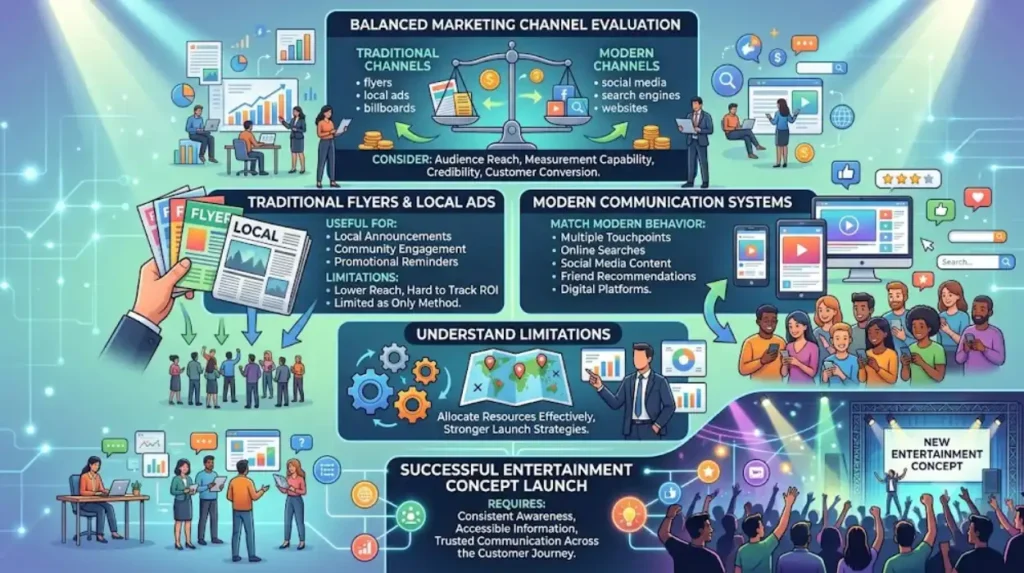
Businesses evaluate marketing channels before launch because each channel influences audience reach, measurement capability, credibility, and customer conversion differently. A balanced approach ensures entertainment concepts communicate effectively with the audiences most likely to engage.
Traditional flyers and local advertisements remain useful for specific purposes, including local announcements, community engagement, and promotional reminders. However, they provide limited support when used as the only awareness method.
New entertainment concepts require communication systems that match modern customer behaviour. Audiences discover experiences through multiple touchpoints, including online searches, media content, recommendations, and digital platforms.
Explore More Expert Insights:
How Modern Travel Industry Influencers and Critics Discover Breakthrough Local Spots
What Happens to a Hospitality Brand’s Reputation During a Public Relations or Service Crisis?
Understanding channel limitations allows businesses to allocate resources effectively and create stronger launch strategies.
A successful entertainment concept depends on more than physical visibility. It requires consistent awareness, accessible information, and trusted communication across the customer journey.