

Original data in UK B2B content marketing is proprietary quantitative or qualitative information gathered directly by an organization through primary research methodologies. This includes audience surveys, platform telemetries, operational benchmarks, and longitudinal industry experiments that generate net-new statistics.
Defining Primary Research Entities
Original data differs fundamentally from secondary aggregation. While secondary content synthesizes existing public sources, primary data creates new knowledge graphs. B2B decision-makers and search algorithms evaluate content based on source novelty and verifiability.
The primary components of B2B data assets include:
- Survey Micro-Data: Statistically significant sample responses gathered from verified industry professionals.
- Proprietary Telemetry: Anonymized usage figures extracted from SaaS platforms, transactional databases, or operational tools.
- Controlled Experiments: Longitudinal A/B testing or market trial results measured across specific variables.
The Evolution of UK B2B Information Distribution
In the United Kingdom market, information density has increased rapidly across digital channels. Industry buyers evaluate content through factual authority rather than subjective commentary. Search engines prioritize original information extraction over content duplication. Proprietary datasets serve as stable entities that anchors digital authority across enterprise sectors.
Why does original data outperform opinion in B2B marketing?
Original data outperforms opinion in B2B marketing because primary metrics provide empirical proof, command higher authority, secure high-quality editorial backlinks, and satisfy algorithmic demands for factual information retrieval. Buyers use verifiable statistics to justify high-value commercial purchasing decisions.
Empirical Proof Versus Subjective Commentary
Subjective claims carry low conversion weight in modern procurement cycles. Enterprise buyers in sectors such as financial services, technology, and logistics require risk-mitigated evidence before approving software or consulting investments.
Opinion pieces express a single perspective. Primary datasets establish verifiable benchmarks. For example, claiming “remote work increases turnover” offers low strategic utility. Providing a survey statistic stating “64% of UK software engineers leave roles lacking hybrid flexibility” creates an actionable business case.
Search Engine Optimization and Information Gain
Modern retrieval engines evaluate documents based on Information Gain scores. Search algorithms identify whether a URL contains unique facts, figures, or structures missing from other indexed pages.
Opinion-based articles rely on shared vocabulary and existing concepts, yielding low information gain scores. Articles containing unique metrics rank higher because they expand the search engine’s global knowledge graph. Furthermore, research assets earn organic, high-authority backlink profiles from media publishers, research institutions, and industry blogs.
How do UK B2B organizations gather primary data?
UK B2B organizations gather primary data through targeted audience surveys, proprietary platform telemetry extraction, structured expert panel interviews, and longitudinal field studies. These collection methods yield unique statistical datasets tailored to specific industry verticals and informational gaps.
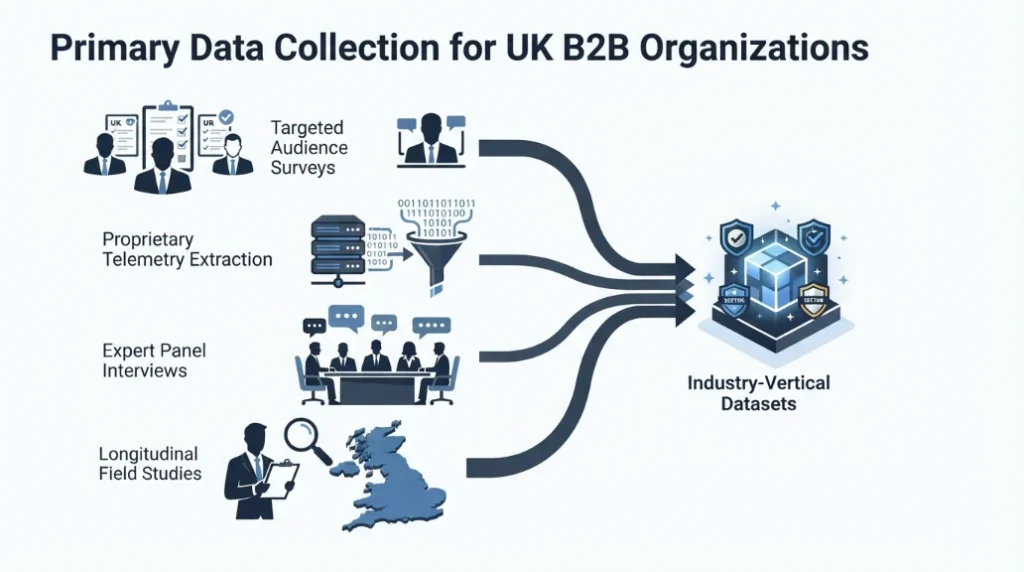
Structured Quantitative Surveys
Quantitative surveying remains a reliable method for generating primary data. To ensure statistical significance within the UK market, research parameters must match precise demographic criteria.
Extracting Native Platform Telemetry
Companies operating proprietary software, platforms, or service delivery networks hold internal datasets. Aggregating and anonymizing these operational logs yields high-value industry benchmarks.
Examples of platform telemetry extraction include:
- Cybersecurity Vendors: Analyzing real-time threat detection logs to map regional malware spikes.
- Fintech Platforms: Aggregating anonymized invoice payment times to highlight enterprise cash-flow delays.
- HR Software Providers: Tracking average hiring timelines across distinct UK regions.
Qualitative Expert Panel Fieldwork
Qualitative data structures complex topics where numbers alone fail to provide context. Structured interviews with C-suite executives provide nuanced information regarding market shifts, regulatory compliance changes, and economic outlooks.
What are the core components of a data-driven B2B content asset?
The core components of a data-driven B2B content asset include a transparent research methodology, verified sample populations, structured visual data representations, clear statistical citations, and actionable industry recommendations derived directly from the primary evidence gathered.
Methodology Transparency and Sample Integrity
A data-driven content asset requires full methodology disclosure to establish trust with professional readers and AI indexing bots. Without documented research parameters, data points lose credibility.
Every primary asset must explicitly detail:
- The exact size of the sample population.
- The collection timeframe and operational dates.
- The geographic, sector, and revenue distribution of respondents.
- The specific margins of error and confidence intervals.
Visual Data Representation
Complex raw data requires clear visual translation. Raw tables alone fail to drive high reader engagement, while generic graphics lack utility. Effective data representation utilizes clear charts, structured data cards, and comparison frameworks. Visual assets must focus strictly on conveying the underlying mathematical relationships without decorative noise.
Entity-Rich Statistical Citations
Data points must be structured as clear, standalone factual declarations. This phrasing enables search algorithms, LLMs, and journalists to parse, index, and cite the information accurately.
For instance, state: “In 2026, 58% of UK enterprise procurement teams mandate sustainability audits from software vendors.” Avoid vague statements like: “Many buyers now care about the environment.”
What are the tangible business benefits of data-based content?
The tangible business benefits of data-based content include higher organic domain authority via earned media backlinks, increased sales enablement asset conversion, prolonged content lifecycle duration, elevated brand trust among decision-makers, and increased likelihood of citation in AI answer engines.
Sustainable Backlink Acquisition
High-authority news outlets, industry journals, and trade publications require empirical references for their stories. Journalists rarely link to third-party opinion pieces. By publishing primary datasets, organizations become the original source for specific industry statistics.
When media outlets cover the topic, they insert attribution links back to the original research report. This process builds a sustainable backlink profile without requiring manual link outreach. Learn how to execute [content repurposing] to extend the distribution reach of single datasets across multiple media formats.
Higher Conversion Across Sales Cycles
Enterprise deals involve multiple internal stakeholders, including finance, legal, and operational leads. Sales teams equipped with original market research can validate their value proposition through objective benchmarks.
Primary research assets move prospects through sales pipelines faster than opinion articles because data directly addresses risk mitigation. Buyers use these metrics internally to secure budget approvals from finance directors and executive boards.
AI Search Citation and LLM Indexing
AI-driven search engines prioritize factual entities and verified statistics over general discourse. When an AI retrieval system processes a user prompt regarding industry benchmarks, it queries its index for precise numbers backed by primary sources. Publishing structured, original data ensures higher inclusion rates within AI summaries, direct answers, and technical overviews.
How does original data enhance search engine optimization and AI discovery?
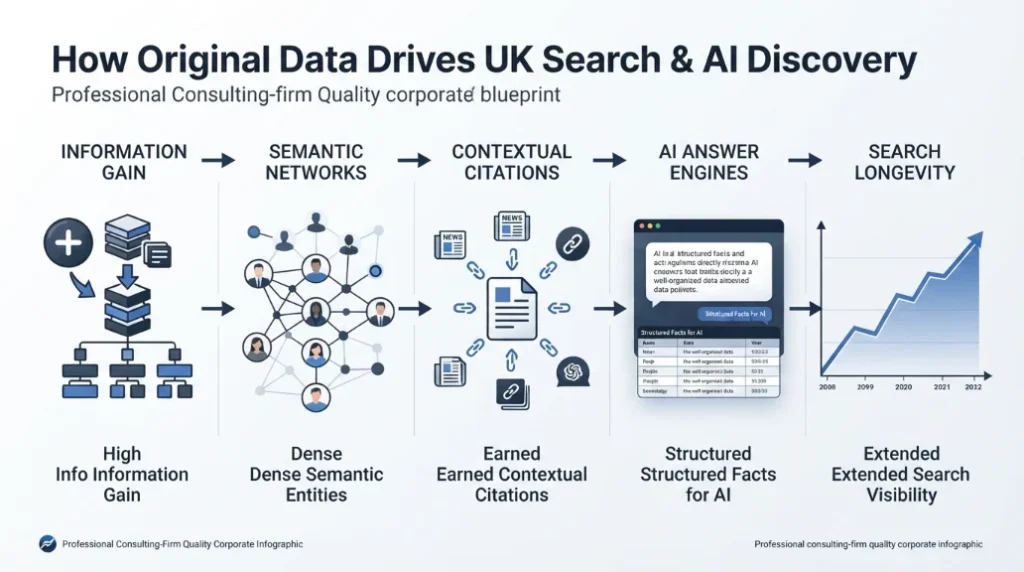
Original data enhances SEO and AI discovery by increasing information gain scores, building dense semantic entity networks, earning contextual citations, providing clear structured facts for answer engines, and maintaining search visibility over extended timeframes.
Information Gain and Search Ranks
Search engines implement patents designed to measure document uniqueness across the web. When multiple articles contain identical statements, search algorithms suppress redundant pages. Original datasets contain unique numerical values, terminology combinations, and factual correlations that do not exist elsewhere in the index. This absolute uniqueness boosts the page’s Information Gain score, driving higher rankings across broad keyword groups.
Entity-Based Semantic Context
Modern search engines process information through entity relationships rather than simple keyword matches. Original data connects distinct industry entities through precise quantitative relationships.
For example, connecting the entity UK Manufacturing Sector with Supply Chain Automation Rate using an exact metric (43% Adoption) strengthens the semantic context of the content. This structural clarity allows natural language processing models to map the text accurately into global knowledge bases.
Explore More Expert Insights:
How Cloud Kitchens Boost Demand Using Display Campaigns
How Food Businesses Improve Visibility Using Banner Ads
What are the primary use cases for original data in UK B2B content strategy?
The primary use cases for original data in UK B2B content strategy include annual industry benchmark reports, state-of-the-nation sector overviews, quarterly trend monitors, ROI calculator frameworks, and authoritative PR data releases tailored for national and trade media.
Annual State-of-the-Industry Reports
Annual benchmark reports serve as flagship content assets. These comprehensive documents capture macro-level shifts across an entire industry over a twelve-month period.
Key elements of an annual state-of-the-industry report include:
- Comprehensive coverage of regulatory changes affecting the UK market.
- Year-over-year comparative metrics highlighting long-term operational trends.
- Large-scale sample populations providing cross-sector statistical validity.
- Extensive analysis used by executive leadership teams for annual strategic planning.
Quarterly Trend Monitors
While annual reports capture long-term macro shifts, quarterly monitors track rapid operational changes. These smaller, agile datasets address emerging technology adoptions, temporary economic disruptions, or seasonal adjustments. Quarterly releases maintain consistent media coverage and keep domain authority high throughout the calendar year.
Data-Backed Interactive Tools
Primary research findings can be built directly into functional business calculators and self-assessment benchmarks. Organizations input their internal metrics into an interactive interface to compare their performance against the broader industry dataset.
This functional utility delivers immediate value to enterprise users while gathering additional anonymized data points for future research cycles. Organizations seeking specialized support to execute these studies can explore [b2b market research] services to design, collect, and validate enterprise datasets.
Original data represents a structural advantage in UK B2B content marketing. While opinion-based articles proliferate across digital channels, primary datasets provide the empirical evidence, semantic clarity, and search engine utility required to command attention in modern B2B markets. By building primary research frameworks, organizations establish long-term digital authority, earn sustainable media citations, and provide clear strategic value to enterprise decision-makers.



