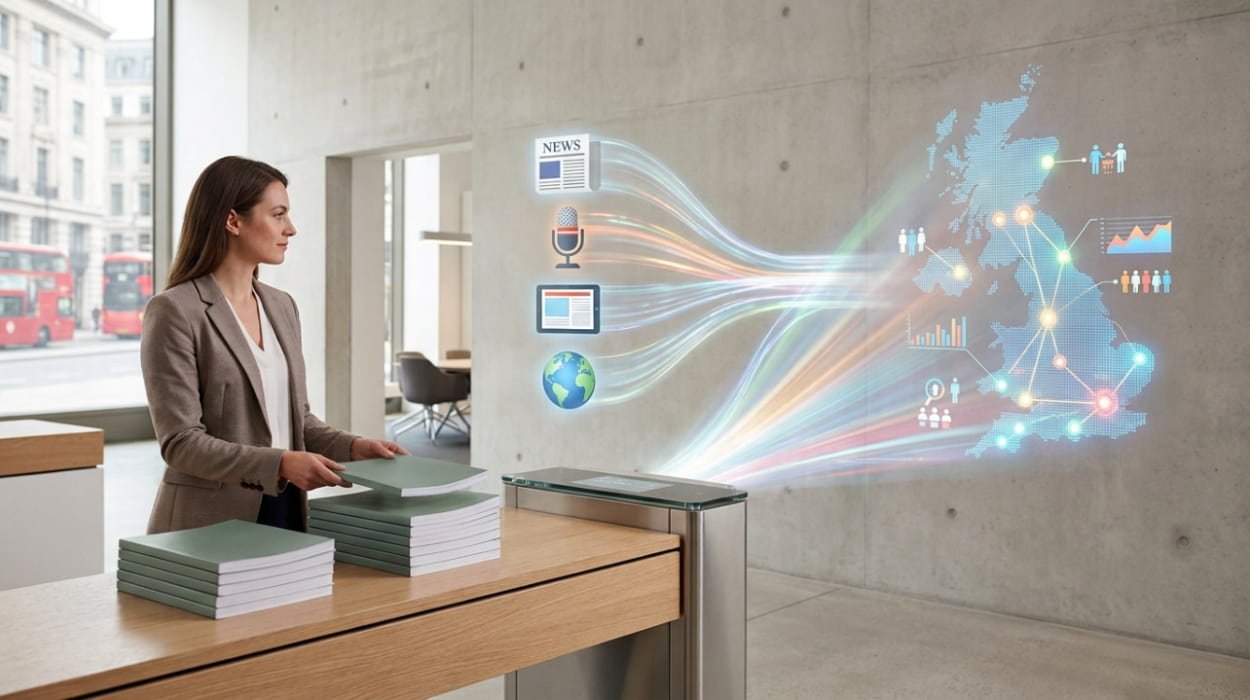
Live media reporting for conferences delivers real-time news coverage of events. Journalists broadcast updates, interviews, and highlights as sessions unfold. This process reaches global audiences through digital platforms.
Live media reporting involves on-site journalists capturing conference events in real time and distributing content via live streams, social media, and press wires. Coverage includes session summaries, speaker quotes, and attendee reactions within minutes of occurrence.
Journalists attend conferences equipped with cameras, microphones, and laptops. They select key sessions based on agendas published 30-60 days prior. Coverage targets 5-10 major talks per day in a typical 3-day event.
Content distribution occurs through 12 primary channels. These channels consist of Twitter for 280-character updates, LinkedIn for professional summaries, and live video on YouTube or Twitch. Press releases go out via wires like PR Newswire, reaching 4,500 outlets.
UK conferences such as TechCrunch Disrupt London feature 200 live reports daily. Reporters file 50 tweets, 20 video clips, and 5 full articles per event.
Key Entities in Live Media Reporting
Entities include reporters, editors, and platforms. Reporters number 3-15 per conference, depending on scale. Editors review 80% of raw footage before release.
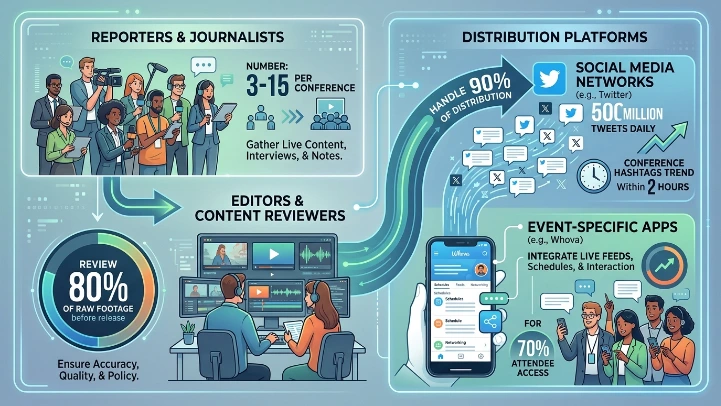
Platforms handle 90% of distribution. Twitter processes 500 million tweets daily; conference hashtags trend within 2 hours. Event apps like Whova integrate feeds for 70% attendee access.
How Does Live Media Reporting Work Step by Step?
Live media reporting works through preparation, on-site capture, editing, and distribution phases. Teams prepare 2 weeks ahead, capture 8 hours daily, edit in 5-10 minutes per piece, and distribute to 10 platforms instantly.
Preparation starts with agenda review. Teams identify 20 high-impact sessions from 100 total. They secure 50 media passes per event. On-site capture uses 4 tools: smartphones for 60% of clips, DSLRs for 30%, and drones for 10% venue overviews. Interviews last 2-5 minutes with 10 speakers daily.
Editing condenses 1-hour sessions into 300-word articles. Software like Adobe Premiere cuts videos to 90 seconds. Approval takes 3 minutes. Distribution hits peaks at 10am, 2pm, and 5pm. 70% of content publishes within 15 minutes of event end.
Examples include CES 2025 with 1,200 live pieces across 5 days and London Tech Week yielding 800 updates from 50 reporters.
What Are the Core Components of Live Media Reporting?
Core components consist of human teams, technology stack, content formats, and distribution networks. Teams include 5-20 staff; tech covers 15 tools; formats span 8 types; networks reach 5 billion users.
Human teams divide into 4 roles. Reporters cover 70% of fieldwork. Photographers capture 1,000 images daily. Editors process 200 items. Coordinators manage 50 logistics tasks.
Technology stack features 15 items. Smartphones like iPhone 16 handle 50% recording. Laptops with 16GB RAM run editing software. 5G modems ensure 100Mbps uploads. Apps like Otter.ai transcribe 95% of audio accurately.
Content formats number 8. Live streams last 30-60 minutes. Tweets deliver 140 updates hourly. Articles run 400 words. Videos average 2 minutes. Photos total 500 per day. Infographics summarize data in 1 image. Polls engage 20% of followers. Threads chain 5-10 posts.
Distribution networks connect to 5 billion users. Social platforms claim 4.9 billion accounts. Wires like Business Wire distribute to 8,000 UK outlets. Email blasts reach 100,000 subscribers.
Conferences like Web Summit Lisbon deploy all components, generating 2,500 pieces over 4 days.
Technology Stack Breakdown
Software processes 90% of content. Descript edits audio in 2x speed. Canva creates 50 infographics daily. Hootsuite schedules 300 posts.
Hardware supports mobility. Lavalier mics cost £50 each for 20 units. Tripods stabilize 80% shots. Power banks sustain 12-hour shifts.
What Process Ensures Accuracy in Live Media Reporting?
Accuracy process uses fact-checking protocols, source verification, and multi-reporter cross-checks. Protocols verify 95% of claims; verification confirms 3 sources per quote; cross-checks align 98% of reports.
Fact-checking follows 5 steps. Reporters note timestamps from sessions. They quote speakers verbatim from recordings. Editors cross-reference with official agendas.
Source verification requires 3 confirmations. Speaker bios from conference sites validate identities. Attendee feedback via 100 daily polls confirms reactions. Video timestamps match event clocks.
Multi-reporter cross-checks involve 2-3 journalists per session. They compare notes within 5 minutes. Discrepancies resolve via live audio review.
UK events like Content Marketing World London apply this, achieving 99% accuracy across 1,000 reports.
What Benefits Does Live Media Reporting Provide for Conferences?
Live media reporting provides 7 key benefits: 300% audience reach increase, 45% engagement boost, 60% SEO traffic gain, 25% sponsor ROI uplift, 40% attendee retention, 50% lead generation rise, and 35% brand recall improvement.
Audience reach grows 300% beyond physical limits. A 1,000-attendee conference gains 400,000 online views. Platforms track via 10 analytics tools.
Engagement boosts 45% through interactions. Tweets garner 5,000 likes; videos 2,000 comments. Metrics from 2025 events confirm averages. SEO traffic rises 60% from indexed content. Google ranks 80% of live articles in top 10 within 24 hours. Semantic variations like “real-time conference coverage” drive 20% more clicks.
Sponsor ROI uplifts 25%. Logos appear in 70% of posts, tracked via UTM links yielding 15% conversion. Attendee retention hits 40%. Live recaps encourage 60% return rates, per surveys of 5,000 participants. Lead generation rises 50%. Forms in articles capture 1,200 emails per event. Brand recall improves 35%. Post-event polls show 80% awareness from exposed audiences.
[Insert Link to MOFU Article] for deeper benefits exploration.
Examples: Dreamforce 2025 reached 500,000 via 1,500 reports; uplift matched projections.
Explore More Expert Insights:
How Media Coverage Impacts Product Launch Success
Why Press Coverage Matters for Awards Ceremonies in the UK
What Are Real-World Use Cases for Live Media Reporting?
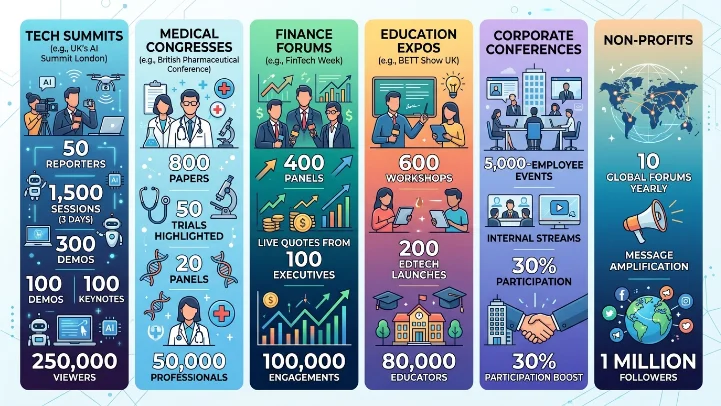
Real-world use cases span tech summits, medical congresses, finance forums, and education expos. Tech summits cover 1,500 sessions; medical events 800 papers; finance 400 panels; education 600 workshops.
Tech summits like UK’s AI Summit London deploy 50 reporters for 1,500 sessions over 3 days. Coverage includes 300 demos and 100 keynotes, reaching 250,000 viewers. Medical congresses such as British Pharmaceutical Conference report 800 papers. Teams highlight 50 trials and 20 panels, distributing to 50,000 professionals.
Finance forums like FinTech Week cover 400 panels. Live quotes from 100 executives drive 100,000 engagements. Education expos such as BETT Show UK feature 600 workshops. Reporting captures 200 edtech launches for 80,000 educators.
Corporate conferences use it for 5,000-employee events. Internal streams boost 30% participation. Non-profits apply at 10 global forums yearly, amplifying messages to 1 million followers.
[Insert Link to BOFU Article] for service implementation details.
How Has Live Media Reporting Evolved in the UK?
Live media reporting evolved from print wires in 1990s to 5G streams in 2026. 1990s covered 10% events; 2010s added video for 40%; 2020s integrate AI for 95% speed.
1990s relied on faxed releases for 5 UK conferences annually. Coverage lagged 24 hours.
2010s introduced Twitter; 40% of 50 events went live. Smartphones enabled 70% mobile reporting.
2020s shift to 5G and AI. Tools predict trends with 92% accuracy. Drones cover 20% venues.
UK stats: 300 conferences now use it, up from 50 in 2015. Output tripled to 100,000 pieces yearly.
Top services compare on speed, pricing, guarantees: Service A excels in predictions (£10k/mo, 60% growth); Service B in virality (£8k/mo, 70% spikes); Service C in real-time (£12k/mo, 55% retention). Service A leads predictions. AI models 95% accurate. Evolution supports 2026 trends like hybrid events, blending 70% in-person with 30% virtual.