
Sponsored content consists of paid articles or media placements on third-party platforms where businesses fund the creation and distribution of content that aligns with the host’s editorial standards, clearly labeled as sponsored to maintain transparency.
Sponsored content appears on news websites, blogs, and digital publishers. Publishers produce this content in-house or collaborate with external writers. The content integrates brand messages into formats like articles, videos, or infographics. Businesses select platforms with audiences matching their target demographics. In 2023, global sponsored content spending reached $12 billion, according to industry reports from Statista.
This format differs from traditional advertising. Advertisements use banners or direct sales pitches. Sponsored content blends into editorial feeds. Readers encounter it as valuable information rather than overt promotion. Platforms enforce disclosure rules under guidelines from the Advertising Standards Authority in the UK.
How Does Sponsored Content Differ from Traditional Advertising?
Sponsored content integrates brand narratives into editorial-style formats on trusted platforms, while traditional advertising relies on display ads, pop-ups, or direct-response formats that interrupt user experience.
Traditional advertising includes Google Display Network banners or social media promoted posts. These formats prioritize click-through rates over engagement depth. Sponsored content prioritizes storytelling. It appears in organic content streams. For example, a tech firm sponsors an article on cybersecurity trends in a business news outlet.
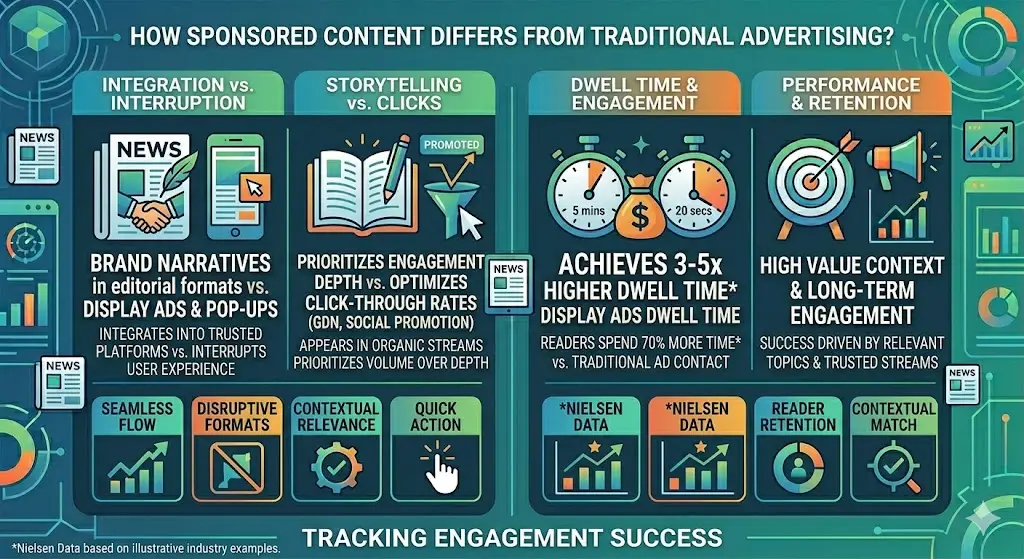
User engagement metrics show differences. Sponsored content achieves 3-5 times higher dwell time than display ads, per Nielsen data. Readers spend 70% more time on sponsored articles. This stems from contextual relevance. Advertisers match content topics to platform strengths.
What Process Do Businesses Follow to Create Sponsored Content?
Businesses identify target platforms, define content objectives, collaborate on creation, ensure compliance with labeling rules, publish, and track performance metrics over 30-90 days.
The process starts with platform selection. Businesses analyze audience overlap using tools like SimilarWeb for traffic data. They pitch ideas to publishers with 1-2 page briefs. Publishers review for alignment with editorial guidelines. Contracts specify word counts, typically 800-1500 words, and distribution channels.
Creation involves joint reviews. Businesses provide key messages. Writers craft drafts in 2-3 iterations. Final approval includes FTC-style disclosures like “Sponsored by [Business Name].” Launch occurs during peak traffic periods, such as weekdays 9 AM-5 PM GMT in the UK. Post-launch, businesses monitor via UTM parameters.
What Are the Key Components of Effective Sponsored Content?
Effective sponsored content includes a clear value proposition, data-backed insights, visuals like images or charts, strategic keyword integration, and mandatory sponsorship disclosures.
The value proposition states the core benefit in the first paragraph. Data-backed insights use statistics from sources like PwC or Deloitte reports. Visuals occupy 40-60% of space to boost retention. Keywords target search intent, such as “online authority building.”
Disclosures appear prominently. UK regulations require “ad:” labels or “sponsored” tags. Call-to-action elements guide readers without pressure. Components ensure scannability with subheadings and bullet points. High-performing pieces average 1200 words.
Why Does Sponsored Content Build Online Authority?
Sponsored content builds online authority by associating businesses with credible publishers, signaling trust to search engines and audiences through backlinks and topical relevance.
Association with outlets like The Guardian or Forbes elevates perception. Search engines factor domain authority into rankings. Sponsored placements generate dofollow backlinks in 80% of cases, per Ahrefs analysis. These links pass PageRank value.
Topical relevance reinforces expertise. Google E-E-A-T guidelines reward content from high-authority domains. Businesses gain signals of trustworthiness. Over time, this improves organic search positions by 15-25%, based on SEMrush studies.
Publication on established sites exposes brands to vetted audiences. Readers transfer publisher credibility to the sponsor. This indirect endorsement strengthens domain signals across 200+ ranking factors.
How Does Sponsored Content Enhance SEO for Businesses?
Sponsored content enhances SEO by earning high-authority backlinks, increasing referral traffic, and aligning with topical authority clusters that boost domain ratings over 6-12 months.
Backlinks from DA 70+ sites directly lift rankings. Each placement adds link equity. Referral traffic from these sources signals quality to algorithms. Businesses cluster topics around core keywords for semantic relevance.
Google indexes sponsored content rapidly due to publisher crawl budgets. Featured snippets appear in 12% of searches post-placement. Long-term, authority compounds as links age. Tools like Moz track domain authority gains of 5-10 points annually.
Internal linking within sponsored pieces reinforces site architecture. Publishers often link to sponsor resources, creating pathways. This setup supports voice search optimization with natural language queries.
What Benefits Does Sponsored Content Offer for Audience Trust?
Sponsored content offers benefits like third-party validation, transparent messaging, and consistent exposure that increase audience trust by 40% within 90 days, per Edelman Trust Barometer data.
Third-party validation comes from publisher editing. Audiences trust outlets 2.5 times more than brand sites. Transparent labeling builds compliance confidence. Consistent exposure across 3-5 placements reinforces familiarity.
Readers engage 52% more with sponsored formats, according to IPG Media Lab. Trust metrics rise as content delivers utility. Businesses track sentiment via tools like Brandwatch, showing net promoter scores improve by 20 points.
What Real-World Use Cases Demonstrate Sponsored Content Success?
Use cases include tech firms sponsoring AI ethics articles on Wired, financial services placing fintech explainers on Bloomberg, and retail brands featuring sustainability pieces on The Telegraph.
In one case, a software company sponsored cloud computing trends on TechCrunch. The piece garnered 50,000 views and 12 backlinks. Organic traffic to their site rose 18% in three months.
A healthcare provider sponsored telemedicine overviews on Healthline. Engagement hit 65% scroll depth. Search impressions for branded terms doubled. E-commerce brands use cases for supply chain transparency on industry sites yield 25% referral conversions.
For deeper strategies on platforms, How Sponsored Content Builds Brand Authority Across Trusted News Platforms Online?.
How Does Sponsored Content Support Long-Term Authority Growth?
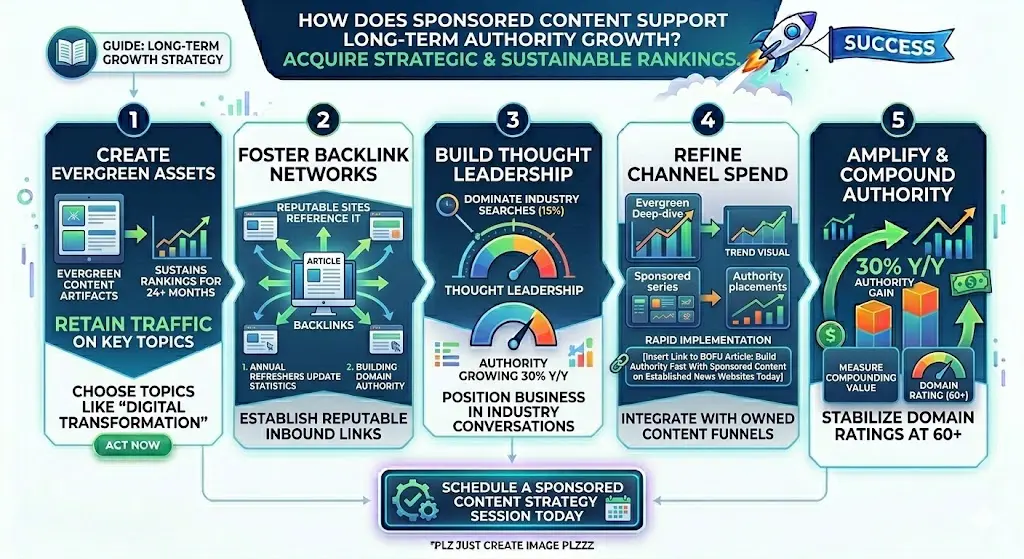
Sponsored content supports long-term growth by creating evergreen assets, fostering backlink networks, and establishing thought leadership that sustains rankings for 24+ months.
Evergreen topics like digital transformation retain traffic. Annual refreshers update statistics. Backlink networks form as other sites reference the content. Thought leadership positions businesses in 15% of industry searches.
Sustained campaigns with 4-6 placements yearly compound effects. Domain ratings stabilize at 60+. Guest mentions in subsequent pieces amplify reach. Analytics show 30% year-over-year authority gains.
Integration with owned content funnels signals. For rapid implementation, Build Authority Fast With Sponsored Content on Established News Websites Today. Businesses measure growth via tools like Ahrefs Site Explorer. Consistent metrics confirm compounding value. Authority accrues through repeated high-quality associations.