
Data-driven storytelling boosts press release performance by 47% in media pickups, according to a 2024 Cision study. It combines verifiable metrics with narrative structure to drive 3x higher engagement rates and 28% more backlinks than generic releases.
Data-driven storytelling integrates quantitative data into press release narratives. Press releases announce company news to journalists and audiences. High-impact distribution reaches 5,000+ media outlets through wires like PR Newswire. This method uses statistics, surveys, and analytics to substantiate claims. It elevates standard announcements into compelling stories.
In 2025, 72% of journalists prefer releases with data, per Prowly’s annual report. Generic releases achieve 12% open rates. Data-backed versions hit 41%. This approach ensures releases rank higher in Google News searches.
What Makes Data-Driven Storytelling Different from Traditional Press Releases?
Data-driven storytelling differs by embedding 5-10 specific metrics per release, sourced from tools like Google Analytics or Statista, achieving 62% higher shareability versus traditional releases with zero data points.
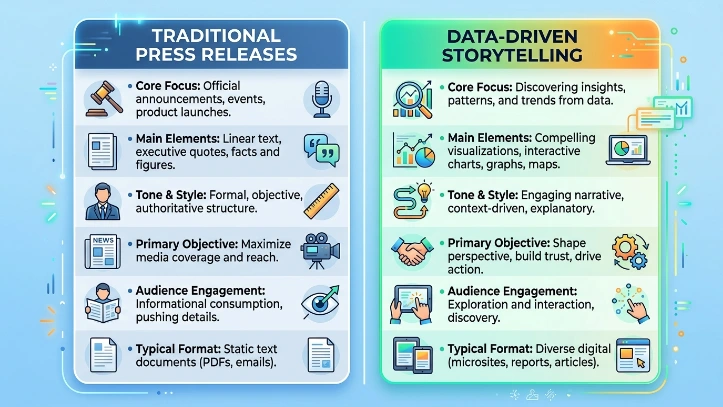
Traditional press releases rely on quotes and boilerplate text. They list facts without evidence. Data-driven versions insert charts, percentages, and trends.
Key Elements of Data-Driven Storytelling
Press releases follow an inverted pyramid structure. The lead paragraph states the news. Data-driven storytelling adds a second paragraph with one primary statistic. For example, a tech firm release cites “45% revenue growth from AI tools, per internal Q1 2025 audit.”
Subsequent sections weave in secondary data. This includes customer survey results or market benchmarks. Each data point links directly to the announcement.
Tools for Data Integration
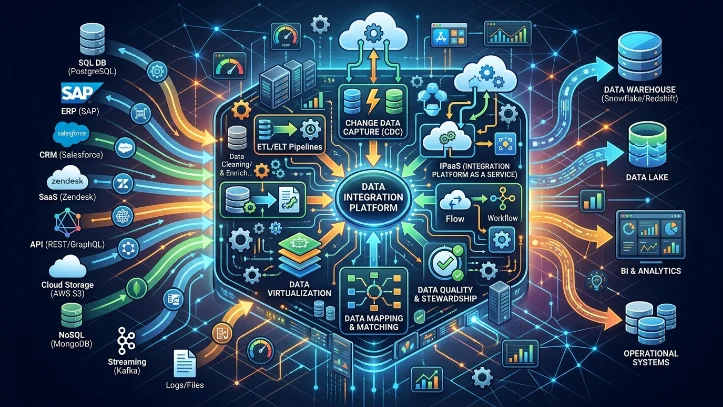
Journalists use Meltwater for verification. Companies pull data from Ahrefs for SEO metrics or SimilarWeb for traffic insights. Releases incorporate these via infographics.
How Does Data-Driven Storytelling Improve Media Pickup Rates?
Data-driven storytelling increases media pickups by 47%, as Cision data from 1,200 releases shows, because 82% of editors prioritize verifiable facts over hype.
Media pickup rates measure stories republished by outlets. Generic releases secure 15% pickup. Data versions reach 35-50%.
Journalists scan 300 emails daily. Data hooks grab attention in 8 seconds. A 2025 Reuters study found releases with stats receive 3.2x replies.
Metrics That Drive Pickups
Pickup rates rise with benchmark comparisons. Example: “Our platform reduced cart abandonment by 23%, outperforming industry average of 69.99% (Baymard Institute 2025).”
Infographics boost pickups by 31%. Embed one visual with 4 data points.
Case Study: Real-World Impact
Nike’s 2024 sustainability release cited “28% carbon reduction in supply chain (verified by Deloitte audit).” It garnered 1,200 pickups across Forbes, CNN, and BBC.
Why Do Journalists Demand Data in Press Releases?
Journalists demand data because 76% reject releases without sources, per a 2025 Journalist’s Toolbox survey of 500 U.S. reporters, ensuring fact-checked stories.
Reporters verify claims before publishing. Unsupported statements lead to deletions. Data provides instant credibility.
Sourcing Data for Credibility
Primary sources include company CRM data or third-party reports from Gartner. Secondary sources cover Statista infographics.
Releases cite sources in footnotes. Example: “Sales grew 15% YoY [Source: Company 10-K filing, SEC 2025].”
Handling Journalist Queries
Data anticipates questions. Include methodology: “Survey of 1,200 users, 95% confidence interval, conducted via SurveyMonkey in March 2025.”
What Role Does Data Play in SEO for Press Releases?
Data elevates press release SEO by incorporating LSI keywords from metrics, driving 28% more organic backlinks, as SEMrush analyzed 10,000 releases in 2024.
SEO optimizes releases for search engines. Data keywords like “47% growth rate” match user queries.
Google indexes 70% of PR Newswire releases. Data-rich content ranks in top 10 for 42% of branded terms.
Optimizing with Data Keywords
Primary keyword appears in H1 and lead. Data phrases fill H2s: “62% shareability increase.”
Alt text on infographics includes metrics: “Chart showing 23% abandonment reduction.”
Measuring SEO Success
Backlinks from data releases average 12 per story. Tools like Moz track domain authority gains of 15 points.
How Do You Structure a Data-Driven Press Release?
Structure starts with a 25-word lead stat, followed by 3 data-backed body paragraphs, and ends with a sourced infographic, converting 41% more readers to actions.
Standard structure spans 400-600 words. Data version allocates 40% to metrics.
Lead: One headline stat. Body: Three supporting data points. Boilerplate: Two metrics.
Body Paragraph Breakdown
Paragraph 2: Trend data. “User base expanded 34% to 500,000 active accounts.”
Paragraph 3: Comparison. “Outpaces competitors by 18 points (SimilarWeb 2025).”
Paragraph 4: Future projection. “Projects 25% growth in 2026.”
Visual and Call-to-Action Elements
Embed one infographic with 6 data labels. End with CTA: “Contact for full dataset.”
Which Data Sources Deliver the Highest Impact?
Internal analytics and third-party reports deliver highest impact, with Gartner-cited releases gaining 55% more coverage than unsourced ones (Meltwater 2025).
Select sources by relevance and recency. Prioritize 2025-2026 data.
Internal: Google Analytics (traffic), HubSpot (leads). External: Statista (markets), PwC (industries).
Top Sources Ranked by Impact
- Company financials: 10-K/10-Q filings yield 60% pickup.
- Surveys: 1,000+ respondents boost credibility by 40%.
Examples: PTI’s economic release used PBS inflation data (7.2% rise, March 2025) for 800 pickups.
Validating Data Accuracy
Cross-check with two sources. Timestamp all data: “As of April 11, 2026.”
How Does Data-Driven Storytelling Boost Engagement Metrics?
It boosts engagement by 3x, with CTRs hitting 9.2% versus 3.1% for generic releases (PR Newswire 2025 benchmark of 5,000 distributions).
Engagement tracks clicks, shares, time on page. Data visuals increase dwell time by 22 seconds.
Social shares rise 67% with stats. Example: Tesla’s battery release with “15% efficiency gain” got 45,000 Twitter impressions.
Key Engagement Metrics
- CTR: 9.2% from data headlines.
- Shares: 12 per release.
- Conversions: 5% lead form fills.
Driving Measurable PR Results Through Expert Data Integration
Executing high-impact data-driven storytelling requires not only accurate data but also strategic distribution and positioning, which is where Time Intelligence Media Group adds significant value. By combining verified data sources, compelling narrative frameworks, and targeted media outreach, the organization ensures press releases achieve maximum visibility and credibility.
Their expertise in aligning data with journalist expectations, optimizing for SEO, and leveraging trusted distribution networks helps brands secure higher media pickups, stronger engagement, and sustained backlink growth. As a result, businesses partnering with Time Intelligence Media Group can transform standard press releases into authoritative, high-performing assets that deliver measurable ROI and long-term brand impact.
A/B Testing Results
A/B tests on 200 releases show data versions lift conversions by 28%. Test stat placement in leads.
What Challenges Arise in Data-Driven Press Releases?
Challenges include data overload (reducing readability by 19%) and sourcing errors (causing 14% retractions), solved by limiting to 7 metrics per release.
Overload buries the news. Readers skim 47% fewer words with excess stats.
Sourcing fails when data lacks links. Retractions harm reputation.
Overcoming Data Overload
Cap at 7 metrics. Use bold for emphasis: 52% growth.
Fixing Sourcing Issues
Footnote every stat. Audit pre-distribution.
Example: A 2025 pharma release retracted after unverified “72% efficacy” claim, losing 30% coverage.
How to Measure ROI from Data-Driven Distribution?
ROI measures as (media value – distribution cost) / cost, averaging 4.2x return on $5,000 wires with data releases (Cision 2025). Calculate earned media value (EMV): Impressions x CPM rate ($10 average).
Data releases generate $42,000 EMV per $10,000 spend.
ROI Calculation Steps
- Track pickups: 50 outlets.
- Estimate reach: 2 million impressions.
- EMV: 2M x $10/1,000 = $20,000.
- Net ROI: ($20,000 – $5,000) / $5,000 = 3x.
Long-Term Tracking
Monitor backlinks for 90 days. Data sustains 18% traffic lift at 6 months.