
Sponsored content in email marketing is paid promotional material that appears within email newsletters or campaigns, clearly labeled as sponsored, to promote a brand’s message to the recipient’s audience. It integrates seamlessly with editorial content and drives engagement through targeted placement.
Sponsored content takes various forms in email marketing. Newsletters often feature it as a dedicated section, banner, or embedded article. Email service providers track it via unique identifiers to ensure transparency. In 2023, over 40% of B2B marketers used sponsored content in emails, according to industry reports from email analytics firms.
This content differs from traditional ads by blending with the newsletter’s tone. Publishers disclose sponsorship through labels like “Sponsored” or “Partner Content.” Recipients receive value through informative pieces that align with their interests. Email platforms enforce disclosure rules under regulations like CAN-SPAM Act equivalents in the UK.
Key characteristics of sponsored content
Sponsored content requires clear labeling. Labels appear at the top, bottom, and within the content. This practice builds trust and complies with advertising standards. UK marketers follow ASA guidelines for transparency.
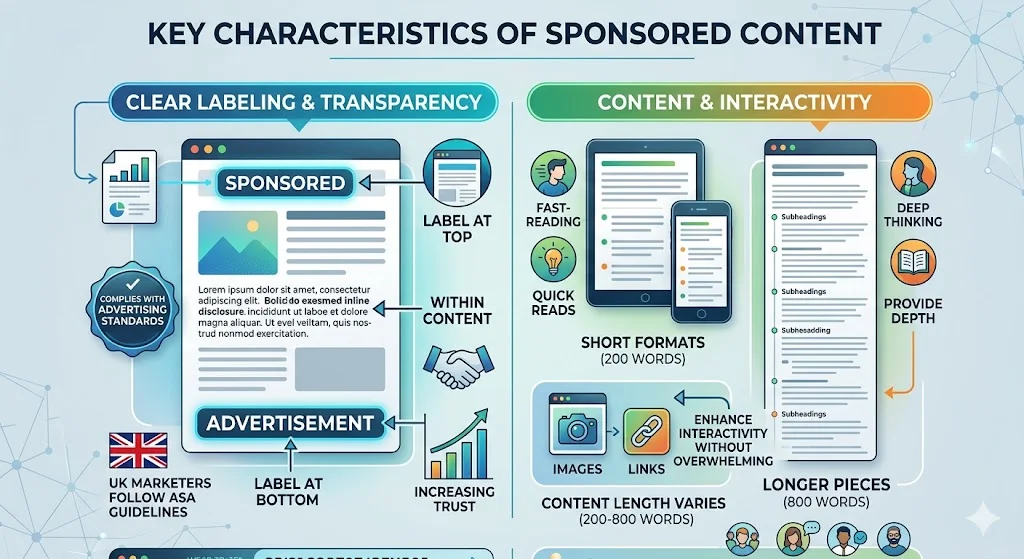
Content length varies from 200 to 800 words. Shorter formats suit quick reads, while longer pieces provide depth. Images and links enhance interactivity without overwhelming the layout.
How does sponsored content work in email marketing?
Sponsored content works through a process where advertisers pay publishers to include promotional material in their email newsletters. Publishers integrate the content, send it to subscribers, and track performance metrics like opens, clicks, and conversions to measure success.
The workflow starts with advertiser-publisher agreements. Advertisers submit content briefs outlining goals and assets. Publishers review for alignment with audience interests. Contracts specify placement, duration, and payment terms, often ranging from £500 to £5,000 per campaign based on list size.
Distribution occurs via email service providers like Mailchimp or Klaviyo. Publishers segment lists for relevance, ensuring high deliverability rates above 95%. Post-send analytics reveal engagement data within 24 hours.
Steps in the sponsored content process
Advertisers create content matching publisher guidelines. Publishers edit for brand voice consistency. Approval happens within 48 hours. Emails deploy on scheduled dates. Tracking pixels capture real-time data. Reports detail metrics for optimization in future sends.
What are the main components of sponsored content in emails?
Main components include a clear sponsor label, compelling headline, body text with value-driven information, visuals like images or infographics, and a call-to-action link directing to the advertiser’s landing page.
The sponsor label ensures transparency. It uses phrases like “Sponsored by [Advertiser]” in bold text. This element appears prominently to avoid misleading readers.
Headlines grab attention with 6-10 words. They promise specific benefits, such as “Boost Your Open Rates by 30%.” Body text delivers 300-500 words of educational content. Visuals occupy 40-60% of space for better scanability. Call-to-action buttons use action verbs like “Learn More” or “Get Started.” Links track clicks via UTR parameters.
Role of each component
Labels comply with UK advertising rules. Headlines increase click-through rates by 20-30%. Text provides context and builds interest. Visuals improve engagement by 42%, per email studies. CTAs convert browsers to visitors at 5-10% rates. For deeper insights into real-world applications, What Are Real Examples of Sponsored Content in Email Newsletters That Convert?.
What benefits does sponsored content provide in email marketing?
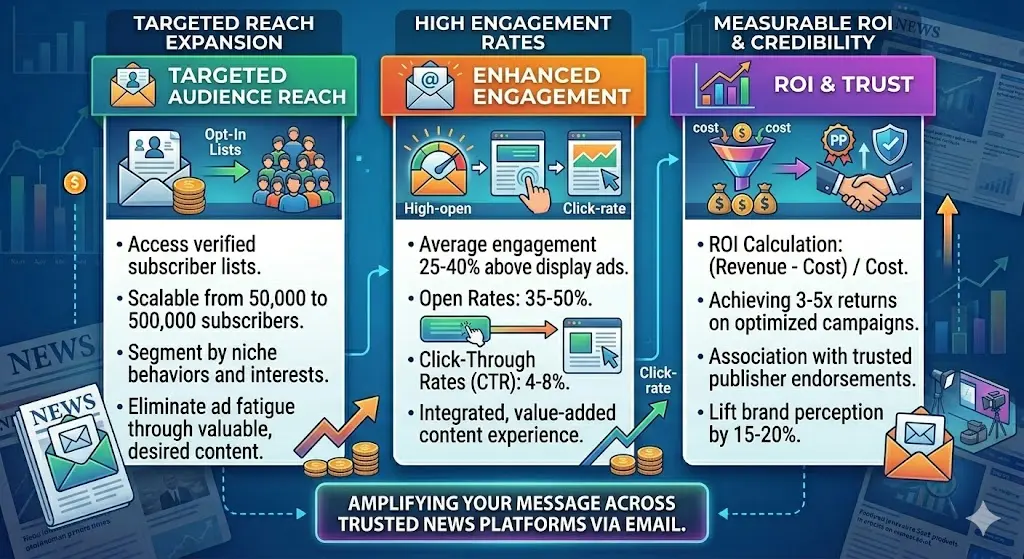
Sponsored content delivers benefits like expanded reach to targeted audiences, higher engagement rates averaging 25-40% above display ads, measurable ROI through direct attribution, and enhanced credibility via trusted publisher association.
Reach expands to subscribers who opt-in for relevant content. Lists with 50,000-500,000 subscribers offer scale without ad fatigue. Engagement metrics show open rates of 35-50% and click rates of 4-8%.
ROI calculation uses revenue from conversions divided by cost. Campaigns yield 3-5x returns when optimized. Credibility stems from publisher endorsement, lifting brand perception by 15-20%.
Quantifiable advantages
Targeted exposure matches demographics like UK professionals aged 25-54. Trackable links attribute sales directly. Cost efficiency beats paid search at £0.50-£2 per click. Long-term nurturing builds loyalty over single transactions.
What are common use cases for sponsored content in email marketing?
Common use cases include product launches, lead generation campaigns, thought leadership pieces, event promotions, and seasonal sales drives, all integrated into niche newsletters for maximum relevance.
Product launches announce features to early adopters. A tech firm sponsors a SaaS newsletter to highlight new tools, driving 1,000 sign-ups. Lead generation uses gated content like ebooks. Readers exchange emails for access, filling funnels with 500-2,000 qualified leads monthly.
Thought leadership positions experts via in-depth articles. Finance newsletters feature market analyses, attracting C-suite readers. Event promotions fill seats for webinars or conferences. Sponsors gain 20-30% attendance boosts. Seasonal sales tie into holidays like Black Friday. Retailers sponsor lifestyle emails for 15% conversion uplifts.
Specific applications by industry
B2B tech uses it for software demos. E-commerce applies for flash sales. Non-profits leverage for awareness campaigns. All cases prioritize audience fit for 2-3x better performance.
To explore practical implementations, Place Your Sponsored Content in High Engagement Email Newsletters Today.
How do you measure success of sponsored content in emails?
Success measures through metrics like open rates (target 30-45%), click-through rates (3-7%), conversion rates (2-5%), revenue per email (£0.10-£1.00), and engagement time (30-60 seconds average). Open rates indicate subject line effectiveness. Tools like Google Analytics track them via UTM tags. Click-through rates reveal content appeal.
Conversion rates track form fills or purchases. Revenue per email divides total sales by sends. Engagement time uses heatmaps from providers.
Optimization based on metrics
Low opens prompt A/B testing subjects. Poor clicks refine CTAs. High conversions scale budgets by 20-50%. Regular audits ensure sustained 4x ROI.
Why integrate sponsored content into email strategies?
Integration expands audience access, boosts deliverability with trusted sends, diversifies traffic sources beyond social media, and supports content repurposing across channels for consistent messaging.
Email lists grow 15-20% yearly for active publishers. Deliverability stays above 98% due to engaged subscribers. Traffic diversifies from 60% organic reliance. Repurposing turns email content into social posts or blogs.
Strategic integration steps
Audit current newsletters for fit. Negotiate multi-send deals. Align with annual calendars for peak timing. This sustains 25% traffic growth.
What role does audience targeting play in sponsored content?
Audience targeting selects newsletters with demographics matching buyer personas, such as UK-based decision-makers in specific industries, achieving 2-4x higher relevance and engagement.
Publishers segment by location, job title, and interests. UK-focused lists filter for postal codes or professions. Tools match ICPs using data from 1 million+ subscribers. Relevance drives 40% better conversions.
Targeting techniques
Behavioral data refines segments. Lookalike modeling expands reach. Geo-fencing ensures UK priority, lifting local sales by 30%.
How does compliance affect sponsored content in emails?
Compliance requires clear disclosures, opt-in consent, and adherence to UK GDPR and PECR regulations, preventing fines up to 4% of global turnover and maintaining list health.
Disclosures label content explicitly. Consent verifies subscriber permission. GDPR mandates data protection. PECR governs electronic mailings.