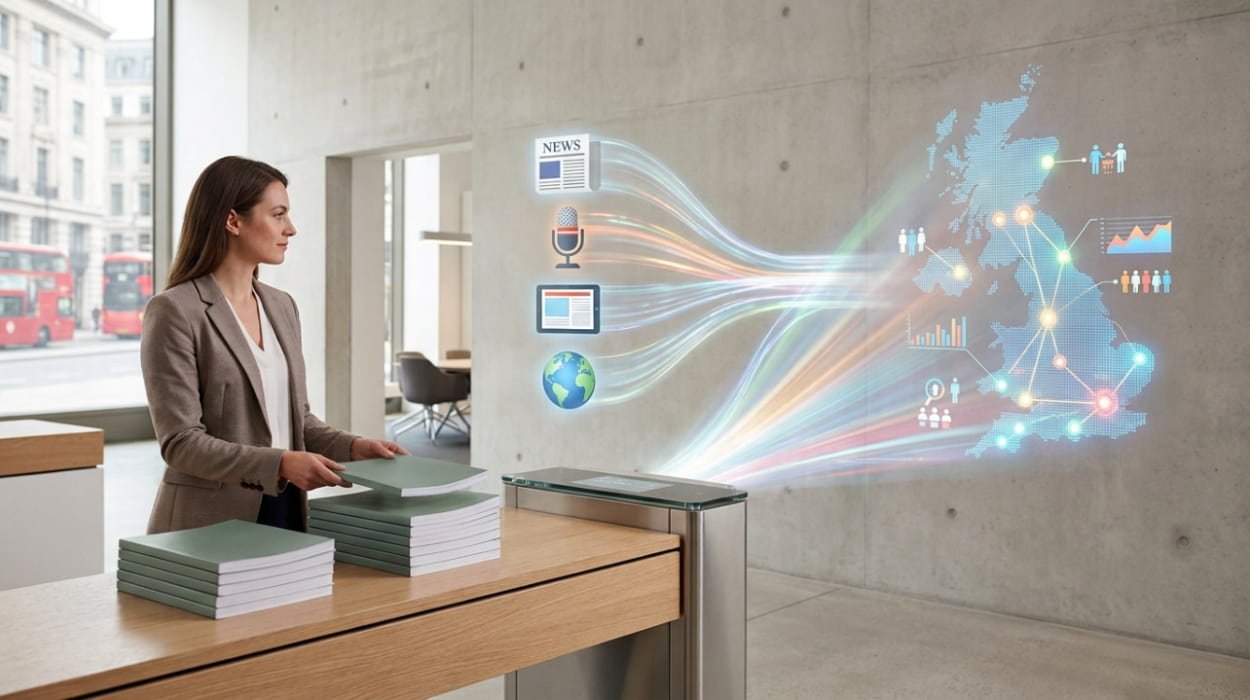
Banner advertising on news websites in the UK displays graphical ads in fixed positions across web pages. These ads appear as rectangular or leaderboard formats on sites like BBC News, The Guardian, and The Telegraph. Publishers integrate them into article pages, homepages, and sections. In 2025, UK news sites generated £1.2 billion from digital display ads, with banners comprising 65% of that revenue.
Banner advertising consists of static or animated digital images placed in designated slots on news websites. Sizes follow IAB standards, such as 728×90 pixels for leaderboards and 300×250 pixels for medium rectangles. UK news sites use these formats to monetize traffic without disrupting reading.
News websites define banner positions through ad servers like Google Ad Manager or OpenX. Publishers auction inventory via real-time bidding (RTB) platforms. Advertisers bid on impressions or clicks. Banners load in milliseconds to maintain page speed.
Banners differ from native ads, which blend into editorial content. Banners remain distinct with borders or backgrounds. UK regulations under the Digital Markets, Competition and Consumers Act 2024 require clear labeling as “Advertisement.”
Standard banner sizes on UK news sites
UK news sites adhere to IAB UK guidelines for consistency.
- Leaderboard: 728×90 pixels, placed at page tops.
- Medium Rectangle: 300×250 pixels, embedded mid-article.
- Skyscraper: 160×600 pixels, in sidebars.
- Mobile Banner: 320×50 pixels, for responsive designs.
These sizes ensure compatibility across devices. In 2025, 72% of UK news traffic came from mobiles, per Press Gazette data.
How does banner advertising work on news websites?
Banner advertising works through an auction system where advertisers bid for impressions on news pages. Ad servers deliver the highest-bidding creative to users matching targeting criteria. UK news sites process 10 billion monthly impressions across top publishers.
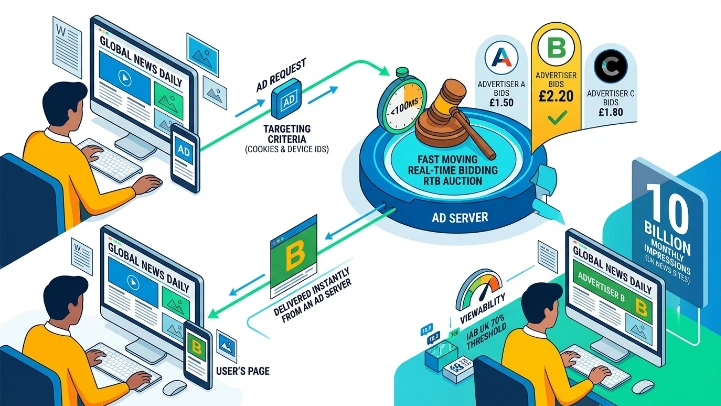
The process starts with a user visiting a news site. The page requests ads from the server. The server runs an auction in under 100 milliseconds. Winners display instantly.
Ad servers track metrics like viewability, using the UK industry’s 70% viewable threshold set by the Interactive Advertising Bureau (IAB). Cookies and device IDs enable targeting.
Steps in banner ad delivery
- User loads news page.
- Publisher’s ad tag triggers auction.
- Demand-side platforms (DSPs) submit bids.
- Server selects winning ad.
- Creative renders on page.
This sequence repeats for each ad slot. Frequencies cap exposures at 5-10 per user session.
What are the key components of banner ads on UK news sites?
Key components include the creative asset, targeting parameters, tracking pixels, and ad server integration. Creatives use HTML5 for animation. Targeting leverages demographics, geography, and behavior data from 50 million UK users. Creatives feature images, text, and calls-to-action. UK news sites enforce 15-second animation limits per CAP Code rules.
Targeting segments users by age, location, and interests. For example, a finance banner targets London readers over 35 viewing business sections. Tracking pixels log impressions, clicks, and conversions. Ad servers like DoubleClick aggregate data for reporting.
Core technical elements
- HTML5 canvas for rich media.
- VAST tags for video banners.
- GDPR-compliant consent banners for data use.
- Frequency capping scripts.
These elements ensure compliance and performance.
What benefits do banner ads provide on news websites?
Banner ads deliver high reach to engaged audiences, with UK news sites averaging 2.5 billion monthly unique users. They achieve 0.1-0.5% click-through rates (CTR) and cost £5-£20 per thousand impressions (CPM). Viewability exceeds 75% on premium sites.
News sites attract informed readers, boosting brand recall by 25%, according to 2025 IAB UK studies. Contextual placement near relevant articles enhances relevance.
Scalability supports campaigns reaching millions. Data from similar audiences refines future targeting. Geofencing limits exposure to UK IP addresses, complying with post-Brexit ad rules.
Measurable advantages
- Impressions: 100% fill rates on top sites.
- Brand lift: 15% increase in awareness.
- Retargeting: 3x higher conversion from repeat views.
These metrics drive advertiser return.
What types of banner ads exist on UK news websites?
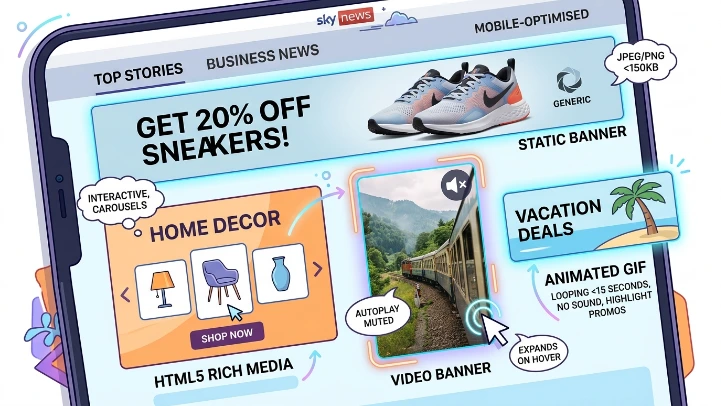
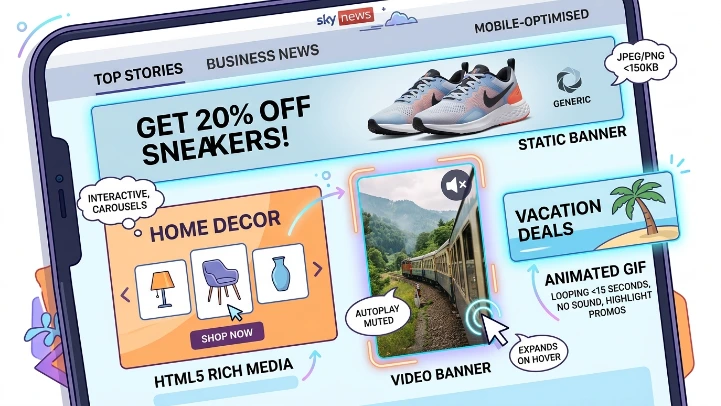
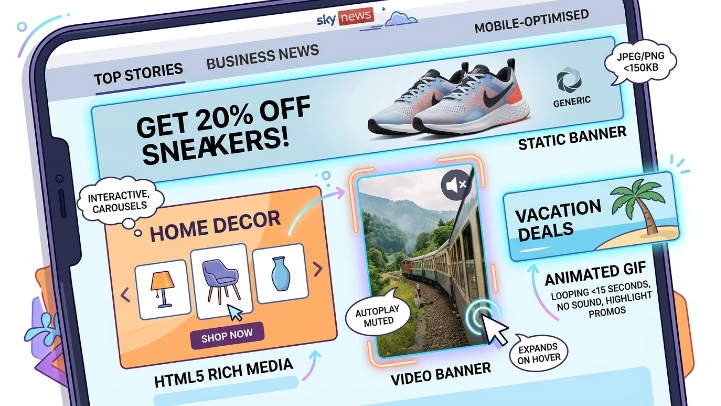
Types include static images, animated GIFs, HTML5 rich media, and video banners. Static ads comprise 40% of inventory, rich media 30%, and video 20%. UK sites like Sky News prioritise mobile-optimised versions. Static banners use JPEG or PNG files under 150KB. They display product images with logos.
Animated banners loop up to 15 seconds. They highlight promotions without sound. HTML5 banners support interactivity, like carousels showing multiple products. Video banners autoplay muted, expanding on hover.
Common formats by usage
- Display banners: 60% of volume.
- Expandable banners: 10%, growing on click.
- Floor ads: Full-width sticky at page bottoms.
Publishers test formats via A/B splits.
How do targeting options work in UK banner advertising?
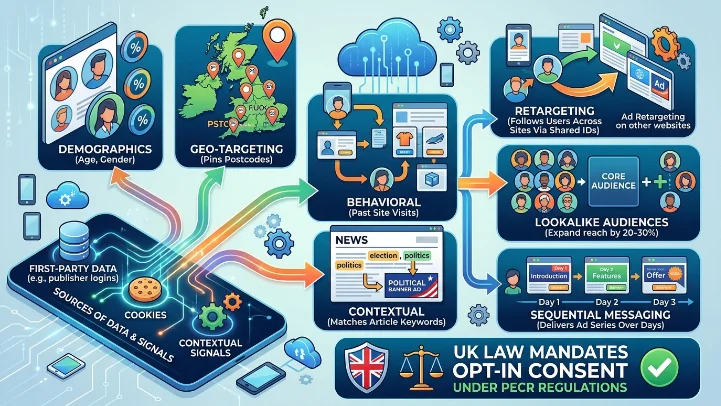
Targeting options use first-party data, cookies, and contextual signals. Demographics cover age and gender; geo-targeting pins postcodes; behavioral targets past site visits. UK law mandates opt-in consent under PECR regulations.
First-party data from publisher logins segments loyal readers. Contextual targeting matches ads to article keywords, like “election” for political banners. Retargeting follows users across sites via shared IDs. Lookalike audiences expand reach by 20-30%. Sequential messaging delivers ad series over days.
Targeting categories
- Demographic: 18-24, female.
- Geographic: London SE1 postcode.
- Behavioral: Visited travel sections.
- Device: iOS Safari users.
Precision reaches 85% match rates.
What regulations govern banner ads on UK news sites?
Regulations include GDPR for data, CAP Code for content, and ASA guidelines for misleading claims. Ads require “Ad” labels. Publishers audit for brand safety using GARM standards.
GDPR demands explicit consent for tracking. Fines reached £12 million in 2025 violations. CAP Code bans false claims, reviewed pre-flight. ASA enforces complaints, upholding 92% of challenges. Brand safety tools block ads near sensitive content.
Compliance requirements
- Transparency notices on every page.
- Cookie banners with granular choices.
- Annual audits for ad networks.
These rules protect users and advertisers.
Explore More Expert Insights:
What Are Banner Advertising Formats and How Do They Impact User Engagement?
What Is Homepage Takeover Advertising and How Does It Work for Brands?
What are real use cases for banner ads on UK news websites?
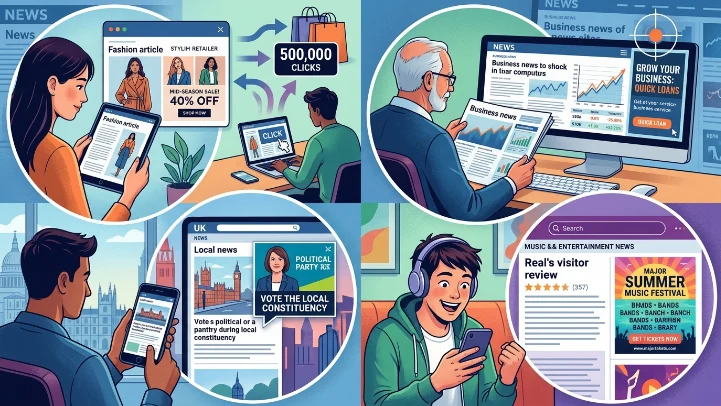
Use cases cover e-commerce promotions, financial services awareness, political campaigns, and event ticketing. Retailers like ASOS ran 2025 Christmas banners on Mail Online, driving 500,000 clicks.
E-commerce banners showcase products mid-fashion articles. Finance firms target business news for loan ads. Political parties geo-fence constituencies during elections. Event promoters advertise festivals near entertainment sections. Non-profits use PSAs on health pages.
Documented examples
- Guardian: Travel banners for holidays, 0.3% CTR.
- Telegraph: Mortgage ads in property sections.
- Independent: Tech gadgets on gadget reviews.
Results track via UTM parameters.
For deeper strategies on traffic generation, read the following:
How Banner Ads on UK News Sites Drive Targeted Traffic
For proven campaigns, check:
Banner Advertising on UK News Websites That Delivers Results