Traditional banner advertising involves manual sales of fixed ad spaces on websites through direct negotiations. Publishers set rates at £5-£20 CPM for 728×90 leaderboards, with contracts locking inventory for 30-90 days across UK sites.
Traditional methods rely on sales teams contacting advertisers via email or calls. Inventory lists specify sizes like 300×250 rectangles and positions such as above-the-fold slots. Rates factor in traffic volumes averaging 1 million monthly uniques. Contracts guarantee delivery of 100,000 impressions minimum.
Processes include creative approvals taking 48 hours and trafficking via ad servers like DoubleClick. Performance reports track clicks at 0.2% rates and impressions via server logs. UK publishers favor this for premium clients controlling 40% of display spend.
What defines programmatic advertising?
Programmatic advertising automates ad buying via real-time auctions on platforms like Google Display Network. Bids occur in 100 milliseconds for £2-£15 CPM, targeting 500 million UK users by device and location.
Programmatic uses demand-side platforms (DSPs) where advertisers bid on impressions. Supply-side platforms (SSPs) from publishers auction inventory. Real-time bidding (RTB) matches ads to users via data management platforms holding 200+ signals. OpenRTB protocol standardizes transactions.
Private marketplaces restrict auctions to select buyers, yielding 25% higher CPMs than open exchanges. Programmatic direct guarantees volumes like 50,000 impressions daily. UK market share hits 85% of display ad spend in 2025.
How do buying processes differ between them?
Traditional banner buying requires human negotiations and IO contracts signed in 7-14 days. Programmatic executes purchases in under 200ms through automated auctions, processing 10 billion bids daily.
Traditional processes start with RFPs outlining reach goals of 5 million impressions. Negotiations cover frequency caps at 5 views per user. Insertion orders (IOs) specify flight dates from 1 January to 31 March. Make-goods compensate undelivered inventory at 10% thresholds.
Programmatic deploys header bidding where 8-12 SSPs compete pre-ad server. Waterfall auctions prioritize highest bidders sequentially. Dynamic allocation optimizes yields in real time. UK advertisers report 60% time savings over manual methods.
What targeting capabilities set them apart?
Traditional banners target broadly by site sections or demographics from publisher data. Programmatic uses 300+ data points for precise targeting, achieving 40% lift in conversions via retargeting abandoned carts.
Traditional relies on contextual cues like sports pages for betting ads. Demographic packages bundle 18-34 males at £10 CPM. Geo-fencing limits to London postcodes. Accuracy hovers at 60% relevance.
Programmatic layers first-party data with third-party segments from 10 providers. Lookalike modeling expands audiences by 200%. Device graph IDs track cross-screen behavior. UK privacy laws under UK GDPR cap identifiers to 50 per user.
[Wondering about banner UX impacts first? Does Banner Advertising Negatively Impact User Experience on Modern Websites Today?
How do costs and pricing models compare?
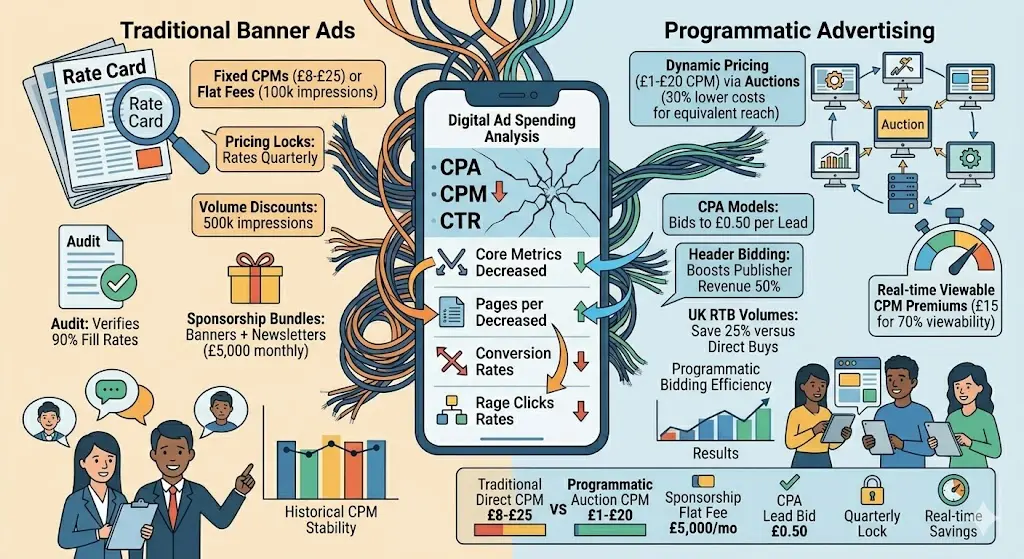
Traditional banners charge fixed CPMs of £8-£25 or flat fees for 100,000 impressions. Programmatic offers dynamic pricing from £1-£20 CPM via auctions, averaging 30% lower costs for equivalent reach.
Traditional pricing locks rates quarterly, with volume discounts at 500,000 impressions. Sponsorships bundle banners with newsletters at £5,000 monthly. Audits verify 90% fill rates.
Programmatic cost-per-acquisition (CPA) models bid to £0.50 per lead. Viewable CPMs premiumize at £15 for 70% viewability. Header bidding boosts publisher revenue 50%. UK RTB volumes save advertisers 25% versus direct buys.
What are the key technology components in each?
Traditional banners use static HTML creatives served via DFP tags with VAST for video. Programmatic integrates APIs, DMPs, and DSPs handling 5,000 QPS with pixel-perfect delivery.
Traditional setups deploy one tag per campaign, rotating 5 creatives. Tracking pixels fire on loads, capturing 95% of events. FTP uploads handle 10MB file limits. Programmatic stacks OpenX SSPs with The Trade Desk DSPs. Ad pods sequence 3 units in 300ms. Server-side rendering cuts load times 40%. UK compliance tools enforce consent signals.
How does creative management vary?
Traditional creative management involves email approvals and 24-hour uploads. Programmatic enables dynamic swapping of 20 variants in real time via tags, testing 10% of traffic.
Traditional workflows route PNG files through agency reviews. Versions A and B test manually over 14 days. Rejections delay launches by 72 hours. Programmatic dynamic creative optimization (DCO) assembles elements from feeds. AI swaps headlines based on 50 user traits. UK creatives refresh hourly, lifting CTRs 35%.
What reporting and measurement differences exist?
Traditional reports aggregate weekly via spreadsheets with clicks and impressions. Programmatic dashboards update in real time, attributing 30% more conversions via multi-touch models.
Traditional Excel sheets tally 100,000 impressions against IOs. Discrepancies under 10% trigger audits. Post-campaign PDFs summarize reach. Programmatic uses MMPs like AppsFlyer for cross-device attribution. Fraud detection blocks 20% invalid traffic. UK dashboards visualize 50 metrics including ROAS at 3:1.
When do publishers prefer programmatic over traditional?
Publishers select programmatic for 80% inventory fill rates and 45% yield uplift on remnant space. Traditional suits premium direct-sold slots yielding £20 CPM on 20% inventory. Programmatic scales auctions across 1,000 sites, minimizing unsold inventory at 5%. Yield management optimizes bids dynamically. UK publishers integrate 90% via Prebid.
Traditional reserves top slots for finance brands at fixed premiums. Relationships sustain 60% revenue. Hybrid models blend 70% programmatic with 30% direct.
What benefits does programmatic offer advertisers?
Programmatic delivers 50% faster campaign launches and 35% ROI gains through precise targeting. Scale reaches 90% of UK internet users in one week. Advertisers access premium inventory via PMPs without negotiations. Budget pacing auto-adjusts daily spends. Frequency management caps at 7 exposures. UK brands report 25% cost efficiencies.
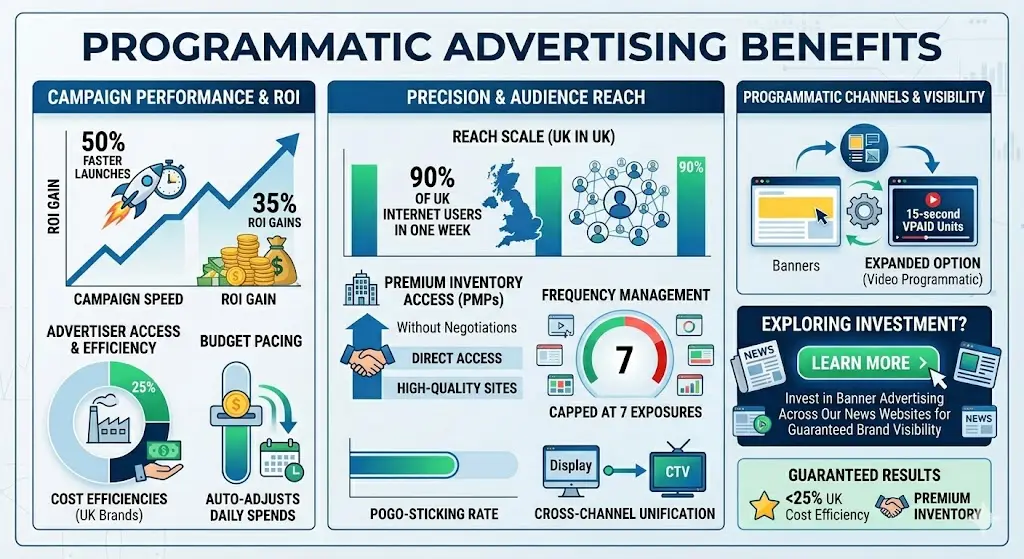
Options like video programmatic expand beyond static banners to 15-second VPAID units. Cross-channel buys unify display and CTV. Exploring investment Invest in Banner Advertising Across Our News Websites for Guaranteed Brand Visibility]