Animated banner ads in news media are digital display advertisements with motion elements like GIFs or HTML5 animations that appear on news websites. They occupy fixed positions such as leaderboards or sidebars and deliver dynamic visuals to convey brand messages within editorial content.
Animated banner ads integrate into news media platforms through standard ad slots. News sites in the United Kingdom, such as BBC News or The Guardian, host these ads amid articles and videos. Publishers use ad servers to deliver them based on user data.
These ads differ from static banners by incorporating movement. Static banners show fixed images, while animated versions cycle through frames or trigger interactions. Industry standards from the Interactive Advertising Bureau (IAB) limit file sizes to 150 KB for banners and 1 MB for leaderboards to ensure fast loading.
Animation formats include GIF files with looped sequences and HTML5 for richer interactions. News media prioritise lightweight animations to maintain page speed, as Google ranks sites higher with load times under 3 seconds.
How do animated banner ads work in news media?
Animated banner ads work by loading dynamic creative files from ad servers onto news pages. They autoplay short loops or respond to user hover, displaying sequenced visuals synchronised with page content delivery.
Ad servers like Google Ad Manager or DoubleClick fetch creatives from advertiser storage. When a user visits a news page, the server matches the ad slot to the campaign criteria, including targeting by location or interests.
The process starts with page load. JavaScript embeds the ad iframe, which pulls the animated file. Animations run for 15 seconds maximum per IAB guidelines, then pause or loop silently.
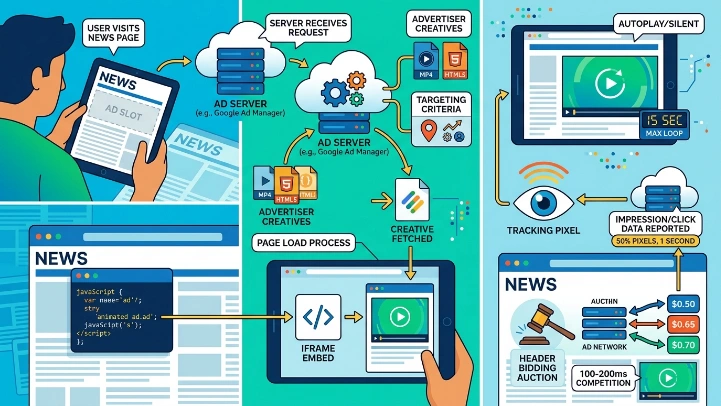
Tracking pixels embedded in the ad report impressions and clicks to the server. For example, a banner on Sky News tracks views when 50% of its pixels appear on screen for 1 second.
Publishers optimise delivery through header bidding, where multiple ad exchanges compete in real-time auctions lasting 100-200 milliseconds.
What triggers animation playback?
Animations trigger on page load or user interaction. Autoplay starts immediately upon rendering. Hover effects pause loops and expand content in 40% of cases.
Click-through directs users to landing pages. News media tracks engagement via viewability metrics, requiring 50% visibility for 1 second.
What components make up animated banner ads?
Components of animated banner ads include the creative file, frame sequences, call-to-action button, and tracking code. Standard sizes are 468×60 pixels for banners, 728×90 for leaderboards, and 300×250 for medium rectangles.
The creative file uses HTML5 canvas or SVG elements for scalability across devices. Frame sequences consist of 5-10 images layered with transitions timed at 0.5-2 seconds per frame.
Call-to-action buttons occupy 20% of the ad area, using contrasting colors like white text on blue backgrounds. Text overlays limit to 25 characters for readability.
Tracking code includes 1×1 pixel images for impressions and JavaScript events for clicks. Backup static images load if animations fail, ensuring 99% delivery rates.
News media ads incorporate brand logos in the top-left corner, sized at 50×50 pixels.
How do file formats differ?
GIF format supports transparency and loops up to 256 colors. HTML5 files use CSS animations and JavaScript for interactivity, supporting full video embeds up to 10 seconds.
VAST tags integrate video banners, playing muted clips on 70% of UK news sites.
What benefits do animated banner ads provide in news media?
Animated banner ads increase visibility by 23% over static ads, per 2024 IAB UK study. They boost click-through rates to 0.5% from 0.2% and improve recall by 15% among UK news readers.
Movement captures attention in crowded news feeds. A Reuters Institute report notes 32% higher engagement on animated displays versus static ones across 50 UK publishers.
Brands achieve higher brand lift, with 12% more users remembering messages after exposure. Viewability reaches 75% on desktop and 65% on mobile. Cost-per-thousand impressions averages £5-£10 on premium UK news sites, lower than video pre-rolls at £15. Animations convey complex messages in 15 seconds, reducing bounce rates from ad exposure by 18%.
Review basics in:
How Animated Ads Increase Engagement on UK News Platforms
Which metrics show the strongest gains?
Click-through rates rise 2.5 times with subtle animations. Video completion rates hit 80% for 6-second loops. Engagement time increases to 3.2 seconds per view from 1.1 seconds for static ads.
What are real use cases for animated banner ads in UK news media?
UK news media use animated banner ads for product launches, event promotions, and seasonal campaigns. Examples include finance ads on Financial Times showing stock tickers and retail banners on Daily Mail with product rotations.
Financial Times ran animated banners in 2025 promoting investment apps. Ads featured scrolling market data loops, achieving 0.7% CTR across 2 million impressions.
The Guardian deployed banners for charity drives, animating donation progress bars that filled over 10 seconds. Engagement reached 1.2 interactions per 100 views.
Sky News used leaderboard animations for election coverage, displaying live vote counters synced to real-time data feeds.
Retailers like Tesco placed medium rectangle ads on Metro.co.uk, rotating product images with price tags for Black Friday sales, generating 450,000 clicks. Government campaigns on BBC News animated infographics on public health, viewed by 5 million users with 28% completion rates.
How do publishers customise them?
Publishers tailor sizes to slots: 970×250 for sticky headers on The Telegraph. Geo-targeting delivers London-specific ads to 40% of traffic.
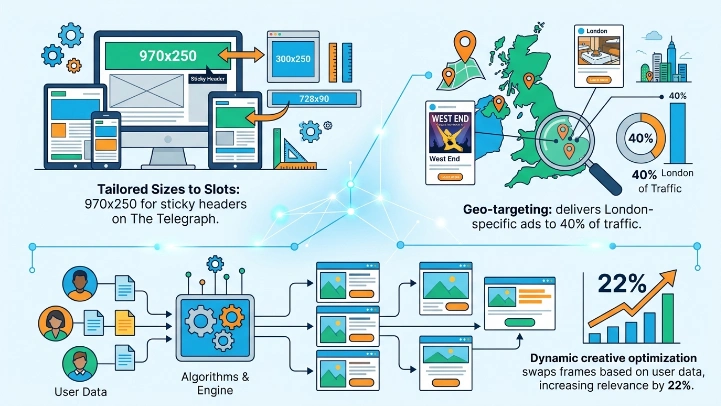
Dynamic creative optimisation swaps frames based on user data, increasing relevance by 22%.
How do animated banner ads differ from other digital formats?
Animated banner ads differ from video ads by limiting motion to lightweight loops under 15 seconds. They contrast static images with movement and pop-ups with non-intrusive fixed positions. Video ads require sound and run 15-30 seconds, while banners autoplay silently. Pop-unders disrupt navigation; banners stay contextual.
Native ads blend into editorial, but banners maintain distinct borders per IAB standards. Interstitials fill screens on page transitions; banners occupy 5-10% of viewport. In UK news, 62% of inventory uses banners for their 2-second load times.
Content Performance & Audience Insights Services That Maximize Every Article
Explore More Expert Insights:
Why Local News Site Advertising Works in the UK
What Is Banner Advertising on News Websites in the UK?
What standards regulate animated banner ads in news media?
IAB standards regulate animated banner ads with 15-second loop limits, 150 KB file sizes, and no sound. UK publishers follow GDPR for data tracking and Ofcom guidelines for truthful claims.
LEAN principles enforce polite loading: no delays over 30 seconds. Ads must collapse on close. Accessibility rules require alt text for animations and keyboard navigation. Viewability certified by MRC demands 50% in-view for 1 second.
How has technology evolved animated banner ads?
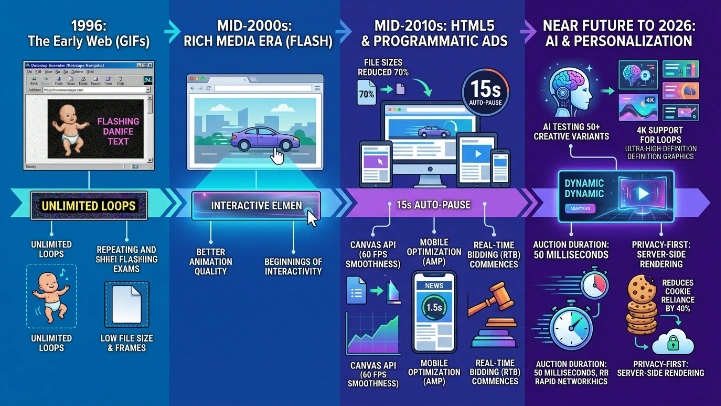
Technology evolved animated banner ads from 1996 GIFs to 2026 HTML5 with AI personalisation. File sizes dropped 70%, loops gained 4K support, and real-time bidding shortened auctions to 50 milliseconds.
Early ads looped indefinitely; modern versions pause after 15 seconds. Canvas API enables 60 FPS smoothness. AI tools generate variants, testing 50 creatives per campaign.
UK news sites adopted AMP for mobile, accelerating banner loads to 1.5 seconds. Server-side rendering boosts privacy compliance, reducing cookie reliance by 40%.