
Direct-to-consumer (D2C) brands sell products directly to customers through digital channels, owned websites, marketplaces, social platforms, and selected retail partnerships. Their growth depends on visibility, trust, customer acquisition, and consistent brand recognition.
Custom PR distribution connects a D2C announcement with relevant media audiences instead of treating every release as a generic news item. This approach gives product launches, retail partnerships, funding announcements, founder stories, product innovations, and expansion news a structured distribution strategy.
For UK D2C innovators, distribution also needs to reflect regional media markets, national publications, consumer press, retail trade media, business outlets, and relevant specialist publications.
Time Intelligence Media Group provides custom PR distribution for businesses that need targeted media visibility around defined announcements and commercial milestones.
What is custom PR distribution for D2C brands?
Custom PR distribution is a targeted process that matches a D2C brand’s announcement with relevant media categories, geographic markets, industry audiences, and campaign objectives, creating a structured route from published release to measurable media visibility.
Generic distribution focuses on broad circulation. Custom distribution starts with the announcement itself.
A D2C skincare brand launching in 150 UK retail stores has different media requirements from a consumer electronics startup announcing a £2 million funding round. The first story has retail, consumer, lifestyle, and regional relevance. The second has business, investment, technology, and startup relevance.
Custom PR distribution identifies these differences before the release enters the distribution process.
What does customisation involve?
Customisation can cover:
- Media category selection
- UK national distribution
- Regional distribution
- Consumer and lifestyle media
- Retail trade publications
- Business and technology media
- Sector-specific publications
- Campaign timing
- Announcement positioning
- Release optimisation
- Coverage monitoring and reporting
This structure makes the distribution process more relevant to the commercial purpose of the announcement.
How does Time Intelligence Media Group approach D2C PR distribution?
Time Intelligence Media Group approaches D2C PR distribution by aligning the release, target audience, media categories, geographic priorities, and campaign objective before distribution, giving consumer brands a defined framework for managing announcement visibility across relevant UK media channels.
The process begins with the news itself. A release needs a clear reason for publication.
For example, a D2C food brand announcing a supermarket partnership has a retail expansion story. A wearable technology brand introducing a new product has a product innovation story. A sustainable fashion company entering Scotland has a geographic expansion story.
Each announcement requires a different distribution focus.
How is the announcement assessed?
The announcement is assessed according to its:
- News value
- Audience relevance
- Industry relevance
- Geographic relevance
- Commercial significance
- Timing
- Supporting evidence
This assessment establishes the distribution requirements before the campaign begins.
How are media priorities established?
Media priorities depend on the story and intended audience.
A UK consumer launch can require national consumer publications, lifestyle media, retail publications, and regional outlets. A technology product launch can require technology, business, startup, consumer electronics, and specialist publications.
The distribution plan then reflects these categories rather than relying on one broad media audience.
Brands developing a broader [press distribution strategy] can use the educational stage to understand how media selection connects with commercial objectives.
Which D2C announcements benefit from custom PR distribution?
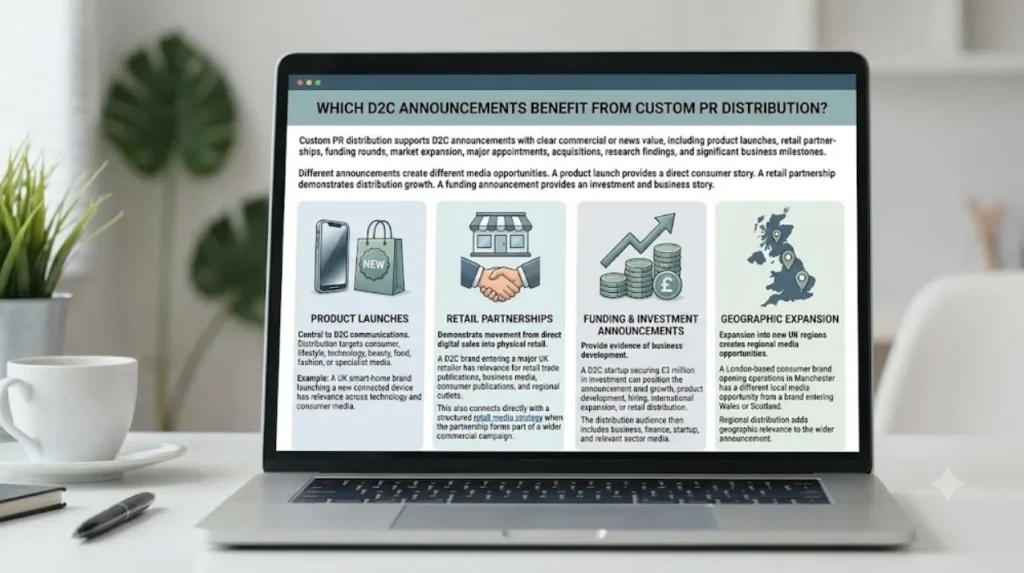
Custom PR distribution supports D2C announcements with clear commercial or news value, including product launches, retail partnerships, funding rounds, market expansion, major appointments, acquisitions, research findings, and significant business milestones.
Different announcements create different media opportunities.
A product launch provides a direct consumer story. A retail partnership demonstrates distribution growth. A funding announcement provides an investment and business story.
Product launches
Product launches are central to D2C communications. Distribution can target consumer, lifestyle, technology, beauty, food, fashion, or specialist media depending on the product.
For example, a UK smart-home brand launching a new connected device has relevance across technology and consumer media.
Retail partnerships
Retail partnerships demonstrate movement from direct digital sales into physical retail.
A D2C brand entering a major UK retailer has relevance for retail trade publications, business media, consumer publications, and regional outlets.
This also connects directly with a structured [retail media strategy] when the partnership forms part of a wider commercial campaign.
Funding and investment announcements
Funding announcements provide evidence of business development.
A D2C startup securing £3 million in investment can position the announcement around growth, product development, hiring, international expansion, or retail distribution.
The distribution audience then includes business, finance, startup, and relevant sector media.
Geographic expansion
Expansion into new UK regions creates regional media opportunities.
A London-based consumer brand opening operations in Manchester has a different local media opportunity from a brand entering Wales or Scotland.
Regional distribution adds geographic relevance to the wider announcement.
How does custom distribution differ from generic press release distribution?
Custom distribution differs from generic distribution because it starts with defined media objectives and audience requirements, while generic distribution typically prioritises broad circulation without establishing the specific commercial, geographic, or sector relevance of each target media category.
Broad distribution can create reach, but reach alone does not define campaign quality.
D2C brands need visibility among audiences that influence customer awareness, retail relationships, partnerships, investment decisions, and industry credibility.
Generic distribution
A generic approach typically focuses on distributing one release across a broad collection of outlets.
This provides a simple publishing route.
However, the same distribution structure does not suit every announcement.
Custom distribution
Custom distribution defines the relationship between the announcement and its target audience.
For example:
| D2C announcement | Priority media |
|---|---|
| New beauty product | Beauty, lifestyle, consumer |
| Retail partnership | Retail, business, consumer |
| Funding round | Finance, startup, business |
| Technology launch | Technology, business, consumer |
| Regional expansion | Regional, business, consumer |
| Sustainability initiative | Sustainability, consumer, business |
This segmentation gives the campaign a clearer strategic purpose.
What does a D2C PR distribution campaign include?
A D2C PR distribution campaign includes announcement assessment, release preparation, audience targeting, media category selection, distribution, publication monitoring, and campaign reporting, creating a defined process for moving a commercial announcement from preparation to measurable media coverage.
Each stage contributes to campaign execution.
Release preparation
The release needs a clear headline, concise opening paragraph, factual supporting information, relevant quotations, company information, and appropriate contact details.
The most important commercial fact needs to appear early.
Audience targeting
The target audience determines the media categories.
A premium skincare brand targeting UK consumers has different priorities from a B2B-enabled D2C software company selling directly to small businesses.
Audience definition prevents irrelevant distribution.
Media category selection
Category selection determines where the story is positioned.
Relevant categories include consumer, retail, lifestyle, business, technology, finance, regional, and specialist trade media.
Distribution and monitoring
Once distributed, the campaign enters its monitoring stage.
Coverage is tracked across relevant publication environments. Published results are then reviewed against the original campaign objective.
How can D2C brands measure PR distribution results?
D2C brands can measure PR distribution through publication volume, media relevance, geographic coverage, audience alignment, referral activity, branded search visibility, engagement signals, and commercial attribution where tracking infrastructure connects coverage with website or sales activity.
Measurement needs to reflect the campaign objective.
A product launch campaign prioritises consumer visibility. A retail partnership campaign prioritises retail and business visibility. A funding announcement prioritises investment and business media.
What should a coverage report contain?
A useful report can include:
- Publication names
- Coverage links
- Publication categories
- Geographic relevance
- Publication dates
- Campaign details
- Coverage totals
- Relevant visibility metrics
The report creates a record of campaign distribution and published outcomes.
How does PR connect with commercial measurement?
PR coverage does not automatically equal sales.
D2C brands need tracking mechanisms to connect media activity with commercial outcomes. These can include campaign URLs, analytics reporting, referral traffic, branded search monitoring, and conversion tracking.
For example, a D2C furniture brand can use a campaign-specific landing page to monitor traffic generated by media coverage.
When is custom PR distribution most valuable for D2C innovators?
Custom PR distribution is most valuable when a D2C brand has a specific announcement, defined audience, measurable business objective, and need for targeted UK media visibility across consumer, retail, business, regional, or specialist publication categories.
The service is particularly relevant during high-value commercial moments.
New product launches
A launch creates a defined news event. Custom distribution helps align the announcement with media categories that cover the product.
Major retail partnerships
Retail expansion creates a combined consumer and business story. Distribution can address both audiences without treating the announcement as a standard product update.
Funding milestones
Investment announcements create a business narrative around growth and future development.
Brand expansion
Expansion into new regions, product categories, or customer segments creates additional media relevance.
Strategic campaigns
Some D2C campaigns combine product, retail, seasonal, and brand objectives. Custom distribution provides a structured approach for separating these media priorities.
Why choose Time Intelligence Media Group for custom D2C PR distribution?
Time Intelligence Media Group gives D2C brands a structured distribution service focused on announcement relevance, audience targeting, UK media categories, campaign execution, and coverage reporting rather than treating every consumer announcement as an identical distribution requirement.
The decision to use a PR distribution provider depends on the brand’s campaign requirements.
D2C companies with frequent announcements need consistency. Brands entering retail need media categories that reflect retail and consumer audiences. Product-led businesses need distribution aligned with their specific market.
Time Intelligence Media Group positions custom PR distribution around these campaign requirements.
What should D2C brands assess before selecting a provider?
Brands can assess providers against five practical criteria:
- Media relevance — Does the service target publications relevant to the announcement?
- UK coverage — Does the distribution reflect UK national, regional, consumer, and trade media?
- Customisation — Can campaign requirements influence distribution?
- Reporting — Does the service provide usable coverage information?
- Campaign fit — Does the distribution approach match the commercial objective?
These criteria create a practical basis for provider comparison.
Explore More Expert Insights:
Selecting a Retail Wire: A Media Kit Checklist for New Consumer Brand Partnerships
Enterprise Retail PR: Evaluating Time Intelligence Media Group vs. Generic Wire Solutions
How should a D2C brand decide if custom PR distribution is right?

A D2C brand should choose custom PR distribution when its announcement has defined news value, a specific target audience, clear commercial relevance, and a requirement for structured media visibility across appropriate UK publication categories and geographic markets.
The decision starts with the announcement.
If the story concerns a major product launch, retail partnership, funding milestone, geographic expansion, acquisition, or significant business development, a targeted distribution process provides a defined route to relevant media audiences.
If the announcement lacks a clear news event, the brand needs to strengthen the story before distribution.
For D2C innovators, PR distribution works best when media activity forms part of a wider marketing system.
The strongest campaigns connect the announcement with owned content, social activity, retail communications, search visibility, customer acquisition, and measurable business objectives.
Custom PR distribution provides the media distribution component of that system.
For brands evaluating a provider at the decision stage,
Custom PR distribution offers a practical route to assess service fit, targeting requirements, reporting expectations, and campaign objectives before committing to a distribution programme. For deeper insight explore:
Time Intelligence Media Group’s service approach is designed for D2C businesses that require a defined UK PR distribution process around specific commercial announcements. The appropriate service depends on the announcement, target audience, distribution requirements, and measurable campaign objectives.