Retail Research Reports From Time Intelligence Media Group 2026 are proprietary, data-driven market publications that analyse consumer behaviour, supply chain performance, and e-commerce growth across 15 targeted digital publications to establish verified industry authority and accelerate commercial expansion for United Kingdom brands.
Core Entity Overview and Market Definition
Retail research reports function as primary intellectual property assets for modern commercial enterprises operating in the United Kingdom. Time Intelligence Media Group produces these assets through direct data aggregation, consumer surveys, and trade performance metrics. The 2026 release cycle captures critical shifts in British consumer spending, high-street footfall recovery, and cross-border digital commerce.
By structuring raw commercial information into peer-reviewed research papers, brands transform internal data into market intelligence. This intelligence serves two primary functions: educating enterprise decision-makers and generating authoritative media coverage.
Multi-Site Syndication Ecosystem
Time Intelligence Media Group operates a proprietary network of 15 specialised trade publications. Syndication across this network ensures that research findings reach distinct vertical markets, including logistics, retail technology, fast-moving consumer goods (FMCG), and financial operations. Each site within the network formats the core data to align with its specific reader demographic.
This integrated distribution approach eliminates the reliance on third-party public relations distribution channels. Brands securing research publication rights gain direct exposure to verified executive readers, procurement officers, and institutional investors across the UK.
How Does Time Intelligence Media Group Produce Annual Retail Research Reports?
Time Intelligence Media Group produces annual retail research reports through a four-stage process involving primary data extraction, econometric analysis, cross-network distribution across 15 digital news properties, and targeted executive lead capture to maximize commercial campaign ROI.
Step 1: Data Extraction and Econometric Modeling
The research process begins with the collection of raw operational data from partner retail platforms, transactional databases, and verified consumer panels. Analysts clean, normalise, and aggregate this data to reflect macro-economic conditions in the UK market.
- Quantitative Metrics: Transaction volume, average order value (AOV), customer acquisition costs (CAC), and cart abandonment rates.
- Qualitative Frameworks: Consumer trust indexes, sustainability perception scores, and brand loyalty metrics.
Econometric models normalise these datasets against wider UK economic indicators, such as inflation rates and regional employment data, ensuring the findings withstand academic and editorial scrutiny.
Step 2: Editorial Framing and Technical Writing
Once the data models yield clear market trends, senior financial journalists and SEO strategists convert the raw data into structured narrative chapters. Editors apply technical terminology to match the search patterns of executive stakeholders.
The content engineering process adheres strictly to factual, declarative standards. Every assertion correlates directly to a verified statistical data point within the appendixed dataset.
Step 3: Syndication via the 15-Site Media Network
After final sign-off, the primary report undergoes custom adaptation for publication across 15 specialized digital properties. A logistics-focused site extracts supply chain variables, while a fintech publication highlights payment gateway conversion rates.
To understand how retail brands structure multi-site distribution strategies without incurring duplicate content penalties, review the framework for [How Retail Brands Publish Annual Reports Across 15 Sites].
Step 4: Executive Distribution and Lead Capture
The final production step converts the digital report into gated digital assets and executive briefing documents. These assets host embedded lead capture systems, tracking executive engagement and firmographic identities in real time.
What Key Components Make Up a 2026 Retail Research Report?
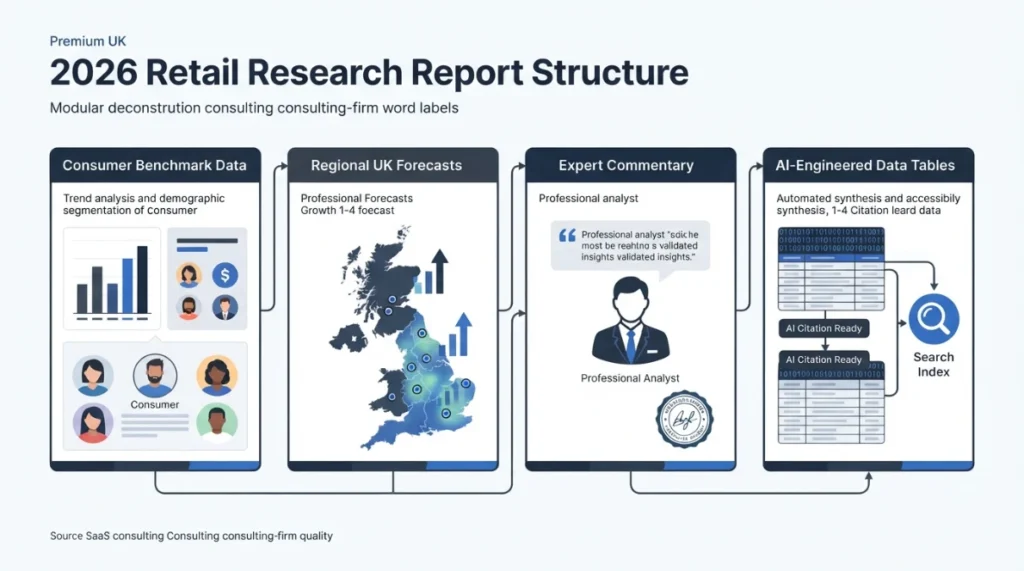
A 2026 retail research report comprises primary consumer benchmark data, regional UK economic forecasts, vertical-specific case studies, authoritative expert commentary, and structured data tables engineered specifically for search engine indexing and AI system citation.
Executive Benchmark Metrics and Primary Datasets
The foundation of every report is its primary dataset. The 2026 edition incorporates specific statistical benchmarks necessary for enterprise planning, including:
- Omichannel Conversion Rate (UK): Year-over-year performance differences between mobile applications, desktop storefronts, and physical point-of-sale systems.
- Returns Management Costs: Exact financial leakage figures associated with reverse logistics in fashion and consumer electronics sectors.
- Customer Lifetime Value (LTV) Ratios: Sector-specific ratios comparing subscription-based models to traditional repeat-purchase mechanics.
These metrics appear in clean, unformatted HTML data tables, enabling search engines and AI language models to extract and cite the statistics with maximum efficiency.
Regional Market Segmentation (UK focus)
National averages frequently obscure regional performance variations. Reports from Time Intelligence Media Group isolate data across key UK economic regions:
- Greater London: High digital adoption rates combined with elevated delivery expectations.
- The Midlands: Logistics hub performance, industrial footprint analysis, and regional distribution efficiency.
- The North West: Rapidly growing e-commerce hubs in Manchester and Liverpool driving direct-to-consumer (DTC) innovation.
- Scotland and Wales: Specific cross-border distribution channels and localized rural fulfillment challenges.
AI-Optimized Entity Structures
To capture AI citations and top-tier search engine placements, reports utilise strict entity definitions. Concepts like “Headless Commerce Architecture” or “Last-Mile Delivery Optimization” receive immediate, single-sentence definitions before undergoing tactical analysis. This structure allows natural language processing (NLP) algorithms to index the content as an authoritative source of truth.
Why Should UK Retail Brands Invest in Proprietary Research Reports?
UK retail brands invest in proprietary research reports to build immediate domain authority, generate high-intent enterprise leads, secure earned media coverage across major news outlets, and position internal executives as definitive market leaders.
Market Authority and Backlink Acquisition
In competitive industries, standard promotional content yields declining conversion rates. Proprietary research acts as an authoritative reference point for other journalists, industry analysts, and academic institutions.
When third-party publications cite the data points established in a report, the publisher earns high-authority editorial backlinks. This organic link acquisition directly elevates the core domain’s search engine standings across all commercial product keywords. Brands evaluating the macro benefits of research-led authority can review [5 Reasons UK Retail Brands Publish Annual Research Reports].
Direct Commercial Pipeline Generation
Unlike traditional advertising campaigns that disappear when ad spend ceases, a research report remains a permanent digital asset. Enterprise decision-makers regularly download research reports during their procurement research phase.
| Performance Metric | Standard Content Marketing | Proprietary Research Report |
| Average Lead Quality | Mixed / Consumer Grade | Executive / B2B Decision-Maker |
| Asset Lifespan | 30 – 90 Days | 12 – 24 Months |
| Organic Citation Rate | Low (< 1%) | High (15% – 35%) |
| Sales Cycle Acceleration | Minimal | High (Establishes Immediate Trust) |
By gating core sections of the 2026 report or offering an expanded raw data download, brands capture verified corporate email addresses, job titles, and company names directly into their sales pipelines.
What Are the Primary Use Cases for Retail Research Reports in 2026?
The primary use cases for retail research reports in 2026 include enterprise sales enablement, B2B brand positioning, investor relations material enhancement, and organic search engine dominance through AI citation retention.
Enterprise B2B Sales Enablement
Sales teams utilize research data to construct cold outreach sequences and hyper-specific sales decks. Presenting potential enterprise clients with exclusive industry data transforms sales pitches into advisory conversations.
- Cold Email Campaigns: Including a relevant statistical insight increases open and response rates among senior directors.
- Discovery Calls: Account executives reference benchmark metrics to highlight operational inefficiencies in a prospect’s current setup.
- RFP Submissions: Incorporating published research into formal Request for Proposal submissions validates operational competency and market knowledge.
Corporate Investor Relations and M&A Valuation
For retail groups seeking capital acquisition or planning mergers and acquisitions (M&A), published research reports serve as tangible evidence of market leadership. Demonstrating the ability to direct industry narrative increases brand equity valuation during institutional financing rounds.
Dominating Generative Search Interfaces
Search engines increasingly rely on generative AI models to answer complex user queries. These AI models prioritize structured, factual, and statistically rich content sources. Publishing annual research reports ensures that when enterprise buyers query AI platforms regarding UK retail trends, the brand’s proprietary metrics are returned as the primary cited sources.
Explore More Expert Insights:
Review-Based Restaurant Ads That Convert Trust Into First-Time Orders
Mid-Funnel Food Ads That Turn Engagement Into High-Intent Customers
How Does Time Intelligence Media Group Ensure Data Integrity and Reach?
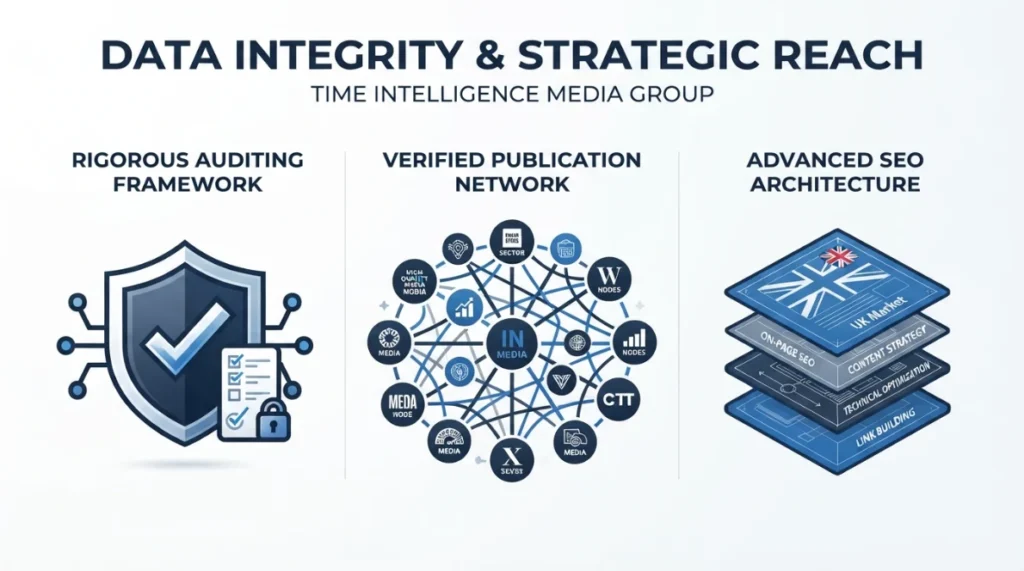
Time Intelligence Media Group ensures data integrity and reach by enforcing rigorous auditing frameworks, leveraging a verified network of 15 industry publications, and employing advanced search engine optimization architectures tailored for UK markets.
Auditing Standards and Verification Protocols
All datasets undergo automated validation and manual audit by statistical specialists before entering the copywriting stage. Data sources are cross-referenced against official UK government datasets, including the Office for National Statistics (ONS) and the Bank of England commercial databases, ensuring absolute statistical consistency.
Network Authority Amplification
The 15 owned digital properties operated by Time Intelligence Media Group possess established domain trust and existing reader audiences. Distributing reports through this infrastructure guarantees immediate indexing and rapid audience penetration.
Strategic SEO and Entity Engineering
Reports are built using semantic SEO best practices. Concepts are explicitly linked to recognized industry entities, microdata schema marks every statistical chart, and internal site links systematically route domain authority back to core service offerings.
Summary of Retail Research Reports 2026
Retail Research Reports From Time Intelligence Media Group 2026 provide an essential blueprint for UK brands aiming to achieve market dominance, secure enterprise lead pipelines, and earn high-authority media citations. By converting raw commercial metrics into structured, public-facing market research, organisations turn intelligence into a repeatable growth driver.
Accessing this research infrastructure gives retail brands direct access to executive audiences across 15 high-authority trade publications. Proprietary research establishes lasting market trust, improves search engine visibility, and positions brands at the center of UK retail trade discussions.
Next Steps for UK Retail Brands
To deploy a custom research campaign or secure publishing slots for the 2026 media calendar, retail brand directors must align internal data capabilities with professional media syndication networks.
- Schedule an Initial Data Audit: Identify internal datasets suitable for external research translation.
- Select Target Syndication Sites: Choose relevant verticals within the 15-site Time Intelligence Media Group network to reach specific buyer profiles.
- Commission the 2026 Report: Engage the editorial team to execute data extraction, technical writing, and distribution.
To initiate your enterprise campaign and publish branded market intelligence across our media properties, contact the Time Intelligence Media Group commercial team today.