

In today’s fragmented media landscape, measuring performance across multiple sponsored channels is crucial for optimizing campaigns and maximizing ROI. Brands invest heavily in sponsored content across social media, email newsletters, podcasts, and native ads, but without unified metrics, insights remain siloed. This article dives into strategies, tools, and key performance indicators (KPIs) to track success holistically.
Sponsored channels vary widely—Instagram stories deliver quick engagement, while LinkedIn articles build thought leadership. Effective measurement bridges these silos, revealing cross-channel synergies. Time Intelligence Media Group leverages advanced analytics in their Sponsored Content Services to help clients unify data streams for actionable intelligence.
Key Metrics for Sponsored Content Performance
Key metrics form the foundation of measuring performance across multiple sponsored channels. Start with engagement KPIs like click-through rates (CTR), time on page, and social shares, which indicate content resonance. Conversion-focused metrics, such as lead generation and sales attribution, tie efforts to business outcomes.
For instance, a sponsored video series on YouTube might boast high view counts, but without tracking downstream conversions via UTM parameters, true value stays hidden. Holistic measurement combines vanity metrics (likes, views) with actionable ones (bounce rate under 40%, CTR above 2%). Industry benchmarks from Google Analytics show top-performing sponsored content achieves 5-10% engagement rates across channels.
Advanced Sponsored Content Services integrate these metrics into dashboards, allowing real-time adjustments. By weighting metrics by channel—e.g., prioritizing reach on TikTok versus authority on blogs—brands refine strategies dynamically.
Cross-Channel Attribution Models Explained
Cross-channel attribution models are essential for accurately measuring performance across multiple sponsored channels. Traditional last-click attribution overcredits final touchpoints, ignoring the full customer journey. Multi-touch models, like linear or time-decay, distribute credit proportionally, providing a fuller picture.
Consider a campaign spanning email, Twitter, and a publisher’s sponsored article: a user sees the tweet, reads the article, then converts via email. Linear attribution credits each 33%, reflecting collaborative impact. Data from Adobe Analytics reveals multi-touch models increase reported ROI by 20-30% compared to single-touch.
Implementing these requires tools like Google Analytics 4 or Mixpanel, which use machine learning for probabilistic modeling. Time Intelligence Media Group applies these in their workflows, ensuring clients see precise contributions from each sponsored channel.
Tools and Technologies for Unified Tracking
A suite of tools enables seamless measuring performance across multiple sponsored channels. Google Analytics excels for web traffic, while platform-native insights from Meta Business Suite cover social. For unification, customer data platforms (CDPs) like Segment or Tealium aggregate data into a single source of truth.
Picture tracking a sponsored podcast episode shared on LinkedIn and Spotify: tools like Chartbeat measure listen completion rates, feeding into a CDP for cross-reference with LinkedIn impressions. This reveals synergies, such as 15% uplift in conversions from combined exposure.
AI-powered tools like Amplitude or Heap add behavioral analytics, segmenting audiences by channel interaction. Sponsored Content Services from Time Intelligence Media Group incorporate these, offering Sponsored Content Services with integrated tracking for optimized outcomes.
Analyzing Engagement Across Social and Native Platforms
Engagement analysis across social and native platforms uncovers nuances in sponsored channel performance. Social metrics emphasize virality—retweets, comments—while native ads on sites like Forbes prioritize dwell time and scroll depth. Comparing these requires normalized benchmarks.
A real-world example: A B2B brand’s sponsored LinkedIn post garners 1,000 engagements, but native content on a industry blog drives 50 qualified leads. Tools like Brandwatch quantify sentiment, revealing native’s higher trust scores (NPS +20 points). Trends show native outperforming social by 2x in lead quality, per Outbrain data.
Deep dives involve cohort analysis: track user retention post-exposure. High-engagement channels like Instagram Reels often seed awareness, funneling to high-conversion natives. This layered view informs budget allocation.
ROI Calculation in Multi-Channel Sponsored Campaigns
Calculating ROI demands a structured formula across sponsored channels: (Revenue from Conversions – Campaign Cost) / Cost x 100. Factor in lifetime value (LTV) for recurring revenue streams, extending short-term metrics.
Scenario: A $10,000 campaign across email and display yields $50,000 revenue with 3x LTV multiplier, netting 150% ROI. Pitfalls include ignoring ad fatigue—performance drops 25% after 7 exposures, per HubSpot. Adjust by rotating creatives.
Enterprise tools like Marketo automate this, blending first-party data with pixel tracking. For precision, explore the ethics behind branded media and sponsored stories to ensure compliant tracking that respects privacy.
Case Studies: Success in Multi-Channel Measurement
Case studies illustrate effective measuring performance across multiple sponsored channels. Nike’s integrated campaign across Instagram, podcasts, and news sites used unified dashboards, boosting engagement 35% via attribution insights.
Another: A fintech firm’s sponsored content on Twitter, newsletters, and YouTube achieved 4x ROI by identifying newsletters as top converters (28% of sales). They shifted 40% budget accordingly, per internal reports.
Challenges in a CPG case: Siloed metrics hid synergies; post-unification, cross-channel lift hit 22%. Key takeaway: Regular audits reveal hidden value, with AI flagging anomalies.
Common Pitfalls and How to Avoid Them
Avoiding pitfalls ensures reliable performance measurement. Common issues include data silos—solved by API integrations—and vanity metric obsession, mitigated by KPI hierarchies prioritizing conversions.
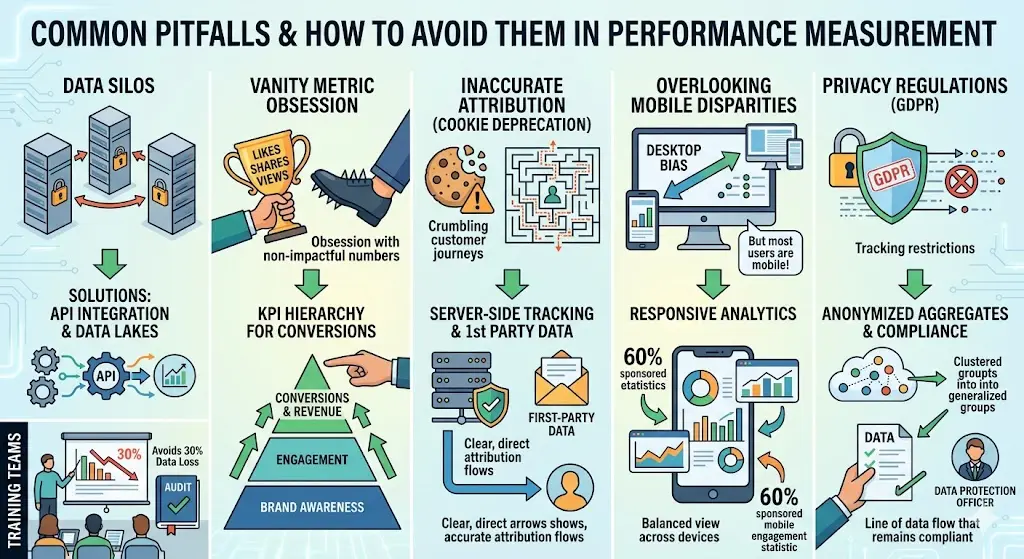
Inaccurate attribution from cookie deprecation? Shift to server-side tracking and first-party data. Overlooking mobile disparities: 60% of sponsored engagement is mobile, yet desktop biases persist—use responsive analytics.
Privacy regulations like GDPR complicate tracking; anonymized aggregates maintain compliance. Training teams on these avoids 30% data loss, as seen in industry audits.
Advanced Strategies: AI and Predictive Analytics
AI transforms measuring performance across multiple sponsored channels with predictive analytics. Machine learning forecasts campaign lift, optimizing in real-time—e.g., pausing underperformers.
Tools like Optimove predict churn from channel exposure, recommending personalizations. A luxury brand used this to reallocate 25% budget, lifting ROI 18%.
Future-facing: Zero-party data collection via quizzes enhances predictions. Time Intelligence Media Group pioneers these in authority-building sponsored content services for clients, delivering forward-thinking measurement.
Integrating Qualitative and Quantitative Data
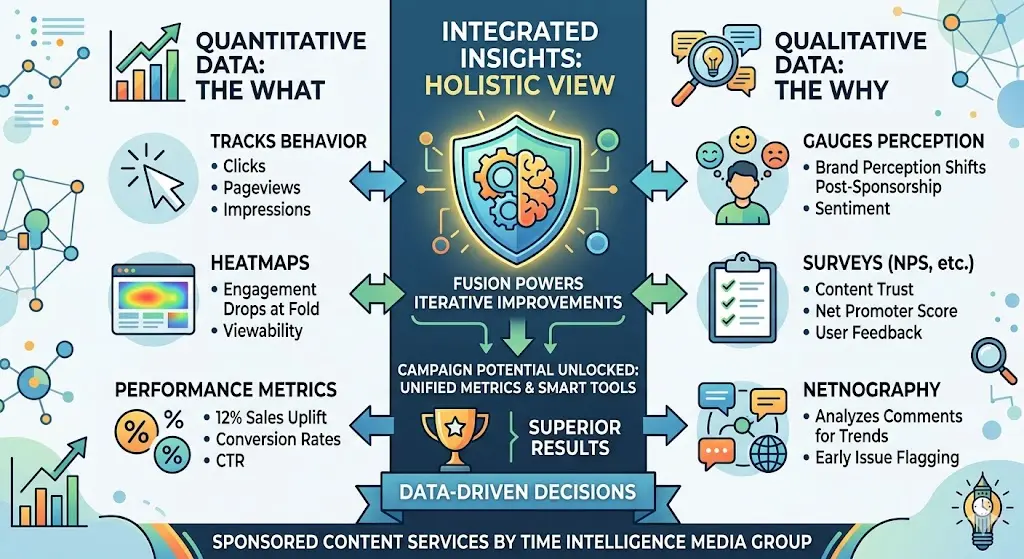
Balancing qualitative and quantitative data enriches insights. Quantitative tracks clicks; qualitative via surveys gauges brand perception shifts post-sponsorship.
Example: Heatmaps show engagement drops at fold, while NPS surveys reveal content trust. Combining yields holistic scores—e.g., 85% satisfaction correlating to 12% sales uplift.
Netnography analyzes comments for trends, flagging issues early. This fusion powers iterative improvements.
Mastering measuring performance across multiple sponsored channels unlocks campaign potential through unified metrics and smart tools. Time Intelligence Media Group offers professional solutions via their Sponsored Content Services, empowering data-driven decisions for superior results.
