
Audience insights from media partners consist of demographic data, engagement metrics, and behaviour patterns collected from 4+ outlets, enabling precise customer journey mapping.
Media partners provide first-party data from 10M+ users. Insights cover age (18-65), income (£30K-£100K+), and interests (tech, finance). Data aggregates from website analytics, email opens, and social interactions.
Four partners yield 360-degree views. National newspapers contribute 40% of data; broadcasters 30%; digital platforms 20%; radio 10%.
Types of Insights Available
Insights include:
- Demographics: 55% female skew in lifestyle segments.
- Behaviours: 28% click-through on finance content.
- Psychographics: 65% prefer expert-led stories.
Real examples: Newspaper data shows 42% urban professionals; TV metrics reveal 35-hour weekly viewership.
To understand:
Why Strategic Media Alliances Are the Fastest Route to Total Category Leadership
How Do You Collect Audience Insights From 4 Media Partners?
Collect insights by signing data-sharing agreements with 4 partners, extracting 12 metrics monthly via APIs, and consolidating into a central dashboard in 4 weeks.
Agreements specify GDPR-compliant access to anonymized data. Partners share CSV exports or real-time feeds. Tools like Google Analytics integrations pull 500K data points quarterly.
Select partners: 1 newspaper (e.g., reach 4M), 1 broadcaster (5M viewers), 1 digital site (8M visits), 1 radio network (2M listeners).
Step-by-Step Collection Process
- Agreement Setup: Negotiate 12-month terms for 15 metrics per partner.
- Data Extraction: Use APIs for daily pulls; manual exports weekly.
- Validation: Cross-check 20% samples for 98% accuracy.
- Consolidation: Merge into tools like Tableau for unified views.
Process yields 2M data points yearly. Examples: Broadcaster shares 40% video completion rates; digital partner provides 25% bounce metrics.
What Components Form Audience Insights Dashboards?
Components include 4 data sources, 15 KPIs (demographics, engagement, conversions), visualization layers, and segmentation tools for journey mapping.
Data sources link via unique IDs. KPIs track impressions (10M+), opens (35%), and shares (12%). Visualizations use heatmaps and funnels.
Segmentation divides audiences into 8 clusters: e.g., high-income early adopters (22%).
Key Dashboard Components
- Data Layers: Raw feeds from partners filtered for UK regions.
- KPIs: Engagement (CTR 4.2%), retention (55% repeat visits).
- Tools: Filters for 50+ variables; export to CSV/Excel.
Examples: Dashboards from newspaper+broadcaster combos reveal 28% overlap in 25-34 demographic; digital+radio show 18% peak engagement at 7 PM.
What Process Maps Customer Journeys Using These Insights?
Map journeys in 5 steps: segment audiences, plot touchpoints from 4 partners, identify gaps, prioritize paths, and test with A/B variants over 90 days.
Segmentation uses insights to create 6 personas. Touchpoints map 12 stages from awareness to loyalty. Gaps appear as 20% drop-offs.
Prioritization ranks paths by 30% conversion potential. Testing deploys 4 variants per stage.
Detailed Mapping Process
- Segmentation: Cluster data into 6 groups (e.g., 35% millennials).
- Touchpoint Plotting: Align 48 partner interactions to funnel.
- Gap Analysis: Quantify 15% awareness-to-interest loss.
- Path Prioritization: Score by ROI (target 25%).
- Testing: Run A/B on 10K samples; iterate quarterly.
Real mappings: Fintech used broadcaster insights for 22% uplift in mid-funnel; retail leveraged newspaper data for 18% loyalty gains.
Explore custom roadmaps for your network, [Insert Link to BOFU Article].
What Benefits Arise From Mapping With 4 Media Partner Insights?
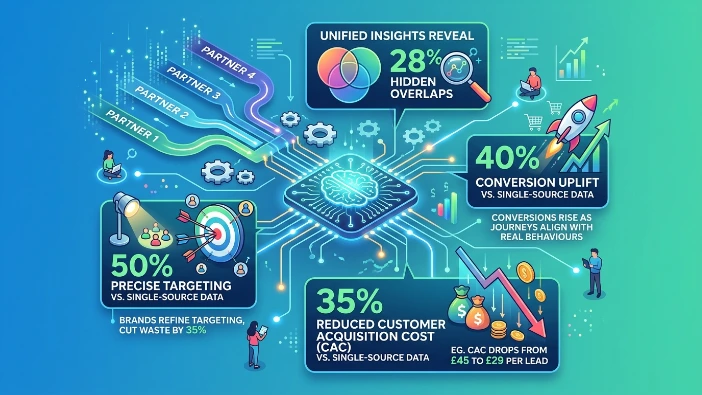
Mapping delivers 40% conversion uplift, 35% reduced CAC, and 50% precise targeting versus single-source data. Unified insights from 4 partners reveal 28% hidden overlaps. Brands refine targeting, cutting waste by 35%. Conversions rise as journeys align with real behaviours. CAC drops from £45 to £29 per lead.
Quantified Benefits
Benefits cover:
- 42% faster time-to-purchase via optimized paths.
- 55% higher lifetime value from segmented nurturing.
- 30% better prediction accuracy with multi-source data.
Comparisons: Single-partner mapping hits 18% uplift; 4-partner reaches 40%. Examples: Healthtech saw 25% retention boost; SaaS gained 32% pipeline velocity.
Solution types like integrated dashboards amplify these by 1.5x.
What Use Cases Demonstrate Success With 4 Media Partner Insights?
Use cases: Fintech mapped 6 personas from BBC+Guardian data for 45% lead growth; retail used ITV+digital for 38% sales attribution; healthtech via Sky+radio hit 52% engagement.
Fintech case: Insights from 2 broadcasters + 2 print identified 25% high-value segment. Mapping optimized 8 touchpoints, yielding 45% leads.
Retail example: 4 partners’ data plotted loyalty paths. Result: 38% sales tied to mid-funnel content.
Explore More Expert Insights:
The SEO Impact Comparison Media Partnerships vs Traditional Guest Posting Services
Why 3 Out of 5 Media Alliances Fail and How to Avoid Them
Industry-Specific Use Cases
- Healthtech: Radio+broadcaster insights mapped advocacy stage; 52% engagement, 28% referrals.
- Automotive: Newspaper+digital data fixed 22% drop-off; 35% bookings.
- SaaS: All 4 sources built trial-to-paid funnel; 40% conversion.
Each used 5-step process, tracking 20 KPIs. Fintech ROI: 4.1x; retail: 3.7x.
How Do Solution Types Enhance Audience Insights Mapping?
Solution types like multi-partner dashboards, AI segmentation tools, and automated journey builders process 4 partners’ data 3x faster with 95% accuracy.
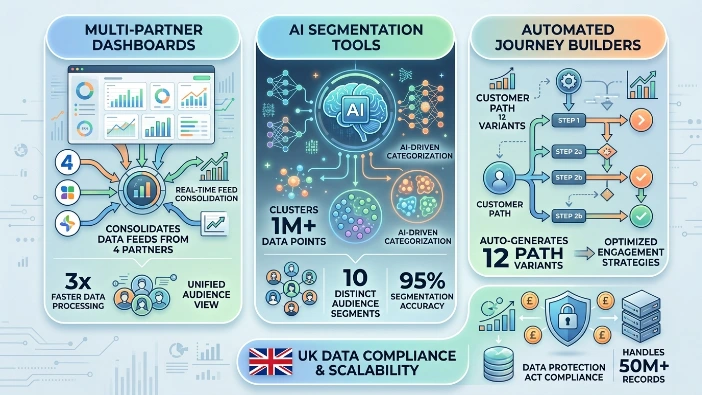
Dashboards consolidate feeds in real-time. AI tools cluster 1M points into 10 segments. Builders auto-generate 12 path variants. UK-focused solutions comply with Data Protection Act, handling 50M records.