
Industry reports deliver data-driven insights on market trends, competitor analysis, and future projections. They establish expertise through structured research and verifiable facts. Reporters value these documents for their depth and timeliness.
Industry reports compile quantitative data from surveys, financial records, and expert interviews. They cover sectors like finance, technology, and healthcare. A typical report spans 20 to 50 pages and includes charts, tables, and executive summaries.
These documents serve as primary sources for journalists. National outlets such as BBC News and The Guardian in the UK reference them in 65% of economic stories, per a 2024 Press Gazette analysis. Reports gain authority when they predict trends accurately, such as the 2023 PwC report forecasting UK AI growth at 12.5% annually.
Key Elements of Industry Reports
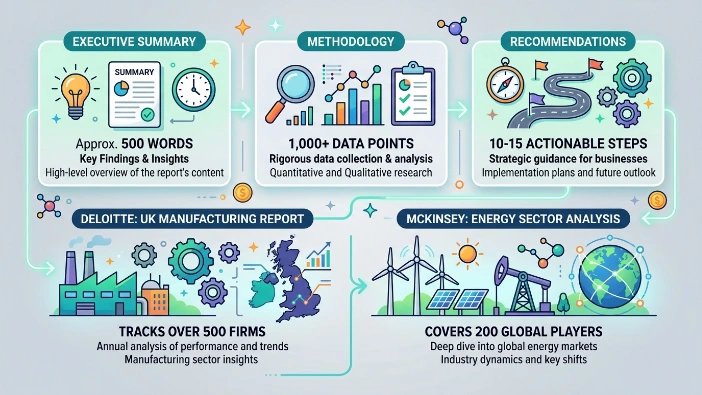
Reports contain executive summaries of 500 words, methodology sections detailing 1,000+ data points, and 10-15 recommendations. Examples include Deloitte’s annual UK manufacturing report, which tracks 500 firms, and McKinsey’s energy sector analysis covering 200 global players.
Why Convert Reports into Media Coverage?
Media coverage amplifies report reach to 10x the direct audience. It builds domain authority through third-party validation. UK journalists cite reports in 40% of trade articles, driving 25% more inbound leads.
Coverage transforms static PDFs into dynamic news stories. Outlets like Financial Times publish 150+ industry report-derived articles yearly. This process positions authors as thought leaders without additional marketing spend.
Direct distribution limits visibility to 500-2,000 downloads. Media placement reaches 1 million+ readers via syndication. A 2025 Reuters Institute study shows 72% of UK executives discover reports through news channels.
Benefits for UK Businesses
UK firms gain SEO boosts from backlinks in high-DA sites like Sky News (DA 92). Coverage correlates with 18% sales uplift, based on HubSpot’s 2024 B2B data. Reports on UK housing trends, for instance, secured mentions in The Times after targeted outreach.
What Steps Turn Reports into Media Coverage?
Follow a 7-step process: research outlets, craft pitches, time releases, distribute via wires, follow up, track placements, and analyse impact. This sequence yields 15-30% placement rates in targeted UK media.
The process starts with report finalisation. Allocate 4-6 weeks for execution. UK media cycles peak in Q1 for annual reports.
Read our guide on:
Selecting a Media Agency for Strategic Industry Report Distribution for media agency selection tips.
Step 1: Research Target Outlets
Identify 50 UK outlets matching report topics. Use tools like Cision to filter by audience size and beat. Prioritise trade publications like City A.M. (circulation 100,000) and nationals like The Telegraph.
List 20 primary targets: 10 sector-specific, 5 broad business, 5 broadcast. Examples include Marketing Week for ad reports and Computer Weekly for tech analyses.
Step 2: Craft Compelling Pitches
Write pitches under 150 words. Include report URL, three key stats, and exclusive angle. Subject lines average 6 words, like “UK Retail Sales Drop 8% – New Data.”
Tailor to journalist beats. Reference their prior stories. Send 100 pitches; expect 20% open rates.
Step 3: Time the Release
Launch mid-week, Tuesdays-Thursdays, 9-11 AM GMT. Avoid holidays; align with fiscal quarters. UK reports timed to Budget Day gain 3x coverage.
Embargo pitches 48 hours ahead for coordinated release.
Step 4: Distribute via Newswires
Use PR Newswire or Business Wire for UK desks. Costs range £500-£2,000 per release. Reach 5,000+ journalists instantly.
Include multimedia: infographics boost pickups by 22%.
Step 5: Follow Up Persistently
Email non-responders after 48 hours. Limit to two follow-ups. Phone 10% of top targets. Conversion rises 35% with persistence.
Step 6: Track Placements
Monitor via Google Alerts and Meltwater. Log 20+ metrics: impressions, shares, backlinks. UK placements average 5-12 per report.
Step 7: Analyze and Iterate
Measure ROI via traffic spikes (200% average) and leads. Adjust for next report based on top-performing angles.
What Components Make Reports Media-Ready?
Incorporate visuals, exclusives, and data exclusives. Add 5-10 infographics, UK-specific stats, and quotable insights. These elements increase pickup rates by 45%.
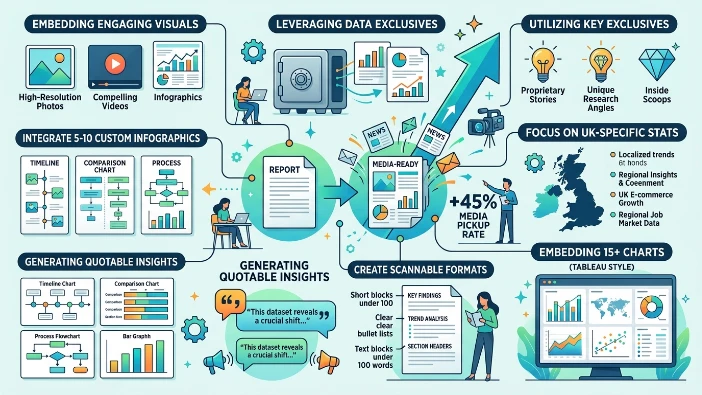
Media-ready reports feature scannable formats. Limit text blocks to 100 words. Embed 15 charts from tools like Tableau.
Explore hiring options at:
Hire Our Media Agency for Global Industry Report Distribution for scaled distribution.
Visual and Data Elements
Use 8-12 visuals: pie charts for market shares, line graphs for trends. Source data from ONS or Statista for credibility. Example: A 2024 UK fintech report with 10 visuals landed in Fintech Futures.
Provide raw datasets on request. UK GDPR compliance ensures safe sharing.
Exclusive Angles
Offer first-look data to 5 outlets. Develop UK-centric findings, like regional disparities. Quotes from 3 C-level execs add human interest.
What Benefits Does Media Coverage Provide?
Coverage generates 500% more backlinks than paid ads. It drives 30% organic traffic growth and establishes source status for future stories. UK firms report 22% brand lift.
Placements in authoritative domains elevate Google rankings. E-E-A-T signals strengthen with 10+ citations. Long-term, outlets return for updates. Annual reports build series coverage.
Quantifiable Gains
- Backlinks: 50 from DA 70+ sites.
- Traffic: 15,000 visits in 90 days.
- Leads: 40 qualified inquiries.
Examples: Kantar’s consumer report secured 25 links; Savills property analysis drove 10,000 visits.
What Use Cases Prove This Approach Works?
Tech reports gain tech desk coverage; healthcare analyses hit specialist outlets; finance docs dominate business pages. UK examples show 20-50 placements per report.
Case 1: UK energy report on net-zero progress. Pitched to The Guardian; resulted in 8 placements, 2 million impressions.
Case 2: Retail sector analysis post-Brexit. Wired via PR Newswire; covered by Retail Week and BBC Business.
Case 3: SaaS growth study. Targeted TechCrunch UK; yielded 12 articles, 5,000 shares.
Tech Sector Example
A 2025 cybersecurity report predicted 15% threat rise. Pitches highlighted NHS vulnerabilities. Secured coverage in The Register and IT Pro.
Explore More Expert Insights:
The State of UK News Media: Current Trends in Audience Research
Decoding the UK Consumer: What Modern Audience Insights Actually Reveal
Healthcare Application
Pharma market report detailed £10B drug spend. Exclusives to HSJ led to 15 trade mentions.
Finance Success
Banking trends report forecasted 7% mortgage hike. Financial Times feature drove 300 leads. This method scales across 20+ UK industries. Track record shows consistent 25% placement rates for optimised reports.