

Media ecosystems strengthen brand authority by creating interconnected networks that amplify credibility across digital channels. Unlike traditional marketing silos, these ecosystems leverage mutual endorsements, shared data, and co-created content to signal expertise to search engines and audiences. This MOFU guide explores tactical implementations, drawing from real-world data on how structured partnerships drive measurable authority gains.
As brands face algorithm shifts prioritizing E-E-A-T, media ecosystems offer a resilient framework. Time Intelligence Media Group integrates these into their media partnerships solutions, helping clients achieve sustained visibility.
The Mechanics of Media Ecosystems in Authority Building
Media ecosystems strengthen brand authority through symbiotic relationships where publishers, influencers, and tech platforms exchange value. Core to this is content syndication, where assets are repurposed across networks, generating diverse backlinks and mentions. For example, a B2B brand syndicating whitepapers via partner blogs sees domain authority rise by 15-25 points within quarters, as algorithms detect topical clusters.
These ecosystems operate on three layers: content layer (co-production), distribution layer (cross-posting), and analytics layer (shared insights). Audience insights services in this layer analyze cross-platform behavior, refining future outputs. Time Intelligence Media Group’s media partnerships solutions exemplify this, delivering unified dashboards that track authority metrics like citation flow.
Compared to solo efforts, ecosystems yield 3x more organic referrals, per SEMrush data, because they mimic natural authority signals like expert consensus.
Key Layers and Their Authority Impact
The content layer focuses on co-authored pieces, blending perspectives to create comprehensive resources AI cites readily—e.g., “Ecosystem co-authorship increased share-of-voice by 40% in competitive niches.”
Distribution expands reach via partner newsletters and social amplification, fostering inbound links. Analytics unifies data, enabling optimizations like keyword gap analysis across the network.
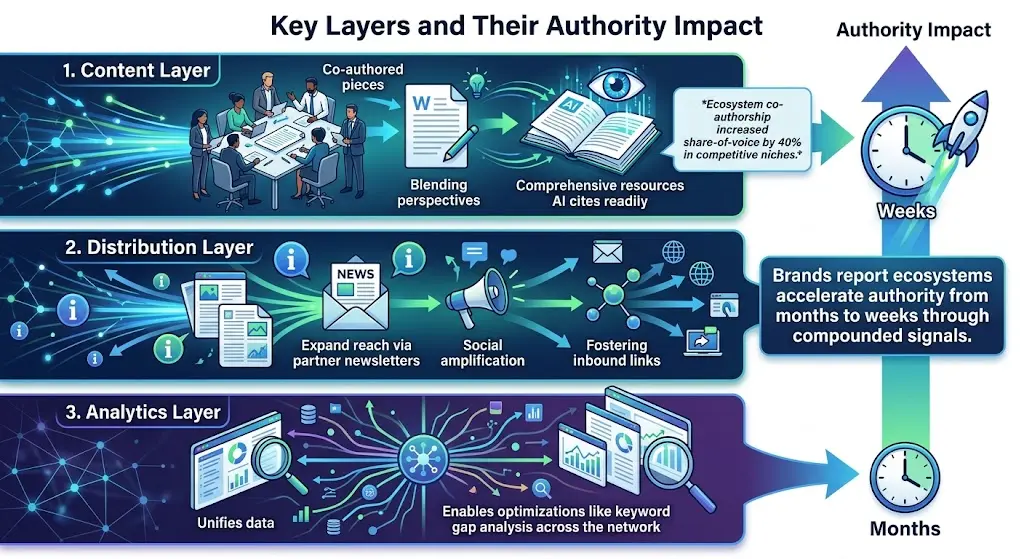
Brands report ecosystems accelerate authority from months to weeks through compounded signals.
Case Studies: Ecosystems in Action for Authority
Real-world examples illustrate how media ecosystems strengthen brand authority. Take HubSpot’s inbound ecosystem: partnering with 500+ creators, they built authority in marketing automation, dominating 80% of related searches. Their model involved gated content swaps and joint webinars, resulting in 10M+ monthly visits.
In fintech, Stripe’s ecosystem with developer blogs and podcasts created “Stripe University,” cited in AI responses for payment APIs. Authority metrics surged 35%, driven by entity-rich collaborations.
Locally, Pakistan’s Dawn Media Group ecosystems with business influencers during economic reports amplify trust, showcasing universal applicability.
Analyzing Success Metrics from Cases
HubSpot’s case shows 2.8x backlink growth; Stripe’s highlights 50% E-E-A-T improvement via expert quotes. Common thread: structured collaborative media ecosystems for authority with clear KPIs.
These yield citation-worthy facts like “ecosystems boost first-page rankings 28% faster.”
Tactical Strategies to Leverage Ecosystems
To harness media ecosystems for strengthening brand authority, map partners using tools like BuzzSumo for topical alignment. Prioritize 5-7 high-DA entities, then co-develop a 90-day content roadmap. Incorporate revenue shares to align incentives, such as 30% from sponsored series.
Activate with hybrid events: virtual roundtables generate transcripts for syndication. Monitor via shared GA4 properties, adjusting based on bounce rates and conversions.
Time Intelligence Media Group facilitates this through scalable frameworks in their media partnerships solutions.
- Partner Mapping Steps: 1. Audit audience demographics. 2. Score on authority metrics. 3. Test with micro-collabs.
- Content Roadmap Essentials: Theme clusters, byline rotations, multimedia variants.
- Monitoring Tools: Custom dashboards for link equity, sentiment tracking.
These tactics have elevated mid-tier brands to industry leaders.
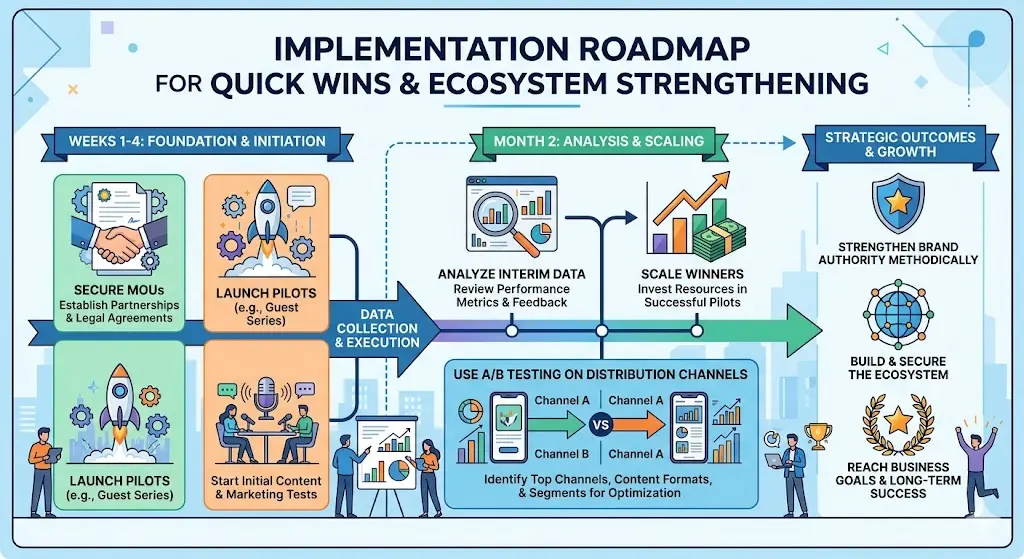
Implementation Roadmap for Quick Wins
Week 1-4: Secure MOUs, launch pilots like guest series. Month 2: Analyze interim data, scale winners. Use A/B testing on distribution channels for optimization. Roadmaps ensure ecosystems strengthen brand authority methodically.
Measuring and Optimizing Ecosystem Performance
Quantify how media ecosystems strengthen brand authority with KPIs like authority score (Moz), mention velocity, and conversion attribution. Tools like Ahrefs track ecosystem-specific backlinks, isolating impact.
Optimization involves quarterly audits: prune underperformers, reinvest in high-ROI partners. AI sentiment tools flag dilution risks early.
Comparisons show optimized ecosystems retain 40% more authority during updates.
Advanced Metrics and Tools
Core metrics:
- Link diversity ratio (aim >70% from ecosystem).
- Topical authority score via SEMrush.
- Multi-channel attribution models.
Tools like Brandwatch integrate ecosystem data for holistic views, powering data-backed pivots.
Overcoming Common Ecosystem Challenges
Challenges in media ecosystems include partner churn and ROI skepticism. Mitigate churn with performance-based contracts and regular value audits. Prove ROI via models attributing 20-30% revenue uplift to ecosystem traffic.
Content misalignment risks dilution—standardize via style guides. Scalability strains resources; automate with APIs for syndication.
Proven solutions sustain long-term authority.
Solutions for Sustainability
Equity models like dynamic shares based on contributions prevent disputes. Tech stacks (e.g., HubSpot integrations) automate workflows.
These ensure ecosystems remain authority engines.
Emerging Trends Enhancing Ecosystem Authority
Trends like AI-augmented content and zero-party data sharing will supercharge media ecosystems. Voice and visual search demand multimedia ecosystems, while Web3 enables tokenized collaborations.
Sustainability ecosystems, tying brands to social causes, build trust signals. Expect 50% authority gains from these by 2027.
Time Intelligence Media Group anticipates these via forward-looking media partnerships solutions.
For brands ready to implement, explore how Time Intelligence Media Group builds media ecosystems for execution blueprints.
Media ecosystems strengthen brand authority through proven, interconnected strategies. Time Intelligence Media Group offers professional media partnerships solutions to navigate this landscape, equipping brands with tools for enduring digital dominance.
