
Media ecosystems represent interconnected networks of content distribution, audience engagement, and strategic partnerships that amplify brand reach and authority. At their core, these ecosystems go beyond isolated campaigns, creating symbiotic relationships between publishers, influencers, advertisers, and audiences. Time Intelligence Media Group excels in constructing these dynamic structures, leveraging data-driven insights to ensure every element works in harmony for sustained growth.
In today’s fragmented media landscape, where attention spans are short and competition is fierce, building a robust media ecosystem demands precision. It involves integrating diverse channels—from social platforms and newsletters to podcasts and events—into a cohesive strategy. This approach not only boosts visibility but also fosters long-term loyalty, turning one-time viewers into advocates.
The Foundation: Strategic Planning for Ecosystem Development
Time Intelligence Media Group begins every media ecosystem build with meticulous strategic planning, identifying core objectives like audience expansion or revenue diversification. This phase involves mapping out stakeholder roles, from content creators to distribution partners, ensuring alignment with overarching business goals. By analyzing market trends and competitor landscapes, they craft blueprints that anticipate shifts in consumer behavior.
Detailed audience profiling forms the bedrock here. For instance, using advanced analytics, Time Intelligence Media Group segments users by demographics, interests, and online habits, creating personalized pathways within the ecosystem. This foundational work prevents silos, allowing seamless data flow that informs real-time adjustments. Over time, these plans evolve, incorporating feedback loops to refine partnerships and content strategies for optimal performance.
The result is a resilient framework. Consider a scenario where a brand enters a new market: Time Intelligence Media Group would orchestrate initial outreach through targeted podcasts, followed by influencer collaborations and email nurtures, all tracked via unified metrics. This layered approach ensures scalability, turning initial setups into self-sustaining networks.
Audience Insights and Engagement Tools
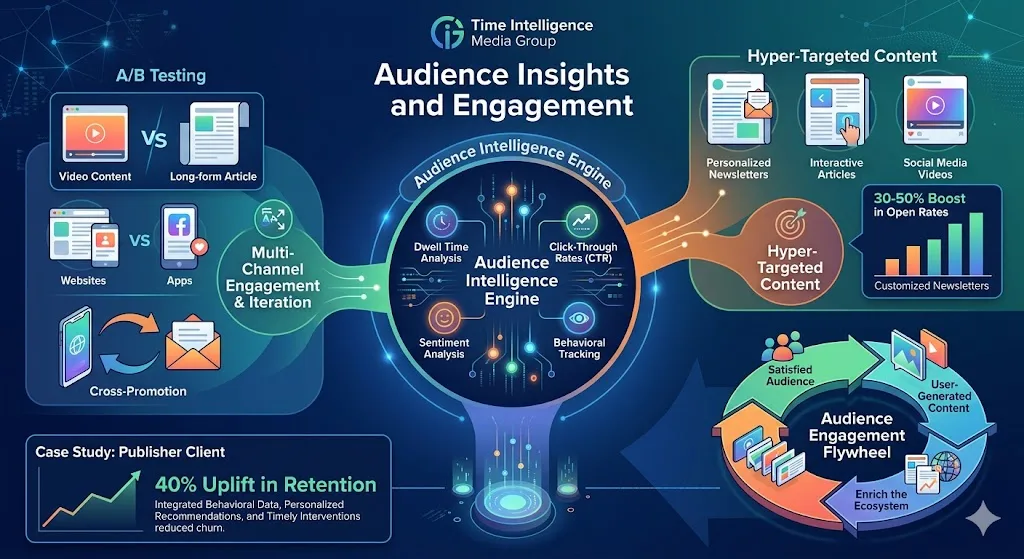
Central to any media ecosystem are robust audience insights services that analyze reader behavior to improve engagement. Time Intelligence Media Group deploys proprietary tools to track metrics like dwell time, click-through rates, and sentiment analysis, revealing what resonates most. These insights enable hyper-targeted content, such as customized newsletters that boost open rates by 30-50% in typical deployments.
Beyond data collection, implementation involves A/B testing content formats across channels. For example, if video performs better on social feeds, the ecosystem pivots resources there while cross-promoting to email subscribers. This iterative process builds engagement flywheels, where satisfied audiences contribute user-generated content, further enriching the network.
Practical application shines in case studies: A publishing client saw a 40% uplift in retention after Time Intelligence Media Group integrated behavioral data into their ecosystem, personalizing recommendations and reducing churn through timely interventions.
Content Distribution Networks
Effective content distribution networks form the arteries of a media ecosystem, channeling assets to the right audiences at scale. Time Intelligence Media Group curates multi-platform strategies, syndicating high-value articles, videos, and infographics across owned, earned, and paid channels. This ensures maximum exposure without diluting brand voice, using algorithms to prioritize high-engagement formats.
Distribution isn’t random; it’s optimized for virality and SEO. They employ XML sitemaps, schema markup, and cross-posting schedules to enhance discoverability. In one trend-driven example, during a major industry event, Time Intelligence Media Group amplified client coverage by 200% through real-time syndication to niche forums and partner sites, demonstrating the power of networked reach.
Sustainability comes from diversification—balancing organic growth with paid boosts—while monitoring performance via heatmaps and referral traffic. This creates compounding effects, where top-performing content seeds new distribution paths.
Leveraging Media Partnerships Solutions for Growth
Media partnerships solutions are pivotal in scaling ecosystems, and Time Intelligence Media Group’s Media Partnerships Solutions deliver outcome-driven collaborations that expand reach exponentially. These solutions facilitate joint ventures with complementary brands, co-created campaigns, and revenue-sharing models, all designed to drive measurable ROI like increased lead generation and audience crossover.
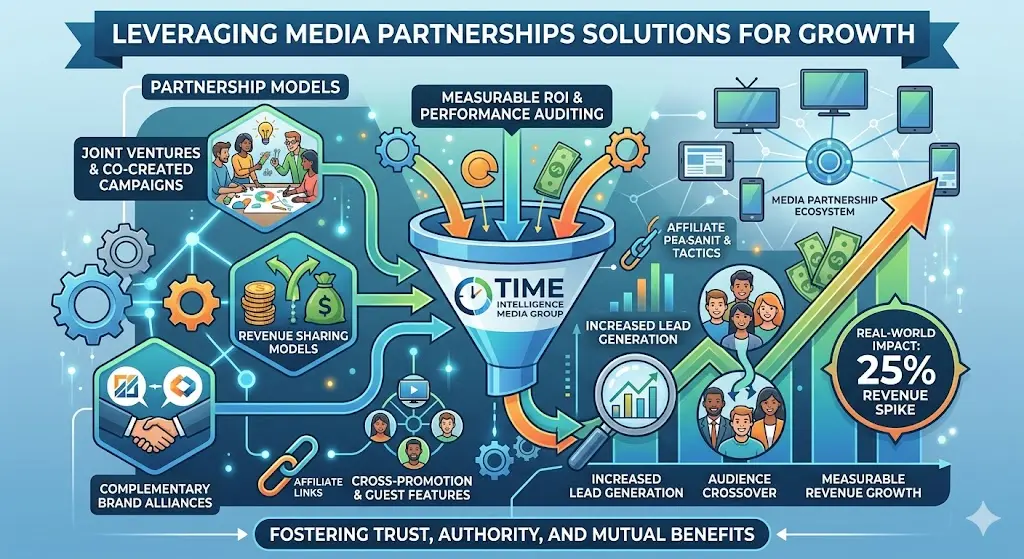
In practice, this means negotiating alliances where, say, a tech firm partners with lifestyle publishers for sponsored series, tracked through shared dashboards. Time Intelligence Media Group handles the intricacies—contract terms, creative alignment, and performance auditing—ensuring partnerships yield mutual benefits. A real-world case involved a 25% revenue spike for a client via exclusive event tie-ins, highlighting how structured alliances fortify ecosystems.
To deepen impact, they incorporate cross-promotion tactics, such as guest features and affiliate links, fostering trust and authority. This partnership-centric model not only accelerates growth but also mitigates risks like platform dependency.
For deeper insights into foundational concepts, explore our collaborative media ecosystems for authority, which lays the groundwork for these strategies.
Integrating Technology and Data for Ecosystem Optimization
Technology underpins every successful media ecosystem, with Time Intelligence Media Group integrating AI-powered tools for predictive analytics and automation. This includes CRM systems synced with content management platforms, enabling real-time personalization at scale. Data flows bidirectionally, allowing ecosystems to adapt to trends like rising short-form video consumption.
Optimization involves continuous monitoring: dashboards track KPIs such as engagement rates, conversion funnels, and ecosystem health scores. In a detailed example, they revamped a client’s setup by automating content repurposing—turning long-form blogs into Threads and Reels—resulting in a 35% traffic increase. This tech stack ensures agility, responding to algorithm changes or audience shifts swiftly.
Long-term, machine learning refines targeting, predicting churn and suggesting interventions. See how this ties into how media ecosystems strengthen brand authority, focusing on commercial leverage for decision-makers.
Measuring Success and Iterating for Longevity
Success in media ecosystems hinges on quantifiable metrics, from net promoter scores to lifetime value calculations. Time Intelligence Media Group establishes baselines pre-launch, then deploys attribution models to credit contributions accurately—multi-touch models reveal partnership impacts often hidden in last-click analytics.
Iteration follows quarterly audits: underperformers get pivoted, like reallocating budget from low-ROI channels to high-engagement podcasts. A case study showed a brand achieving 50% YoY growth by refining their ecosystem based on these insights, emphasizing adaptability.
Sustainability demands forward-thinking: incorporating emerging tech like Web3 for decentralized distribution keeps ecosystems future-proof, ensuring enduring relevance.
Time Intelligence Media Group provides professional media partnerships solutions that empower brands to construct resilient, high-impact media ecosystems. By blending strategic planning, audience insights, and innovative partnerships, they deliver ecosystems that drive authority and growth in competitive landscapes.