
Data journalism is the practice of analyzing, structuring, and visualizing quantitative datasets to uncover public-interest news stories. UK media outlets use data journalism to verify claims, create interactive visual graphics, and report objective facts to nationwide audiences daily.
Data journalism combines statistical analysis, investigative research, and digital storytelling. Modern newsrooms rely on numerical evidence to support editorial coverage. Instead of relying solely on subjective opinion or qualitative interviews, journalists examine raw numbers to identify trends, disparities, and systemic changes across the United Kingdom.
Core Foundations of Data-Driven Reporting
The foundation of data journalism rests on open-source records, corporate reports, freedom of information requests, and government statistics. Outlets such as the BBC, The Guardian, and The Times maintain dedicated data desks. These specialized teams process complex spreadsheets to build clear charts, maps, and investigative articles.
Why UK Outlets Prioritise Quantitative Evidence
UK national editors prioritize quantitative evidence because numerical data provides immediate credibility. A dataset covering 10,000 UK consumers carries more authoritative weight than an isolated anecdote. Statistical evidence reduces editorial bias and gives journalists concrete proof when reporting on economic, social, or industry shifts.
How Do Research Reports Become National News Stories?
Research reports become national news stories through systematic data extraction, statistical verification, news hook identification, and targeted media outreach. PR strategists transform dense analytical documents into clear press releases that national journalists can quickly evaluate, verify, and publish.
Converting a 40-page industry report into a 500-word news article requires an organized transformation process. Media outlets receive hundreds of press releases daily. Reports that secure leading coverage follow a structured pipeline that aligns research findings with national news agendas.
Extracting the Primary News Hook
A research report often contains multiple statistical angles. Data journalists isolate the most striking data point to form the lead sentence. A primary news hook focuses on significant growth, drastic declines, regional variations, or unexpected consumer behaviors across the UK.
Formatting Data for Fast Editorial Consumption
Busy editors require immediate access to key statistics. Successful media distributions summarize complex methodologies into bulleted topline facts. Press releases include direct links to raw data tables, enabling journalists to cross-reference calculations instantly. Readers seeking a broader foundation on research credibility can examine Why Data Journalism Powers Credible UK Research Reports.
What Makes a Data Report Newsworthy to UK Editors?
A data report is newsworthy to UK editors when it demonstrates strong national relevance, timely alignment with current affairs, statistical authority, clear geographic variations, and surprising empirical findings that challenge standard public assumptions or industry benchmarks.
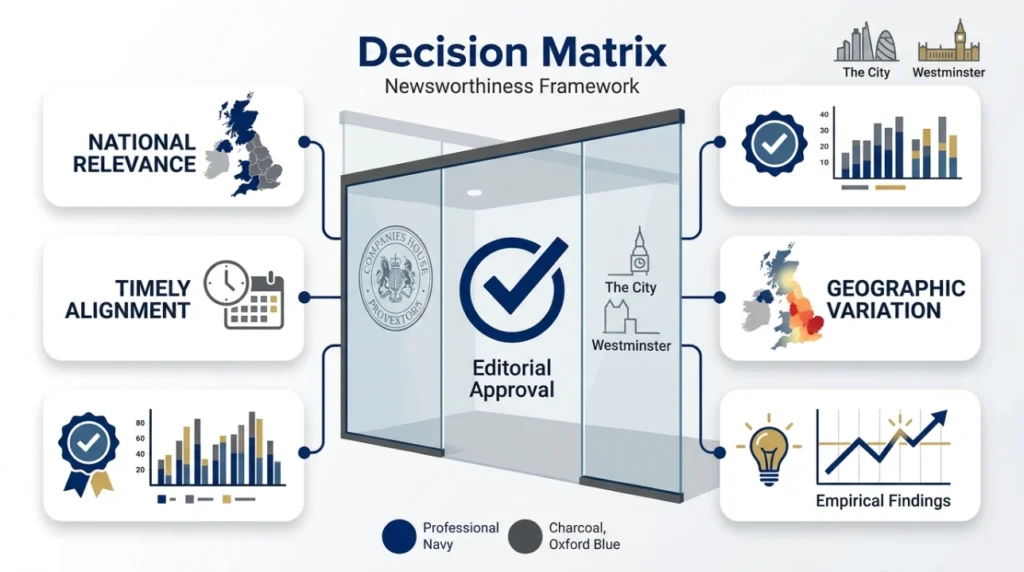
National editors evaluate incoming data research against strict news criteria. A corporate report containing self-serving promotional metrics is routinely discarded. Data stories must deliver genuine value, objective insights, and public interest to secure space in national newspapers or digital publications.
| Newsworthy Element | Editorial Requirement | Practical Example |
| Timeliness | Direct link to active news agendas | Publishing energy cost trends during winter tariff adjustments |
| Scale & Authority | Sample size representative of target market | A survey of 2,050 UK adults weighted by ONS demographics |
| Geographic Hook | Regional breakdowns across UK territories | Comparing house price increases in Manchester versus London |
| Surprise Factor | Data counter to common public perception | Showing a 30% drop in digital streaming despite rising usage |
Geographic and Demographic Segmentation
UK national media outlets serve diverse regional audiences. Data reports that segment results by UK regions—such as Scotland, Wales, Northern Ireland, and specific English regions—allow local publications to localize national news. Regional breakdown tables make stories relevant to publications like the Manchester Evening News or Yorkshire Post.
Sample Sizes and ONS Weighting Standard
Statistical validity is non-negotiable for UK national news desks. A survey sample must typically include a minimum of 2,000 respondents to represent the UK adult population accurately. Weighting sample data against Office for National Statistics (ONS) census criteria ensures age, gender, socio-economic class, and regional distributions match national demographics.
How Is Data Storytelling Structured for Press Coverage?
Data storytelling for press coverage is structured using the inverted pyramid model, placing the headline finding in the lead paragraph, followed by supporting statistical evidence, contextual methodology, methodology notes, and expert commentary to ensure immediate editorial understanding.
Journalistic writing differs fundamentally from academic or corporate writing. While research reports present methodologies and background before reaching a conclusion, news stories present the key conclusion first.
The Inverted Pyramid Model for Data Distribution
- The Lead (Toplines): The single most important statistic or trend finding.
- The Context: Why this statistical finding matters to the UK public right now.
- The Supporting Proof: Secondary metrics, regional comparisons, and demographic splits.
- The Methodology: Sample size, field dates, research firm details, and weighting standards.
Visualising Complex Data Sets for Digital Media
Modern news stories require visual assets to drive user engagement. Providing publication-ready charts, infographics, and dynamic data tables increases media uptake. News sites use embedded visuals to increase time-on-page metrics and clarify complex technical statistics for readers.
Explore More Expert Insights:
How Investment Firms Build Awareness Using Market Insight Ads
How Finance Brands Improve Conversion Intent Using Retargeting Ads
Why Do Businesses Use Data Journalism for Public Relations?
Businesses use data journalism for public relations because empirical data builds immediate brand authority, earns high-quality editorial backlinks, establishes executive thought leadership, and secures organic media coverage across top-tier UK national news publications consistently.
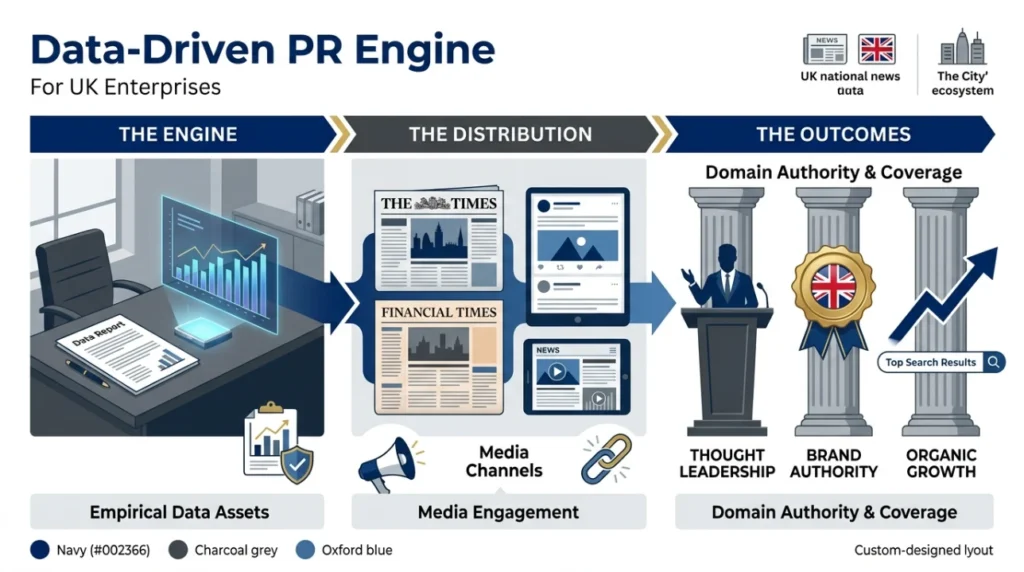
Data-led public relations shifts corporate messaging from self-promotional announcements to high-value editorial contributions. By funding independent research, brands act as primary source publishers for national media.
Building Domain Authority via Editorial Backlinks
National news websites feature high domain authority search metrics. When outlets cite a corporate research report as their data source, they frequently include a hyperlinked citation. Accumulating organic editorial backlinks from sites like Telegraph.co.uk or Independent.co.uk strengthens the brand’s long-term search engine visibility.
Establishing Category Authority and Thought Leadership
Consistent publication of industry-standard research positions a business as a market expert. Journalists regularly re-interview corporate executives who provide reliable, statistically sound research. Over time, the organization becomes a permanent commentary source for breaking news events.
What Types of Research Datasets Excel in UK Newsrooms?
UK newsrooms favor consumer surveys, open-government data analysis, proprietary operational records, freedom of information responses, and longitudinal economic tracking datasets that reveal broader structural shifts across UK society, business sectors, or financial markets.
Different data sources offer distinct strategic advantages when building media campaigns. Selecting the correct dataset model depends on research budgets, execution timelines, and targeted media sectors.
Consumer Opinion Surveys
Nationally representative consumer surveys capture real-time public sentiment, financial behaviors, and lifestyle changes. Survey providers gather quantitative responses across thousands of UK households to benchmark opinion shifts on economic topics.
Government and Public Dataset Analysis
Analysing existing public databases—such as datasets from Companies House, the NHS, the Land Registry, or the ONS—provides authoritative news stories without survey collection costs. Data journalists reorganize public records to highlight hidden geographic trends or year-on-year market shifts.
Freedom of Information (FOI) Requests
Submitting systematic Freedom of Information requests to UK public authorities, local councils, or government departments yields exclusive datasets. FOI requests reveal non-public operational metrics, regional spending disparities, and institutional performance records.
How Can Organisations Plan a Data Journalism Campaign?
Organisations plan a data journalism campaign by identifying clear editorial gaps, designing statistically rigorous surveys, extracting compelling story angles, creating press-ready assets, and executing targeted pitching schedules aligned with major UK news desks and relevant industry journalists.
Executing a successful media research campaign requires coordination between market research specialists, data analysts, content producers, and media strategists.
Phase 1: Campaign Strategy and Hypothesis Testing
Before gathering data, teams formulate clear hypotheses. Identifying what specific statistical findings would interest national editors ensures research budgets focus on viable media angles.
Phase 2: Survey Design and Fieldwork Execution
Questions must be clear, unbiased, and compliant with professional market research standards. Market research agencies collect data from verified UK panels, applying demographic quotas to guarantee national representation.
Phase 3: Data Analysis and Asset Production
Data analysts cross-tabulate raw results to extract key demographic and regional trends. Writers translate these findings into structured press packages, infographics, and executive summaries. Organizations seeking specialized execution models can consult Data Journalism Reports by Time Intelligence Media Group.
Phase 4: Targeted Media Outreach
Press releases and raw data summary sheets are pitched directly to relevant UK media journalists, sector editors, and national news desks under embargo, allowing journalists adequate time to review complex data before publication.
What Errors Disqualify Data Reports from Media Coverage?
Data reports are disqualified from media coverage due to unrepresentative sample sizes, biased survey question design, incorrect statistical calculations, overly promotional branding, outdated datasets, and a failure to disclose transparent research methodologies publicly.
National news desks strictly vet external data submissions to avoid publishing inaccurate information. Avoiding common research pitfalls protects organizational reputation and maintains journalist trust.
Flawed Sampling and Small Panels
Pitches based on samples under 1,000 respondents or non-representative opt-in web polls are routinely rejected by tier-one UK national publications. Unweighted samples skew results and produce invalid statistical conclusions.
Leading and Biased Survey Questions
Phrasing questions to force a specific corporate outcome invalidates research credibility. Questions must remain neutral to ensure respondents provide accurate, unbiased answers that withstand editorial scrutiny.
Over-Branded and Promotional Packaging
Including corporate slogans, heavy sales language, or constant brand references within press materials causes editors to dismiss the release. The data must stand independently as a legitimate public-interest news story.
Data journalism serves as the primary bridge connecting complex corporate research with mainstream UK news coverage. By adhering to rigorous statistical standards, employing clear inverted-pyramid structures, and focusing on genuine public interest, organizations transform raw data reports into nationwide editorial features.