Festival organisers compete for audience attention months before an event opens. A structured press distribution strategy helps organisers place announcements in relevant media, build public awareness, and encourage consistent ticket sales throughout the campaign. Instead of relying on isolated announcements, an organised distribution plan aligns news releases with marketing milestones, audience interests, and seasonal media opportunities.
A press distribution strategy defines when, where, and how festival news reaches journalists, trade publications, regional media, entertainment outlets, and digital publishers. For UK festivals, effective planning combines local relevance with national exposure while supporting wider marketing activity across search, social media, email, and partnerships.
Businesses exploring broader credibility-building techniques can also review:
How Under-the-Radar Hospitality Brands Build Credibility Against Massive International Chains for additional strategic context.
Why does a press distribution strategy influence festival ticket sales?
A structured press distribution strategy increases media visibility, builds audience awareness, creates repeated buying opportunities, supports search visibility, and maintains public interest throughout the ticket sales cycle using scheduled announcements that match campaign objectives and festival milestones across multiple media channels.
Press coverage introduces festivals to audiences beyond paid advertising. Every published announcement expands reach through news websites, regional publications, entertainment magazines, radio stations, and online event calendars.
Media coverage also supports trust. Audiences regularly compare several festivals before purchasing tickets. Independent news coverage provides additional information that advertising alone does not deliver.
Festival promotion normally follows several stages:
- Initial festival announcement
- Early bird ticket launch
- Artist announcements
- Headliner announcements
- Experience updates
- Sponsor announcements
- Sustainability initiatives
- Final event reminders
Each announcement creates another opportunity for ticket sales.
How does repeated media exposure support ticket purchases?
Most attendees purchase after multiple interactions with an event. A visitor who sees an artist announcement in a regional newspaper, another feature in an entertainment publication, and a reminder through online news receives several purchase prompts during the buying journey.
Consistent press activity maintains visibility between paid advertising campaigns.
What objectives define an effective festival press distribution strategy?
An effective strategy establishes measurable objectives including audience reach, media placement quality, regional visibility, ticket conversion support, website traffic growth, search performance improvement, and long-term festival reputation before selecting distribution channels or publication schedules across the campaign timeline.
Every distribution campaign starts with clear objectives.
Common objectives include:
- Increase early bird ticket sales by 20%
- Generate coverage across 50 UK regional publications
- Secure entertainment publication features
- Increase branded search traffic
- Improve organic search visibility
- Support sponsor visibility
- Build anticipation before headline announcements
These objectives determine both media selection and campaign timing.
Which audience groups require different messaging?
Different audiences respond to different festival announcements.
Examples include:
- Music fans seek artist announcements.
- Families seek activity updates.
- Food enthusiasts seek chef line-ups.
- Local residents seek community information.
- Tourists seek accommodation partnerships.
- Sponsors seek attendance growth.
- Journalists seek newsworthy developments.
Each release addresses one primary audience rather than every audience simultaneously.
How does campaign timing affect ticket sales?
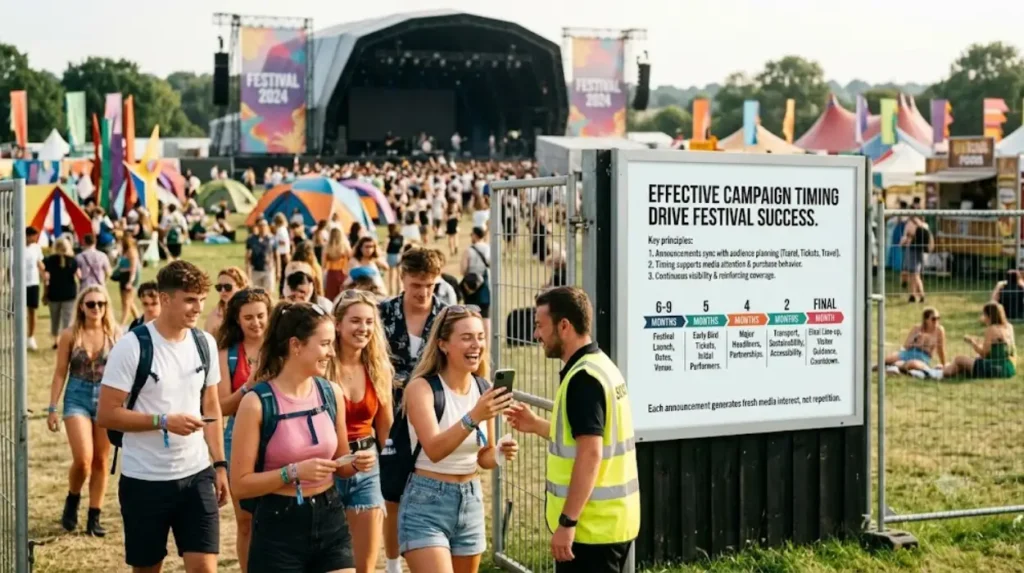
Campaign timing ensures festival announcements appear when audiences actively plan attendance, purchase tickets, arrange travel, and consume entertainment news, allowing each press release to reinforce previous coverage while maintaining continuous public attention before the event begins.
Timing determines whether media attention supports purchasing behaviour.
A typical UK festival campaign extends across six to nine months.
Example campaign timeline
Six to nine months before
- Festival launch
- Venue confirmation
- Dates announcement
Five months before
- Early bird tickets
- Initial performers
Four months before
- Major headliners
- Partnership announcements
Three months before
- Food vendors
- Experiences
- Attractions
Two months before
- Transport information
- Sustainability programme
- Accessibility improvements
Final month
- Final line-up
- Visitor guidance
- Countdown campaign
Each announcement creates fresh media interest rather than repeating previous information.
Which media channels support festival promotion most effectively?
Festival campaigns combine regional newspapers, national media, entertainment publications, music websites, tourism platforms, radio stations, event calendars, trade publications, and digital news platforms because different audiences consume information through different trusted media sources across the purchasing journey.
No single publication reaches every potential attendee.
A balanced strategy combines multiple media categories.
Regional media
Regional newspapers attract local attendees.
Examples include city news websites, county newspapers, and regional broadcasters.
National entertainment media
Entertainment publications expand awareness nationally.
Examples include music news websites, arts magazines, and culture publications.
Tourism publications
Travel-focused media attract visitors planning weekend breaks or holidays around festivals.
Trade publications
Industry publications strengthen credibility among sponsors, performers, suppliers, and event professionals.
Combining these channels produces broader market coverage.
What information belongs in every festival press release?
Every festival press release contains verified information, clear headlines, factual event details, ticket availability, organiser quotations, supporting statistics, media contacts, and structured formatting that enables journalists to publish accurate stories without unnecessary clarification or additional research.
Journalists prioritise clear, factual information.
Every release includes:
- Festival name
- Event dates
- Venue
- Ticket information
- Confirmed announcements
- Organiser quotation
- Supporting facts
- Contact details
Each announcement focuses on one primary story.
Which announcements generate stronger coverage?
Newsworthy announcements include:
- International headline performers
- Charity partnerships
- Record attendance projections
- Sustainability initiatives
- Economic impact studies
- Community programmes
- New attractions
- Technology innovations
For example, announcing a new renewable energy initiative provides a different story from announcing additional performers.
Distinct news angles support repeated coverage.
How does press distribution support search visibility?
Press distribution strengthens search visibility by increasing authoritative references, expanding branded content across trusted publications, improving discoverability for festival-related searches, and reinforcing consistent event information published across multiple recognised online media platforms throughout campaign activity.
Modern festival promotion depends on both media visibility and search visibility.
Published articles introduce additional indexed content across trusted websites.
Search engines identify repeated references to:
- Festival name
- Event location
- Artists
- Ticket launches
- Event dates
Consistent information strengthens search relevance.
Why does consistent messaging matter?
Consistent event information reduces confusion.
Every publication uses identical facts including:
- Dates
- Venue
- Ticket links
- Artist names
- Event branding
Accurate information supports audience confidence and improves online discoverability.
How can organisers measure press distribution performance?
Performance measurement combines media coverage, audience engagement, referral traffic, search visibility, ticket sales patterns, publication quality, campaign reach, and announcement timing to evaluate how effectively press activity contributes to commercial festival objectives throughout the promotional period.
Press activity requires measurable outcomes.
Useful metrics include:
- Number of media placements
- Publication authority
- Regional coverage
- Website referral traffic
- Ticket sales after announcements
- Branded search growth
- Media enquiries
- Social sharing
Comparing these metrics after each announcement identifies successful campaign stages.
Which metrics connect directly with ticket sales?
Useful commercial indicators include:
- Daily ticket purchases
- Early bird sales
- Website sessions
- Conversion rate
- Returning visitors
- Geographic demand
- Average order value
Tracking performance after each release shows which stories generate the strongest audience response.
What common mistakes reduce festival press distribution effectiveness?
Common mistakes include irregular communication, repetitive announcements, inaccurate information, poor timing, limited regional targeting, weak media relationships, inconsistent messaging, and measuring publication quantity instead of meaningful audience engagement and commercial campaign performance.
Many campaigns lose momentum because communication becomes inconsistent.
Common mistakes include:
- Publishing every announcement simultaneously
- Repeating identical messages
- Ignoring regional media
- Delaying artist announcements
- Sending incomplete information
- Missing seasonal news opportunities
- Failing to measure campaign outcomes
Each mistake reduces long-term visibility.
How does planning improve campaign consistency?
A structured communications calendar organises every announcement before ticket sales begin.
Planning includes:
- Release dates
- Approval deadlines
- Media targets
- Supporting assets
- Performance reviews
This approach reduces rushed communication while maintaining consistent media visibility.
Organisations evaluating specialist support for campaign planning can compare available approaches through:
Time Intelligence Media Group Service Guide: Custom PR Distribution for Entertainment Disrupters.
How can organisers build a complete festival press distribution strategy?

A complete strategy integrates campaign objectives, audience segmentation, media targeting, announcement scheduling, search optimisation, performance measurement, and continuous refinement into one coordinated communication programme that supports ticket sales from launch until the festival concludes successfully.
Successful strategies treat press distribution as an ongoing campaign rather than a single announcement.
A complete workflow includes:
- Define commercial objectives.
- Identify audience groups.
- Build a campaign calendar.
- Prepare multiple news angles.
- Select appropriate media categories.
- Schedule distribution.
- Monitor coverage.
- Measure ticket sales impact.
- Review campaign performance.
- Refine future announcements using collected data.
This structured approach creates continuous public awareness throughout the festival lifecycle.
Explore More Expert Insights:
Timing Your Campaign: How to Synchronize Press Releases with Seasonal Tourism and Event Calendars
How to Build a Digital Press Kit That Captures the Attention of Top Food and Travel Journalists
Designing a press distribution strategy to maximise ticket sales for upcoming festivals requires structured planning, consistent communication, and measurable objectives. Effective campaigns deliver multiple newsworthy announcements instead of relying on a single launch release. They align media outreach with ticket sales milestones, target relevant audience groups, maintain consistent event information, and measure performance throughout the promotional period.
For UK festival organisers, press distribution works most effectively when integrated with wider marketing activity, search visibility efforts, and audience engagement strategies. A planned sequence of timely announcements strengthens media presence, supports informed purchasing decisions, and maintains public interest from the initial launch through the final countdown to the event.