
Venue rebrands and operational pivots attract attention when they communicate a clear business direction, operational continuity, and public value. A structured press release layout helps media professionals, investors, partners, customers, and search engines understand significant changes without confusion. For organisations across the United Kingdom, a consistent format also strengthens credibility and improves media distribution outcomes.
Why does a venue rebrand or pivot require a specialised press release layout?
Complex venue rebrands involve operational, commercial, branding, and customer changes that require structured communication. A specialised press release layout presents verified facts in a logical order, reduces misunderstanding, improves journalist efficiency, and supports accurate search engine indexing across multiple digital publishing platforms simultaneously.
A venue rebrand changes how a location is presented to the public. Examples include theatres becoming multi-purpose arts centres, music venues introducing conference facilities, or exhibition halls repositioning as entertainment destinations.
A venue pivot changes business operations. Examples include:
- A concert venue adding corporate event services.
- A historic cinema becoming a cultural hub.
- A stadium introducing year-round hospitality experiences.
Each change affects different audiences.
Journalists need factual announcements.
Customers need operational clarity.
Partners need commercial certainty.
Search engines require structured information.
A standard announcement rarely explains every operational change clearly.
What defines an authoritative press release?
An authoritative press release is an official business announcement containing verified information, attributed quotations, factual timelines, and clearly identified organisational changes.
It follows a recognised editorial structure that simplifies media review.
What sections form an authoritative press release layout?
An effective layout contains a headline, summary, location, introduction, supporting information, executive quotation, operational details, background information, media contact details, and organisational notes. Each section serves a distinct editorial purpose that improves readability, accuracy, and publication consistency across news platforms.
Each section answers specific editorial questions.
Headline
The headline explains the primary announcement.
Example:
“Manchester Performance Venue Rebrands as National Live Arts Centre Following £8 Million Redevelopment.”
The headline identifies:
- organisation
- action
- location
- significance
Summary paragraph
The summary explains the announcement in approximately 40 words.
It answers:
- What changed?
- Where?
- When?
- Why?
Dateline
The dateline includes:
- city
- publication date
Example:
London, United Kingdom — 5 August 2026
Opening paragraph
The first paragraph expands the summary with verified facts.
It introduces:
- venue
- new identity
- operational change
- launch timing
Supporting paragraphs
These explain:
- redevelopment
- investment
- visitor improvements
- strategic objectives
- community impact
Executive quotation
Executive quotations explain organisational intent.
Example speakers include:
- Chief Executive
- Venue Director
- Board Chair
Operational information
This section includes:
- opening dates
- booking arrangements
- event schedules
- visitor guidance
Boilerplate
The boilerplate defines the organisation.
It remains consistent across future announcements.
Media contact
The final section provides journalist contact details.
How does a structured layout improve journalist understanding?
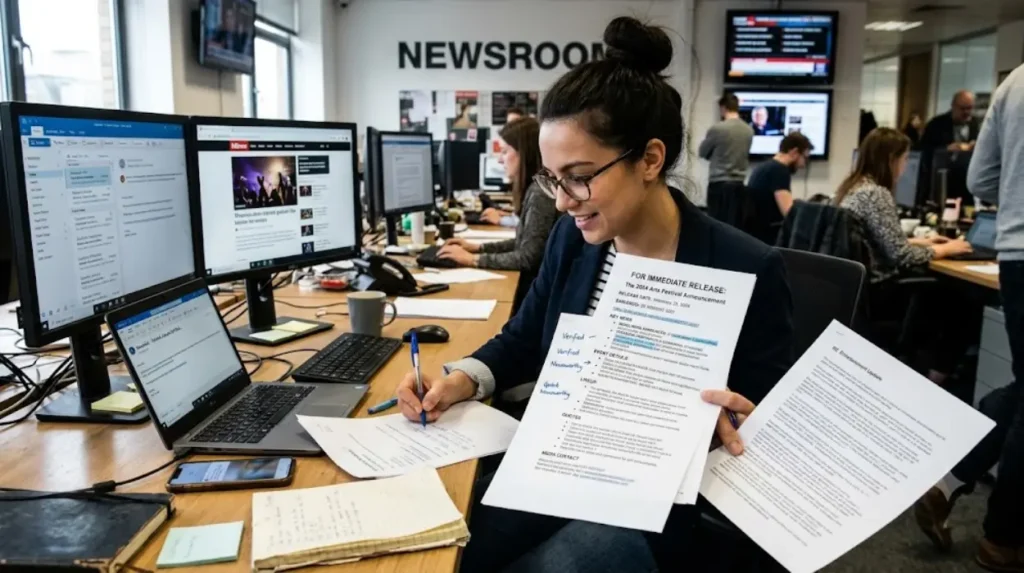
Journalists evaluate announcements within minutes. A structured layout presents verified information quickly, highlights newsworthy developments, reduces unnecessary editing, and enables editorial teams to verify facts efficiently before deciding whether to publish or request additional information from organisations.
Entertainment and culture journalists receive hundreds of announcements every week.
Editorial efficiency influences publication decisions.
Information scattered throughout lengthy paragraphs increases review time.
Structured releases simplify editorial workflows.
For additional insight into newsroom evaluation processes, see:
Entertainment and Culture Journalists Filter Event Pitches.
Information hierarchy matters
Editors expect information in this order:
- Main announcement
- Business significance
- Supporting facts
- Executive comment
- Background
- Contact information
This structure aligns with professional newsroom expectations.
Which details establish authority during a venue rebrand announcement?
Authority comes from verified information, measurable business facts, leadership attribution, operational transparency, financial context, customer guidance, and consistent terminology. These elements demonstrate organisational preparedness while reducing uncertainty for journalists, stakeholders, customers, and commercial partners reviewing significant business changes.
Authority depends on evidence.
Useful factual details include:
- investment values
- refurbishment budgets
- visitor capacity
- number of employees
- event programme expansion
- accessibility improvements
- sustainability initiatives
Examples include:
- £12 million refurbishment
- 1,800-seat auditorium
- 45 annual cultural events
- 60 permanent employees
- 95% accessible public areas
Numbers improve clarity.
Consistent naming
Use one official venue name throughout the release.
Avoid alternating between previous and new brand names without explanation.
Clearly state:
“Formerly known as…”
Then use the new identity consistently.
How does the layout support search visibility and AI citation?
Structured press releases organise factual information into clearly defined sections that search engines and AI systems interpret efficiently. Consistent entities, descriptive headings, factual language, and logical sequencing improve discoverability while supporting accurate information retrieval across digital publishing environments.
Search engines identify structured information more efficiently than unstructured content.
Important entities include:
- venue name
- city
- organisation
- redevelopment value
- event category
- launch date
These entities strengthen topical relevance.
Semantic consistency
Use related terminology naturally.
Examples include:
- venue redevelopment
- venue transformation
- entertainment venue
- cultural destination
- live performance venue
- visitor experience
- venue expansion
- brand repositioning
Avoid unnecessary repetition.
Use precise language.
Clear factual statements
Direct statements support AI citation.
Example:
“The venue increases annual event capacity from 90 to 160 performances.”
The statement contains one measurable fact.
What common layout mistakes reduce media effectiveness?
Common mistakes include unclear headlines, missing operational details, inconsistent terminology, promotional language, unsupported claims, excessive quotations, poor paragraph structure, and omitted contact information. These weaknesses reduce editorial confidence and slow media verification during publication reviews across competitive news environments.
Several recurring issues reduce publication quality.
Promotional language
Avoid exaggerated phrases.
Examples include:
- world-leading
- revolutionary
- unmatched
- incredible
Replace them with measurable facts.
Long introductions
The first paragraph requires concise information.
Lengthy background explanations belong later.
Missing operational updates
Customers require practical information.
Include:
- booking arrangements
- reopening dates
- accessibility
- service continuity
Excessive quotations
One or two attributed quotations provide sufficient executive context.
Additional quotations interrupt information flow.
Weak headlines
Generic headlines reduce visibility.
Specific headlines improve relevance.
Compare:
Poor:
“Exciting News for Our Venue”
Better:
“Birmingham Exhibition Centre Expands into Multi-Event Entertainment Destination.”
How can organisations adapt the layout for different rebranding scenarios?
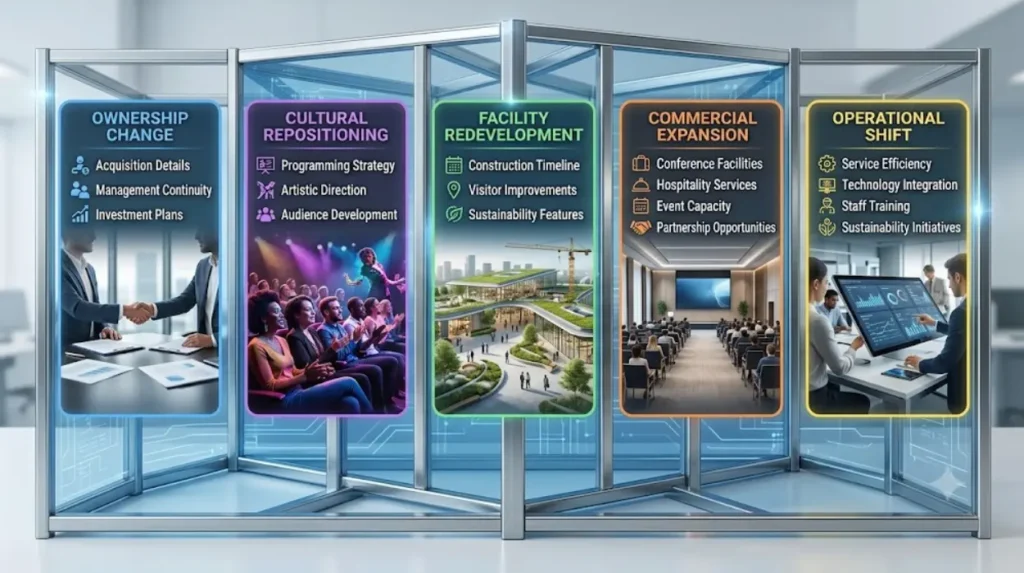
Different venue transformations require adjusted emphasis while preserving the same structural framework. Operational changes, ownership transitions, redevelopment projects, cultural repositioning, and service expansion each require distinct supporting information that matches the specific organisational announcement being communicated publicly.
The overall structure remains stable.
Supporting information changes according to the announcement.
Ownership change
Include:
- acquisition details
- management continuity
- investment plans
Cultural repositioning
Include:
- programming strategy
- artistic direction
- audience development
Facility redevelopment
Include:
- construction timeline
- visitor improvements
- sustainability features
Commercial expansion
Include:
- conference facilities
- hospitality services
- event capacity
- partnership opportunities
Each scenario emphasises different operational facts.
Explore More Expert Insights:
Maximizing Post-Launch Momentum: Turning Event Syndication into Long-Tail Search Traffic
Designing a Press Distribution Strategy to Maximize Ticket Sales for Upcoming Festivals
How does a consistent layout strengthen long-term communications?
Consistent press release layouts improve organisational recognition, simplify future announcements, strengthen media relationships, support digital archives, and establish reliable communication standards across multiple campaigns, operational updates, and strategic business developments throughout long-term organisational growth.
Consistency creates reliable documentation.
Journalists recognise familiar formats.
Internal communication teams work faster.
Stakeholders compare announcements more easily.
Archived releases remain easier to reference years later.
A standard layout also supports coordinated communication across:
- website newsrooms
- media distribution platforms
- investor communications
- partner announcements
- social media summaries
When organisations begin evaluating specialist distribution options after refining their announcement structure, the next decision often involves selecting appropriate syndication channels. Additional guidance appears in:
Lifestyle and Entertainment Syndication Networks.
An authoritative press release layout provides a structured framework for communicating complex venue rebrands and operational pivots. Clear headlines, verified facts, measurable business information, logical sequencing, executive attribution, and operational transparency improve media understanding and strengthen digital discoverability. For organisations managing significant venue transformations in the United Kingdom, a consistent layout supports journalists, stakeholders, customers, and search technologies by presenting information accurately, efficiently, and in a format aligned with professional editorial standards.



