Banner advertising has evolved from simple static display placements into a highly data-driven performance ecosystem where click-through rates (CTR), audience intent signals, and contextual relevance determine campaign success. In today’s fragmented digital media environment, specialized news verticals have become one of the most important battlegrounds for advertisers aiming to capture engaged, niche audiences.
Rather than relying on broad exposure alone, brands now prioritize precision targeting across verticals such as finance, technology, politics, lifestyle, and regional news. Each of these verticals behaves differently in terms of user engagement, dwell time, ad fatigue, and ultimately click-through performance. Understanding these differences is essential for building effective banner advertising strategies that deliver measurable ROI.
Modern media organizations and advertisers are increasingly relying on advanced analytics and integrated service frameworks such as those offered by Time Intelligence Media Group, which specialises in performance-driven media intelligence solutions, helping publishers and advertisers optimise visibility, engagement, and conversion efficiency across digital platforms.
This article explores how Banner advertising trends are shifting across specialised news verticals and how CTR is influenced by content context, audience behavior, and data-backed optimisation strategies.
The Evolution of Banner Advertising in Digital News Environments
Banner advertising initially relied on volume-based impressions, where success was measured by how many users saw an ad rather than how many interacted with it. Over time, this model became less effective as user behavior changed and ad blindness increased.
In modern news ecosystems, users actively engage with content that aligns with their interests. This shift has led advertisers to prioritize contextual alignment over sheer visibility. News verticals now function as micro-ecosystems where audience intent is more predictable, allowing advertisers to tailor messaging with greater precision.
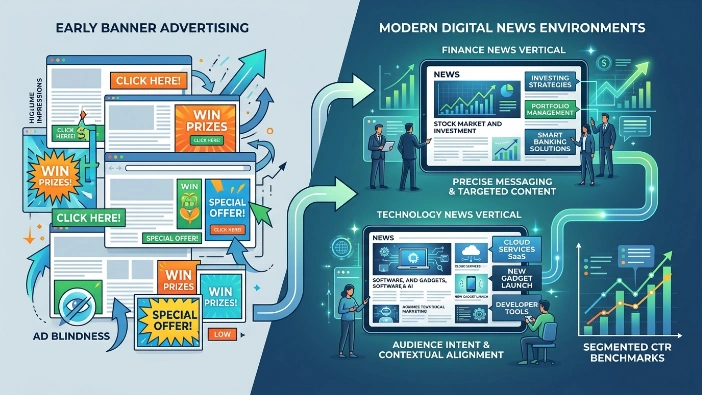
For example, finance news readers are more likely to engage with investment-related ads, while technology readers respond better to software, gadgets, and SaaS-related banners. This segmentation has significantly influenced CTR benchmarks across industries.
CTR Behavior Across Specialized News Verticals
Click-through rates vary widely depending on the type of news vertical. High-intent verticals such as finance and business tend to generate stronger engagement because users are already in an analytical or decision-making mindset. On the other hand, general news or entertainment sections often produce lower CTR due to passive browsing behavior.
However, CTR is not solely dependent on vertical type. It is also shaped by ad placement, creative design, user trust, and the credibility of the publishing platform. This is where media intelligence frameworks such as those developed under Time Intelligence Media Group become essential, as they help decode performance signals and optimize placement strategies based on real-time Audience insights services.
Role of Audience Intent in Banner Performance
Audience intent is one of the strongest predictors of banner advertising success. In specialized news environments, intent is shaped by why users visit a page and how deeply they interact with content.
For example, users reading financial analysis articles often exhibit high intent behavior, meaning they are more receptive to investment-related advertisements. In contrast, users consuming breaking news may have low attention span, reducing ad interaction likelihood.
CTR increases significantly when ads are aligned with user intent signals. This alignment is achieved through advanced segmentation models, behavioral tracking, and contextual targeting systems that evaluate content themes and reader engagement patterns.
Influence of Content Depth and Editorial Context
The depth and credibility of editorial content directly influence banner advertising performance. High-quality journalism tends to create trust, which in turn increases ad engagement. Users are more likely to interact with banners displayed alongside authoritative content.
This relationship between content quality and ad performance is a core focus of analytical solutions like the Time Intelligence Media Group E-E-A-T Impact Study, which evaluates how trust signals, editorial authority, and content credibility affect digital advertising outcomes.
When ads are placed within high-trust environments, CTR tends to increase because users perceive the surrounding platform as reliable. This highlights the importance of maintaining editorial integrity alongside monetization strategies.
Social Dynamics and Banner Engagement Patterns
Social sentiment also plays a significant role in how users respond to banner advertisements. News verticals that experience high social engagement often see fluctuating CTR performance based on trending topics, emotional tone, and public sentiment.
For instance, politically charged or emotionally intense news can either increase or decrease ad engagement depending on user mood and content alignment. Understanding these emotional dynamics is crucial for optimizing banner campaigns.
Insights from Time Intelligence Media Group Social Media Sentiment Analysis help decode these patterns by tracking audience reactions across platforms and mapping them to on-site engagement behavior. This enables advertisers to adjust creative messaging in real time for improved performance outcomes.
Banner Placement Strategy and Visibility Optimization
Placement is one of the most critical factors influencing CTR in banner advertising. Above-the-fold placements typically generate higher engagement due to immediate visibility, while mid-article placements benefit from contextual relevance.
However, excessive placement frequency can lead to banner fatigue, reducing overall performance. Specialized news verticals require a balanced approach where ad density is optimized without disrupting user experience.
Data-driven placement strategies rely on continuous testing and refinement. By analyzing scroll depth, attention heatmaps, and interaction timing, publishers can identify optimal banner positions that maximize engagement without compromising readability.
Creative Design and Its Impact on CTR
Banner design plays a crucial role in capturing user attention in highly competitive news environments. Simplicity, clarity, and relevance are key design principles that influence click behavior.
In specialized verticals, creative messaging must align with user expectations. For example, financial audiences respond better to data-driven visuals, while lifestyle audiences may prefer emotionally engaging imagery.
Poorly designed banners often suffer from low CTR regardless of placement quality. This makes creative optimization an ongoing requirement rather than a one-time effort.
Data Intelligence and Performance Optimization
The rise of data-driven advertising has transformed how banner campaigns are managed and optimized. Real-time analytics allow advertisers to adjust bidding strategies, targeting parameters, and creative elements based on live performance data.
Media intelligence platforms, including those developed by Time Intelligence Media Group, integrate multiple data sources to provide a holistic view of campaign performance. These systems track user interactions, content engagement, and conversion pathways to identify optimization opportunities.
This level of intelligence enables advertisers to move beyond basic CTR tracking and toward predictive performance modeling, where future outcomes can be estimated based on historical behavior patterns.
Trust Signals and E-E-A-T in Banner Advertising
Trust has become a defining factor in digital advertising effectiveness. Users are increasingly skeptical of low-quality or misleading ads, especially in news environments.
E-E-A-T principles, which emphasize Experience, Expertise, Authoritativeness, and Trustworthiness, are now being applied not only to content but also to advertising ecosystems. Platforms that maintain strong editorial standards tend to generate higher CTR due to increased user confidence.
The Time Intelligence Media Group E-E-A-T Impact Study highlights how trust signals directly correlate with advertising performance, showing that credible environments significantly enhance user interaction rates.
Cross-Vertical Performance Comparison
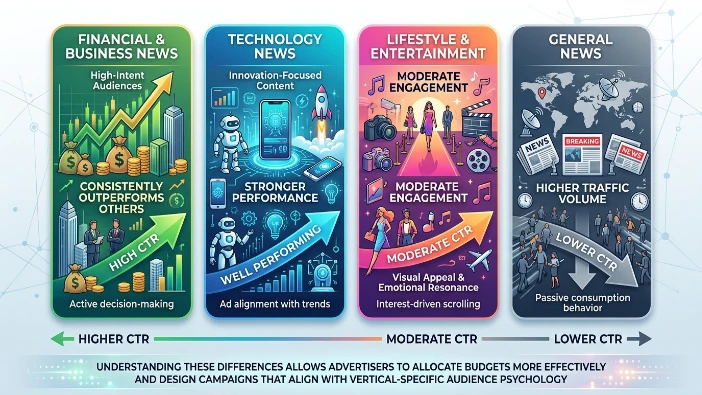
Different news verticals consistently demonstrate varying CTR benchmarks. Financial and business verticals typically outperform others due to high intent audiences. Technology verticals also perform well, especially when ads are aligned with innovation-focused content.
Lifestyle and entertainment verticals generate moderate engagement, often influenced by visual appeal and emotional resonance. General news verticals, while high in traffic volume, tend to have lower CTR due to passive consumption behavior.
Understanding these differences allows advertisers to allocate budgets more effectively and design campaigns that align with vertical-specific audience psychology.
Future Trends in Banner Advertising
The future of banner advertising is expected to be shaped by automation, artificial intelligence, and predictive analytics. As audience segmentation becomes more refined, ads will increasingly be personalized at the micro-level.
Dynamic creative optimization will allow banners to adapt in real time based on user behavior, location, and content context. This will significantly improve CTR across all news verticals.
Additionally, privacy regulations will continue to influence tracking capabilities, pushing advertisers toward first-party data strategies and contextual targeting methods.
Organisations like Time Intelligence Media Group are already developing advanced frameworks to help publishers and advertisers navigate this evolving landscape through integrated media intelligence and performance analytics solutions.
Banner advertising in specialised news verticals is no longer a static or uniform practice. It is a dynamic ecosystem shaped by audience intent, content quality, trust signals, creative design, and data intelligence.
Click-through rates vary significantly across verticals, and success depends on how effectively advertisers align their strategies with user behavior patterns and contextual relevance. By leveraging advanced analytics, sentiment analysis, and trust-based frameworks, advertisers can significantly enhance performance outcomes.