
Sponsored content requires disclosure in the United Kingdom under the Consumer Protection from Unfair Trading Regulations 2008 (CPRs) and Advertising Standards Authority (ASA) rules. Labels such as #ad or #sponsored identify it clearly to consumers.
Sponsored content consists of articles, videos, or posts created by brands or third parties and published on websites, social media, or news platforms. Publishers receive payment or equivalent value for featuring this material. The CPRs prohibit misleading actions that deceive consumers about commercial intent. ASA enforces non-broadcast advertising standards, including transparency rules. Disclosure prevents consumers from mistaking sponsored posts for independent editorial content. Regulators monitor platforms like Instagram, YouTube, and news sites for compliance.
UK law defines sponsored content as material where a trader pays for promotion. This includes influencer posts, native ads, and branded articles. Failure to disclose leads to enforcement actions. The Competition and Markets Authority (CMA) oversees CPRs compliance. ASA rulings provide precedents for disclosure practices.
Definition of Sponsored Content Under UK Law
Sponsored content falls under “advertorials” or “paid-for promotions” in ASA guidelines. Traders include any business paying for exposure. Platforms must label content at the start and in prominent positions. Examples include a fashion brand paying a blogger for a product review post labeled #ad.
Regulators updated rules in 2023 to cover emerging formats like deepfakes and AI-generated promotions. Disclosure applies across all media, from print to digital.
Why Does UK Law Require Disclosure of Sponsored Content?
UK law mandates disclosure to protect consumers from misleading commercial communications under CPRs Article 6, which bans hidden advertising. ASA Rule 9.4 states paid promotions must be obviously identifiable.
Consumers rely on transparency to distinguish editorial from advertising. CPRs Article 5 prohibits unfair practices that distort economic behavior. Disclosure ensures informed choices. ASA monitors 2024 complaints, with 15% related to undisclosed sponsorships. Enforcement includes website takedowns and fines up to 10% of turnover.
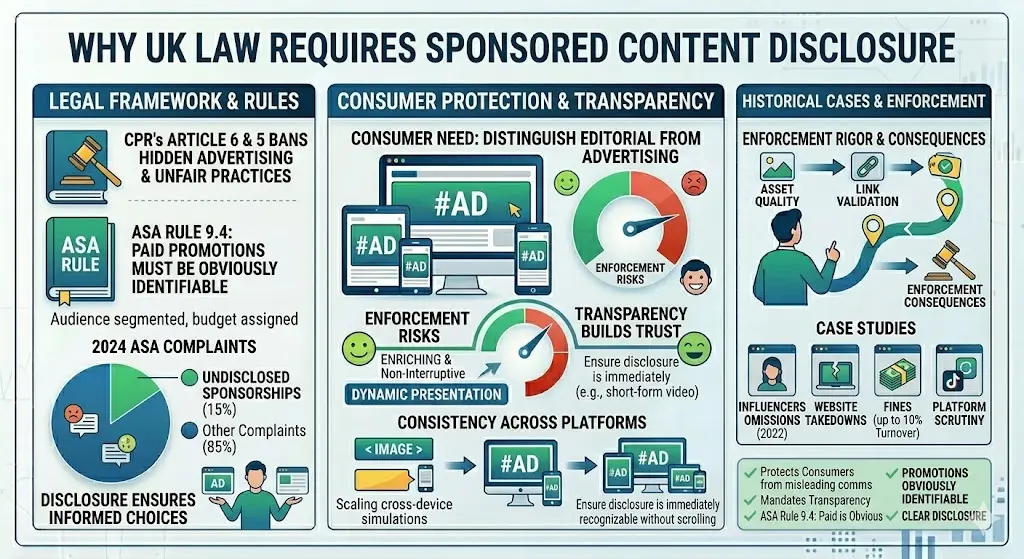
Historical cases demonstrate enforcement rigor. In 2022, ASA upheld complaints against influencers omitting #ad labels. Courts interpret “obviously identifiable” as immediate recognition without scrolling. Platforms like TikTok face scrutiny for short-form video disclosures.
Historical Enforcement Examples
CMA issued 2021 guidance after investigating 20 influencers. Fines reached £150,000 for persistent violations. ASA published 50 rulings in 2023 on native ads disguised as news.
What Are the Specific Legal Requirements for Disclosure?
Disclose sponsored content with clear labels like “#ad,” “#sponsored,” or “Paid promotion” at the beginning. ASA requires labels in a font size matching the main text and in the same visual field.
CPRs demand material information about commercial arrangements. Labels must appear before engaging content. ASA CAP Code Rule 9.7 specifies placement for social media. Websites use banners or inline text. Videos require on-screen text and verbal mentions within three seconds.
Regulations cover all formats. Email newsletters label subject lines. Podcasts state sponsorship upfront. ASA audits 500 posts monthly for compliance.
Label Placement Rules by Platform
Social media posts need labels in captions and images. ASA ruled against buried disclosures in 2024. News websites place “Advertisement” or “Sponsored” headers above articles spanning 100 words.
Who Must Comply with Sponsored Content Disclosure Rules?
Brands, influencers, publishers, and agencies must disclose sponsored content. CPRs apply to all traders; individuals face ASA sanctions for non-compliance.
Traders include companies funding content and platforms hosting it. Influencers with over 1,000 followers report 80% sponsorships annually. Publishers verify sponsor declarations before publication. Agencies draft compliant contracts specifying labels.
Compliance extends to employees posting on personal accounts. CMA guidance targets micro-influencers with nano-audiences under 10,000 followers.
Responsibilities of Different Parties
Brands provide disclosure scripts. Influencers add personal labels. Publishers reject unlabeled content. ASA holds all parties jointly liable in 70% of cases.
What Happens If You Fail to Disclose Sponsored Content?
Failure triggers ASA adjudication, CMA investigations, and fines up to £5,000 per breach plus CPRs penalties. Platforms remove content; repeat offenders face trading bans.
ASA issues 300 adverse rulings yearly, leading to pre-vetting requirements. CMA pursues criminal charges under CPRs Section 11 for deliberate misleading. Courts awarded £200,000 in 2023 consumer redress.
Businesses halt campaigns during probes lasting 6-12 months. Reputational damage affects 40% of non-compliant firms per ASA data.
Common Penalties and Case Studies
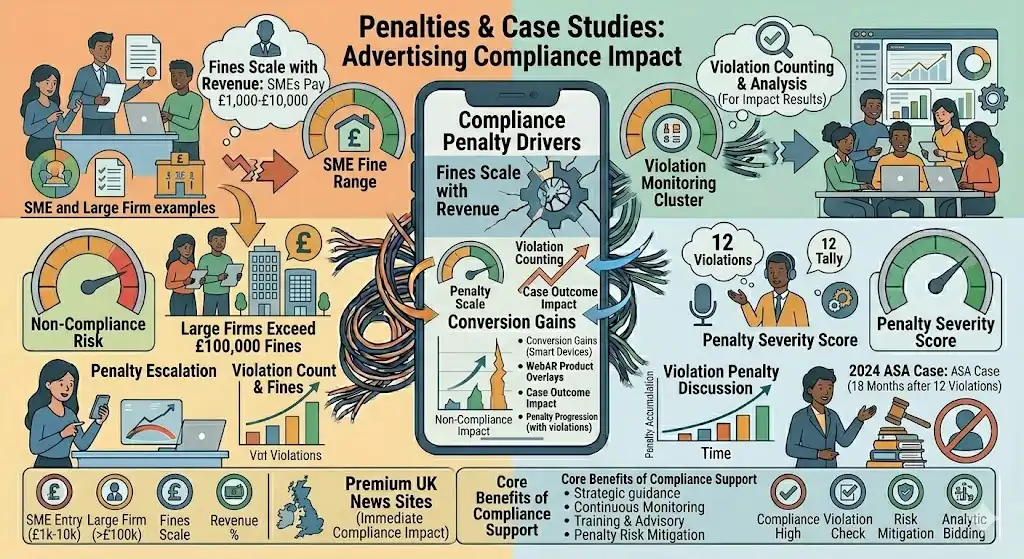
Fines scale with revenue; SMEs pay £1,000-£10,000. Large firms exceed £100,000. A 2024 ASA case banned an influencer’s account for 18 months after 12 violations.
How Do You Properly Label Sponsored Content in the UK?
Place #ad or “Sponsored” immediately at the start in bold, readable text. Use consistent labels across posts, stories, and videos for full compliance.
Start captions with labels on Instagram, visible without taps. Videos overlay text from second one. Websites use CSS-styled banners matching article prominence. ASA tests label visibility on 20 devices yearly.
Contracts mandate labels in creative briefs. Tools automate detection on CMS platforms.
Step-by-Step Labeling Process
Draft content with placeholders. Review for commercial cues like product links. Insert labels. Test on mobile and desktop. Archive proofs for audits.
For more detailed guidelines on publishing sponsored content safely, What Are UK Guidelines for Publishing Sponsored Content on News Websites Safely?.
What Counts as Sponsored Content Needing Disclosure?
Content counts as sponsored if payment, free products, or services exceed £50 value. Barter exchanges trigger rules under ASA definition of “commercial arrangement.”
Payment includes cash, gifts, or affiliate commissions. Free hotel stays for reviews require #ad. ASA deems 90% of gifted items promotional. Employee posts about employer products need disclosure. Exceptions apply to personal opinions without incentives. Unsolicited gifts under £20 rarely trigger rules.
Examples of Sponsored vs. Non-Sponsored Content
Sponsored: Paid tweet praising a gadget. Non-sponsored: Personal purchase review. ASA clarified barter in 2023 guidance covering 50 scenarios.
Are There Exceptions to Disclosure Requirements?
No broad exceptions exist; disclosure applies to all paid promotions. ASA allows “gifted” labels only for non-cash exchanges, but #ad remains mandatory.
Personal social media posts by non-traders escape rules if no commercial gain. News interviews with brands require context if paid. ASA rejects “organic” claims for incentivized content. Journalistic exemptions cover public interest reporting, limited to 5% of cases.
Narrow Exemptions Explained
Charity endorsements label as “in partnership.” Editorial features disclose if funded. Courts uphold disclosure in 95% of disputes.
How Has Sponsored Content Regulation Evolved in the UK?
Regulations evolved from 2008 CPRs to 2023 ASA updates addressing influencers and AI. Enforcement tripled since 2020 with 1,200 annual checks.
CPRs established baseline in 2008. 2019 influencer crackdown followed 100 complaints. 2022 CMA guide targeted platforms. 2024 rules cover metaverse promotions. Annual ASA reports track 20% compliance rise.
Key Milestones in Regulation
2011: CAP Code update. 2021: TikTok partnership. 2025: AI disclosure mandate. To achieve full compliance on trusted platforms, explore Get Fully Compliant Sponsored Content Published on Trusted UK News Platforms.
What Tools Help Ensure Disclosure Compliance?
Use free ASA Label Tester and CMA checklists. Platforms like Instagram flag unlabeled ads automatically since 2023. ASA provides templates downloaded 50,000 times yearly. Software scans posts pre-publish. Influencer platforms enforce contracts digitally. Training courses certify 10,000 users annually.