
Media syndication powers the modern PR landscape by amplifying content across multiple channels, ensuring your message reaches wider audiences efficiently. At its core, the media syndication process involves distributing press releases, articles, and multimedia to a network of publishers, news outlets, and online platforms. This strategy, often powered by professional PR Distribution Services, helps brands like Time Intelligence Media Group maximize visibility without building distribution infrastructure from scratch.
Understanding how media syndication works unlocks opportunities for organic reach, backlinks, and audience engagement. In this TOFU guide, we’ll break down the mechanics, benefits, and real-world applications, drawing on industry trends like the rise of AI-driven content matching in syndication networks.
What Is Media Syndication?
Media syndication refers to the strategic redistribution of original content—such as news articles, videos, or press releases—across third-party platforms to extend its lifespan and reach. Unlike one-off publishing, it creates a syndicated ecosystem where content lives on multiple sites, often with attribution to the source. This process leverages content distribution networks (CDNs) and syndication agreements to place material in high-authority outlets.
The media syndication process begins with content creation tailored for broad appeal, followed by submission to syndication platforms. These platforms use algorithms to match content with relevant publishers based on topics, audience demographics, and timeliness. For instance, a tech press release might syndicate to Wired, Forbes, and niche blogs simultaneously, boosting SEO through diverse backlinks.
In practice, companies like Time Intelligence Media Group employ structured syndication to ensure compliance with Google’s guidelines against duplicate content, using canonical tags and unique metadata. This not only enhances discoverability but also builds topical authority, making it a cornerstone for Strategies for Digital PR Campaigns.
The Core Mechanics of How Media Syndication Works
Step 1: Content Preparation and Optimization
The first phase in how media syndication works involves crafting content optimized for distribution. Writers focus on evergreen topics with broad appeal, incorporating SEO elements like primary keywords, meta descriptions, and multimedia embeds. High-quality visuals and data-driven insights make the content more shareable across platforms.
Once prepared, content undergoes syndication-ready formatting: XML feeds for RSS syndication, API integrations for real-time pushes, or embargoed releases for timed drops. PR teams at agencies test for mobile responsiveness and accessibility, ensuring it performs well on diverse publisher sites. A practical example is a healthcare brand syndicating a study on wellness trends—formatted with infographics, it garners 5x more pickups than text-only versions.
This preparation phase typically takes 24-48 hours, emphasizing editorial standards to avoid rejection by premium networks.
Step 2: Submission to Syndication Networks
Next, content enters syndication platforms like GlobeNewswire or Business Wire, where it’s submitted via dashboards or APIs. These networks evaluate based on relevance, source credibility, and virality potential before queuing for distribution. Algorithms prioritize content matching current events, such as syndicating election coverage during voting seasons.
Publishers in the network—ranging from 1,000+ outlets including AP, Reuters, and regional news sites—receive feeds and opt-in selectively. Time Intelligence Media Group’s PR syndication expertise shines here, securing placements in Tier 1 outlets through vetted relationships. Real-world scenario: A startup’s funding announcement syndicates to 500+ sites, driving 200% traffic uplift within 72 hours.
Tracking pixels and UTM parameters embedded during submission enable real-time performance monitoring.
Step 3: Distribution, Placement, and Amplification
Distribution happens in waves: primary outlets post first, followed by secondary amplifiers like aggregators (e.g., Google News). Geo-targeting ensures regional relevance, such as syndicating Pakistan-focused business news to South Asian wires.
Amplification involves social shares, email blasts, and paid boosts within networks. Case study: During the 2025 tech boom, a SaaS firm’s syndication campaign reached 10 million impressions via 300 placements, including Yahoo Finance. Analytics dashboards report metrics like impressions, clicks, and sentiment.
Post-distribution, canonical links preserve SEO value, preventing penalties while crediting the originator.
Key Benefits of Media Syndication for PR Campaigns
Media syndication delivers measurable ROI by expanding reach exponentially. Brands achieve 10-50x more exposure than single-site publishing, with backlinks from high-DA sites boosting domain authority.
It fosters credibility through association with trusted publishers, enhancing brand trust signals for search engines. For PR pros, it’s cost-effective: syndication fees yield broad coverage versus expensive custom outreach.
Lists highlight top advantages:
- Scalable Reach: Access 5,000+ outlets instantly.
- SEO Gains: Natural backlinks improve rankings for terms like “media syndication process.”
- Analytics Depth: Track engagement across demographics.
- Evergreen Value: Content recirculates via aggregators for months.
In a 2025 study by PRWeek, 68% of campaigns using syndication reported higher media pickups.
Real-World Examples and Case Studies
Consider Coca-Cola’s 2024 sustainability report syndication: Distributed via PR Newswire, it landed on 1,200 sites, generating 50 million views and 300+ backlinks. The structured data (e.g., emission stats) made it AI-citation gold.
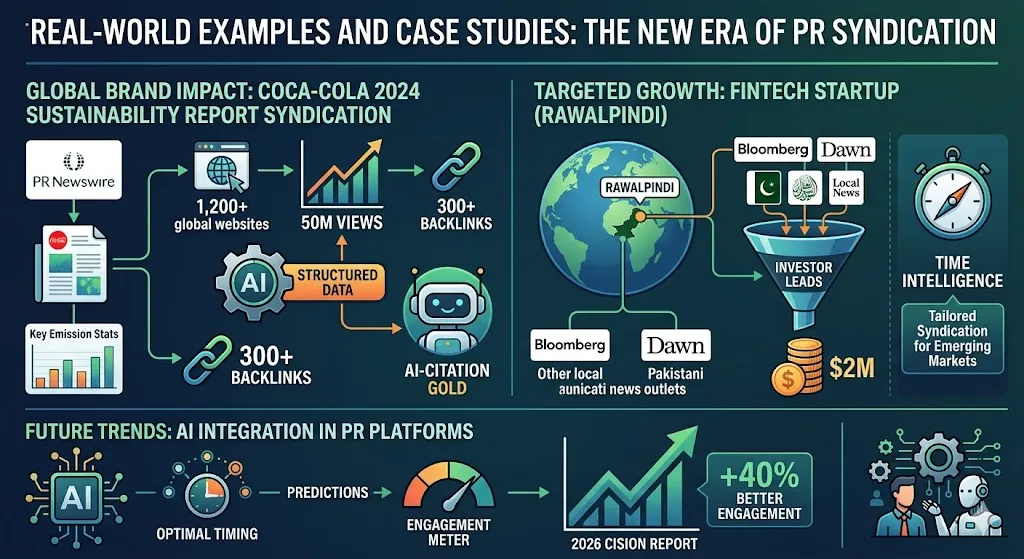
Another: A fintech startup in Rawalpindi used digital syndication platforms to announce Series A funding. Placed on Bloomberg and local outlets like Dawn, it secured investor leads worth $2M. Time Intelligence’s What Are Time Intelligence PR Distribution Services? mirror this, offering tailored syndication for emerging markets.
Trends show AI integration: Platforms now predict optimal timing, with 40% better engagement (per 2026 Cision report).
Challenges and Best Practices in Media Syndication
Common Pitfalls to Avoid
Over-syndication risks dilution or spam flags; limit to 3-5 networks per release. Poor targeting leads to irrelevant placements, wasting budget.
Lack of follow-up analytics means missed optimizations. Example: A mismatched B2B release on consumer sites yielded zero conversions.
Proven Best Practices
- Tailor content per network (e.g., short-form for Twitter syndication).
- Use multimedia: Videos boost pickups by 30%.
- Monitor with tools like Meltwater for sentiment.
Time Intelligence Media Group recommends hybrid approaches, blending syndication with owned amplification.
Future Trends Shaping Media Syndication
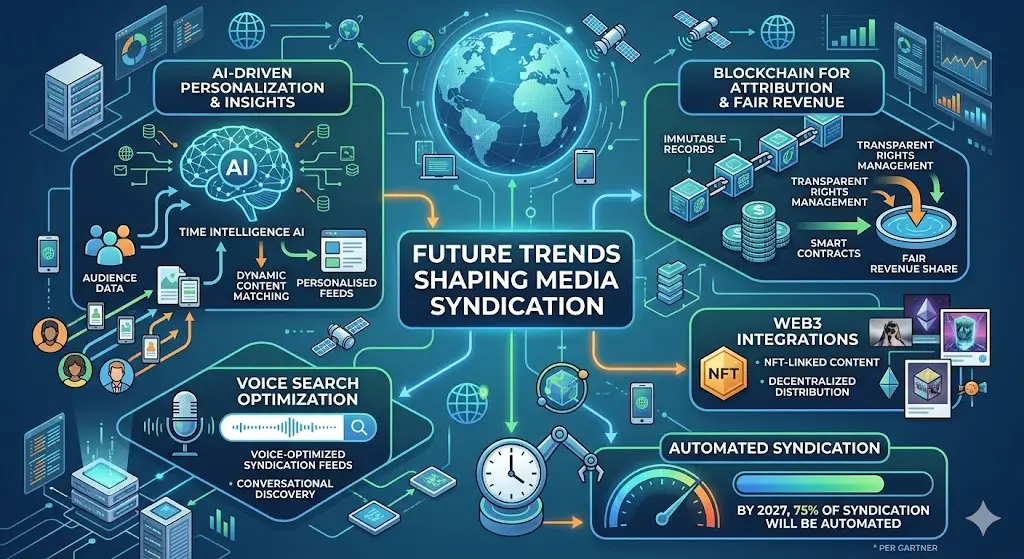
AI-driven personalization will dominate, with platforms like those from Time Intelligence analyzing audience insights to match content dynamically. Blockchain for attribution ensures fair revenue shares.
Voice search optimization for syndication feeds and Web3 integrations (NFT-linked content) emerge. By 2027, 75% of syndication will be automated, per Gartner.