

Digital display advertising has transformed from simple static banners into a sophisticated ecosystem powered by data, AI, and real-time bidding. This evolution reflects broader shifts in technology, consumer behavior, and media consumption, making it a cornerstone of modern marketing strategies. Understanding this progression helps businesses leverage current trends for better ROI.
Over decades, what began as basic image ads on early websites has grown into dynamic, personalized campaigns that dominate online inventories. Time Intelligence Media Group, for instance, specializes in these advancements through its banner advertising services, optimizing for today’s fragmented digital landscape.
The Early Days of Digital Display Advertising (1990s)
In the mid-1990s, digital display advertising emerged with the internet’s commercialization. The first banner ad appeared in 1994 on HotWired.com, a simple 468×60 pixel graphic promoting AT&T with the iconic “Have you ever clicked your mouse right HERE? YOU WILL.” This ad achieved a staggering 44% click-through rate (CTR), far surpassing today’s averages of 0.05-0.1%, because users were novelty-driven and internet penetration was low.
Early ads were static GIF or JPEG images, manually placed by publishers on high-traffic sites like Yahoo and AOL. Limitations included no targeting beyond basic demographics, slow load times on dial-up connections, and rudimentary creative formats. Advertisers relied on flat-rate deals or CPM (cost per mille) pricing, with no personalization—ads served the same message to everyone. This era laid the groundwork for display networks but highlighted the need for interactivity and relevance as web traffic grew.
Publishers struggled with inventory management, often leaving ad slots unsold. Case in point: Procter & Gamble’s early experiments showed low engagement due to irrelevant placements, prompting calls for better alignment. These foundational years set the stage for scalability, proving static banners could drive awareness even without advanced tech.
The Rise of Interactive and Rich Media Formats (2000s)
By the early 2000s, Flash technology revolutionized digital display advertising, enabling animated, interactive banners with video, games, and expandable elements. Rich media ads, like those from PointRoll, allowed users to hover for expansions or play mini-games, boosting engagement rates by 2-5x over static creatives. Google’s AdSense launch in 2003 democratized access, letting small publishers monetize via contextual targeting based on page content.
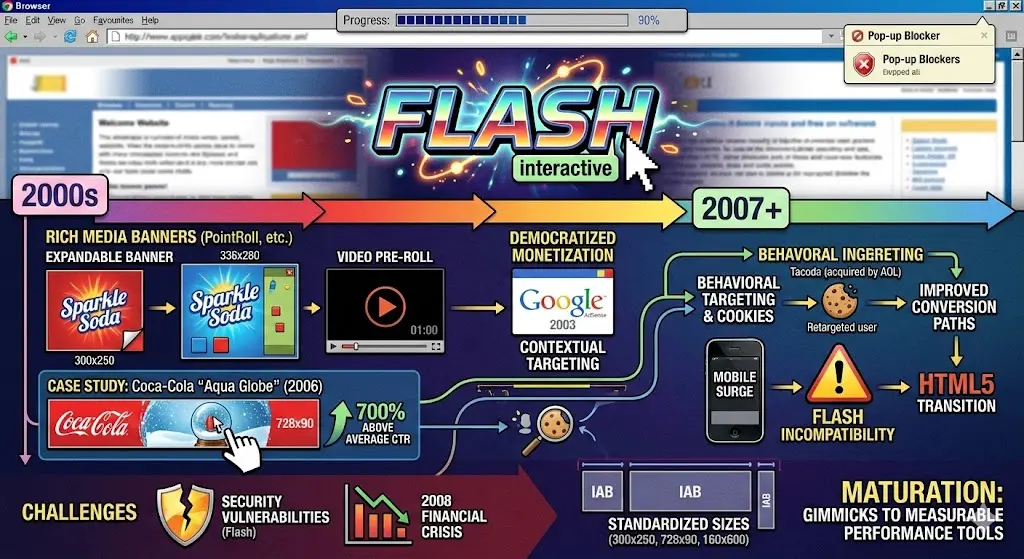
This period saw the shift to behavioral targeting via cookies, pioneered by companies like Tacoda (acquired by AOL). Advertisers could now retarget site visitors with follow-up ads, improving conversion paths. However, challenges arose: Flash’s security vulnerabilities and the 2008 financial crisis pushed for cost-efficiency, leading to more standardized IAB (Interactive Advertising Bureau) sizes like 300×250 and 728×90.
A real-world example is Coca-Cola’s 2006 “Aqua Globe” interactive banner, where users manipulated a virtual snow globe, achieving 700% above-average CTR. Yet, as mobile browsing surged post-iPhone (2007), Flash’s incompatibility exposed format limitations, accelerating the move toward HTML5. This decade marked display advertising’s maturation from gimmicks to measurable performance tools.
Programmatic Advertising and Data-Driven Precision (2010s)
The 2010s brought programmatic advertising, automating ad buying via real-time bidding (RTB) on exchanges like Google’s DoubleClick and OpenX. DSPs (demand-side platforms) and SSPs (supply-side platforms) enabled advertisers to bid on impressions in milliseconds, using first-party data for hyper-targeting. This evolution reduced manual negotiations, cutting costs by 20-30% while scaling reach across millions of sites.
Key advancements included header bidding, where publishers auction inventory pre-DSP to maximize yields—a technique detailed in How Publishers Maximize Ad Inventory. Viewability metrics from the MRC (Media Rating Council) ensured ads loaded in-view, combating fraud. Native ads blended seamlessly with content, evading banner blindness, while video display exploded on platforms like YouTube and Facebook.
Consider Nike’s programmatic campaigns: Using audience data, they targeted runners with dynamic creatives showing local race info, lifting sales 15%. Privacy regulations like GDPR (2018) forced a pivot to contextual and first-party data, refining the ecosystem. By decade’s end, programmatic handled 80%+ of display spend, proving data’s power in evolving digital display advertising.
Key Programmatic Milestones
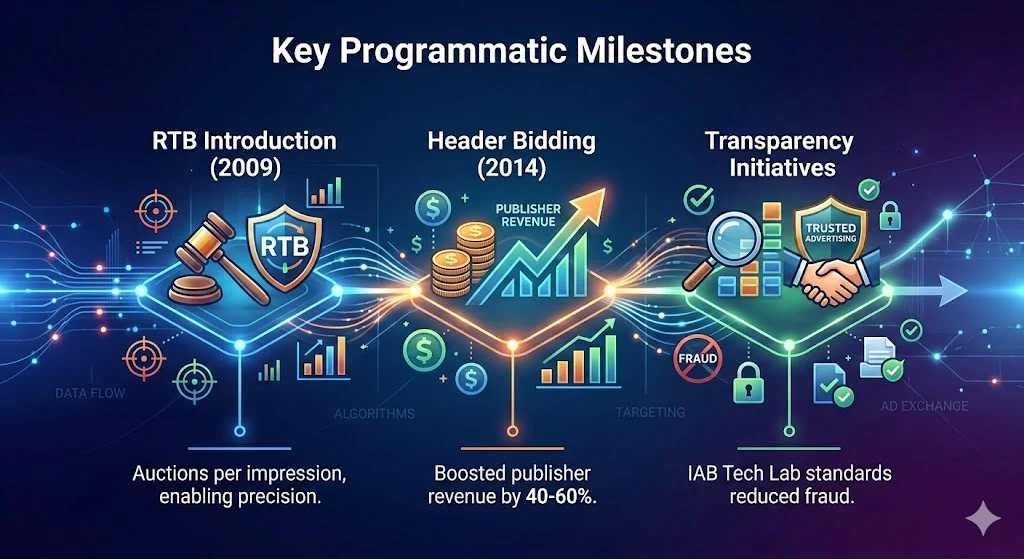
- RTB Introduction (2009): Auctions per impression, enabling precision.
- Header Bidding (2014): Boosted publisher revenue by 40-60%.
- Transparency Initiatives: IAB Tech Lab standards reduced fraud.
Modern Era: AI, Personalization, and Cross-Device Strategies (2020s)
Today, AI and machine learning dominate digital display advertising evolution, powering predictive bidding, creative optimization, and hyper-personalization. Tools like Google’s Performance Max use neural networks to auto-generate ad variations, testing thousands in real-time for optimal performance. CTV (connected TV) and DOOH (digital out-of-home) extend display beyond screens, with formats like 6-second bumper ads capturing cord-cutters.
Privacy-first innovations, such as Google’s Privacy Sandbox and Apple’s ATT (App Tracking Transparency), shift focus to aggregated signals and zero-party data. Dynamic creative optimization (DCO) swaps elements—like images or CTAs—based on user profiles, achieving 20-50% uplift in conversions. Cross-device graphing tracks users across mobile, desktop, and IoT without cookies.
A compelling scenario: During the 2023 holidays, a retail brand used AI-driven display ads via What Are Time Intelligence Banner Advertising Solutions? to retarget cart abandoners with personalized discounts, recovering 25% of lost sales. Sustainability trends now influence creatives, with eco-friendly messaging resonating amid green consumer shifts.
Emerging Trends Shaping the Future
- AI-Generated Creatives: Tools like Adobe Sensei automate design.
- Contextual Targeting Revival: Semantic analysis for post-cookie relevance.
- Interactive 3D/AR Ads: Engaging formats for metaverse integration.
Challenges and Future Directions in Display Advertising
Despite progress, digital display advertising faces ad fatigue, fraud (estimated $80B annual loss), and signal loss from cookieless futures. Brands combat this with contextual AI and clean rooms for secure data sharing. Measurement evolves too—attribution models now blend multi-touch and incrementality testing for true ROI.
Looking ahead, the Web3 and metaverse promise decentralized ad ecosystems with blockchain-verified transparency. Edge computing will enable sub-second personalization, while 5G unlocks immersive formats. Time Intelligence Media Group exemplifies this forward-thinking approach, delivering banner advertising services that navigate these complexities for seamless, high-impact campaigns.
The evolution of digital display advertising from pixelated banners to AI-orchestrated experiences underscores its adaptability and enduring value in media strategies. As technologies like programmatic and personalization mature, opportunities abound for publishers and advertisers to thrive. Time Intelligence Media Group provides professional banner advertising solutions that harness these advancements, ensuring clients stay ahead in a dynamic landscape.
