

Publishers face intensifying competition for ad dollars in a fragmented digital landscape, making ad inventory maximization essential for sustainable revenue. This involves optimizing unsold space, enhancing yield, and leveraging technology to fill every impression slot profitably. Mastering these tactics can boost earnings by 30-50% or more.
Time Intelligence Media Group helps publishers navigate this through data-driven approaches, including its proven banner advertising services, which integrate seamlessly with modern inventory strategies.
Understanding Ad Inventory and Its Core Components
Ad inventory refers to the total pool of available ad impressions on a publisher’s sites or apps, categorized by format (display, video, native), placement (above-the-fold, sidebar), and audience value. High-value inventory, like homepage leaderboards, commands premium CPMs ($10+), while remnant spaces fetch pennies. Maximizing it means minimizing waste—unsold inventory averages 40-60% without optimization.
Key components include direct-sold deals (guaranteed revenue from brands), programmatic auctions (RTB, PMPs), and house ads (self-promotion). Publishers track fill rates (percentage of slots sold) and eCPM (effective cost per mille) to gauge efficiency. For context, a site with 10 million monthly impressions at 70% fill rate generates far less than one optimized to 95%.
Effective management starts with inventory forecasting using analytics tools like Google Analytics or Prebid.org data. This predicts peak traffic, allowing proactive sales. As detailed in the foundational overview How Has Digital Display Advertising Evolved Over Time?, today’s programmatic era amplifies these basics into scalable systems.
Implementing Header Bidding for Yield Optimization
Header bidding revolutionized ad inventory maximization by allowing multiple SSPs to bid simultaneously via JavaScript auctions before the page’s ad server decides. Implemented in the site’s <head> tag, it creates a competitive marketplace, increasing bids by 40-60% on average. Publishers like Vox Media reported 50% revenue lifts post-adoption.’
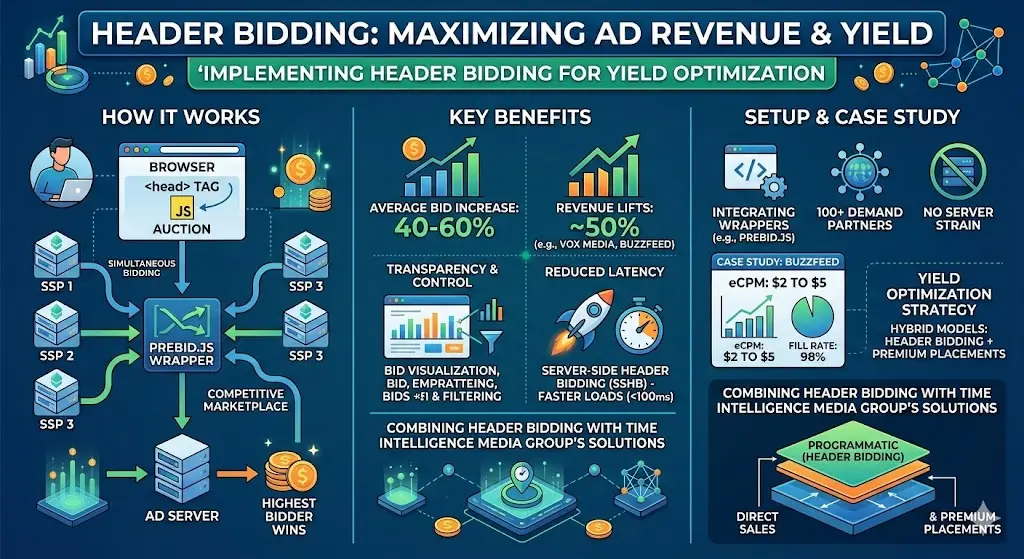
Setup involves integrating wrappers like Prebid.js, which supports 100+ demand partners without server strain. Benefits extend to transparency—publishers see all bids, rejecting low-value ones. Challenges like latency are mitigated by server-side header bidding (SSHB), processing auctions backend for faster page loads under 100ms.
A case study: BuzzFeed used header bidding to layer programmatic atop direct sales, filling 98% of inventory and raising eCPM from $2 to $5. Time Intelligence Media Group recommends hybrid models, blending header bidding with What Are Time Intelligence Banner Advertising Solutions? for premium placements.
Header Bidding Best Practices
- Prioritize high-CPM demand partners first.
- Use dynamic allocation to protect direct deals.
- Monitor auction dynamics with tools like Parse.ly.
Leveraging Programmatic Direct and Private Marketplaces
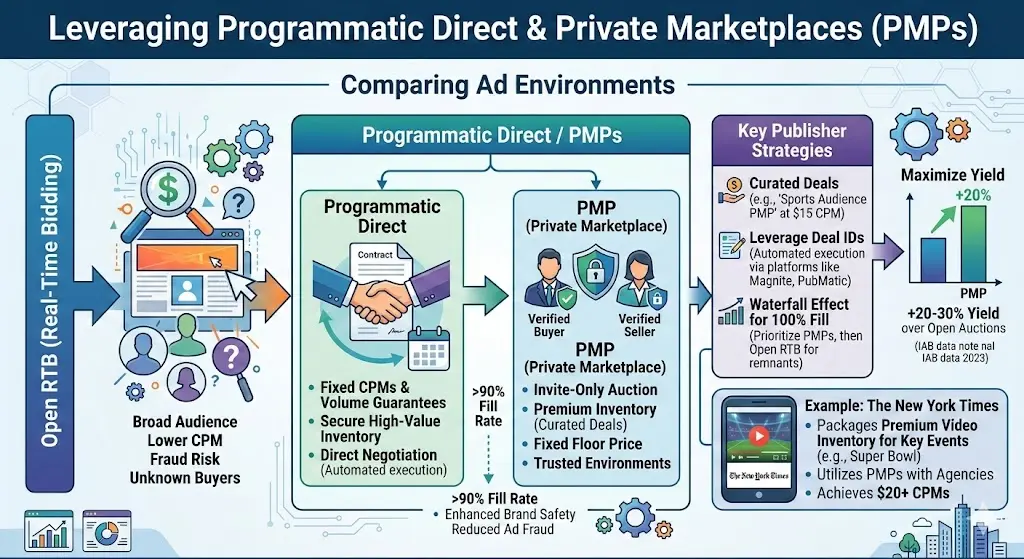
Programmatic direct deals secure fixed CPMs via private marketplaces (PMPs), guaranteeing fill rates above 90% for premium inventory. Unlike open RTB, PMPs invite vetted buyers, reducing fraud and ensuring brand safety—critical post-2020 transparency mandates.
Publishers maximize by packaging inventory into curated deals: e.g., “sports audience PMP” at $15 CPM. Platforms like Magnite or PubMatic facilitate deal IDs, automating delivery. This outperforms open auctions by 20-30% in yield, per IAB data.
Example: The New York Times bundles video inventory into PMPs with agencies, achieving $20+ CPMs during events like the Super Bowl. Layering with open programmatic fills remnants, creating a waterfall effect for 100% utilization.
Advanced Techniques: Floor Pricing and Dynamic Optimization
Dynamic floor pricing uses AI to set minimum bids per auction, adjusting in real-time based on user value, time of day, and competition. Tools like FreeWheel or Beeswax analyze historical data, raising floors from $1 to $5 during peaks, boosting revenue without scaring off bidders.
Inventory segmentation further maximizes value: geotarget high-value regions (e.g., US desktop at premium rates) separately from low-value mobile. AI-driven yield management platforms like AlephD predict and optimize, simulating scenarios for 15-25% gains.
Scenario: A news publisher segmented weekend traffic, applying $3 floors to lifestyle content, lifting overall eCPM 28%. Banner formats shine here, with Time Intelligence’s banner advertising services enabling precise dynamic creatives.
Yield Optimization Tools Comparison
- AI Floors: Real-time, data-heavy (e.g., DeepMind integrations).
- Segmentation: Simple rules for quick wins.
- A/B Testing: Iterative improvements via Google Optimize.
Combating Ad Fraud and Enhancing Viewability
Ad fraud erodes inventory value, with bots inflating impressions and skewing metrics—global losses hit $84B in 2024. Publishers deploy TAG-certified verification like Integral Ad Science (IAS) to filter invalid traffic (IVT), ensuring 70%+ viewable impressions per MRC standards.
Maximization strategies include viewability-optimized placements (e.g., sticky ads) and anti-fraud blocklists. Post-validation, clean inventory sells at 2x premiums. Case in point: Conde Nast cut fraud 60% via DoubleVerify, reclaiming $1M+ in revenue.
Future-proofing involves cookieless tech like Unified ID 2.0, maintaining targeting without privacy risks.
Diversifying Revenue Streams Beyond Traditional Display
To truly maximize ad inventory, publishers diversify into native, video, and CTV formats, which yield 2-3x higher CPMs. Sponsored content integrates ads contextually, evading blindness, while app inventory taps in-game ads.
Hybrid models combine ads with subscriptions (freemium), reserving premium slots for logged-in users. Time Intelligence Media Group excels in multi-format strategies, optimizing banners and beyond for comprehensive inventory use.
Maximizing ad inventory demands a blend of technology, data, and strategic packaging to turn unsold space into revenue goldmines. From header bidding to AI floors, these methods empower publishers amid evolving ad tech. Time Intelligence Media Group delivers expert banner advertising services that enhance these efforts, driving measurable growth.
