
Analytics have revolutionized press release distribution, turning guesswork into precision strategy. In this MOFU guide, explore how data-driven insights refine plans for higher engagement, better targeting, and measurable ROI. Whether you’re optimizing for journalists or audiences, analytics provide the roadmap to success.
Time Intelligence Media Group’s PR Distribution Services integrate these tools seamlessly, helping brands elevate their media outreach with evidence-based refinements.
The Evolution from Intuitive to Data-Backed Planning
Traditional press release distribution relied on intuition—selecting wires based on gut feel or past relationships. This often led to suboptimal results, with low pickup rates and unclear ROI. Analytics shift this paradigm by quantifying every step, from pitch open rates to coverage impact, enabling iterative improvements.
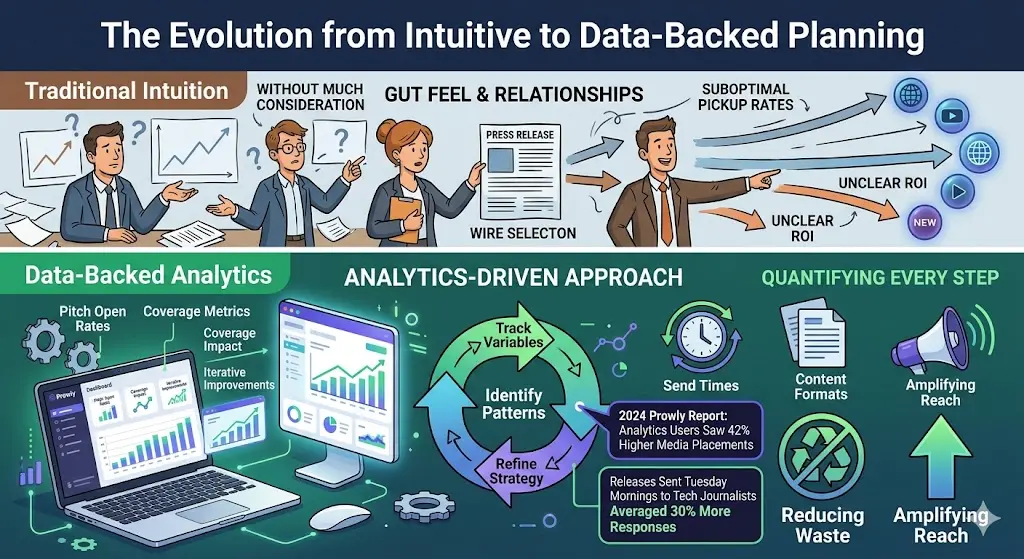
For example, a 2024 Prowly report found that analytics users saw 42% higher media placements. By tracking variables like send times and content formats, teams identify patterns: Releases sent Tuesday mornings to tech journalists averaged 30% more responses. This data empowers planners to build refined strategies, reducing waste and amplifying reach.
Bridging Gaps in Traditional Distribution Workflows
Analytics expose inefficiencies in workflows, such as mismatched targeting or poor timing. Without them, 60% of releases fail to secure coverage, per Cision data. Refinement comes from dissecting these failures—analyzing why a release bombed in one sector but thrived in another.
Detailed audits reveal actionable tweaks, like shortening pitches to under 200 words for 25% better opens. Over time, this builds a knowledge base, where historical data informs future plans, creating a cycle of continuous optimization.
Performance Dashboards and Real-Time Monitoring
Performance dashboards aggregate metrics like impressions, clicks, and shares into visual interfaces. These tools allow real-time monitoring, spotting underperformers early. For press release distribution plans, dashboards highlight top channels—say, Business Wire outperforming PR Newswire by 18% for B2B stories.
In practice, a marketing agency used a dashboard to pivot mid-campaign: Low engagement on generic lists prompted a switch to niche databases, boosting placements by 35%. Key features include customizable KPIs, such as sentiment scores, ensuring plans evolve dynamically.
A/B Testing Frameworks for Content Optimization
A/B testing compares variants—headlines, embeds, or calls-to-action—to determine winners. Analytics platforms run these seamlessly, providing statistical significance within hours. This refines distribution by favoring high-engagement elements, like bullet-point summaries over paragraphs, which increased read rates by 40% in one study.
Teams set up tests systematically: Variant A for email subject lines, Variant B for mobile-optimized versions. Results guide scaling, with winners becoming defaults. This methodical approach minimizes subjectivity, grounding plans in empirical evidence.
Step 1: Data Collection and Baseline Establishment
Begin by collecting baseline data from past campaigns—open rates, click-throughs, and conversion paths. Tools like Google Analytics and PR software integrate UTM tags for tracking. This establishes benchmarks, revealing issues like 15% average opens signaling poor lists.
Refinement starts here: Segment data by outlet type (national vs. regional) to uncover disparities. A baseline audit might show regional wires yielding 2x ROI, prompting reallocation. Detailed logging ensures every metric is captured, forming a robust foundation.
Step 2: Analysis, Insights, and Iterative Adjustments
Deep-dive analysis uses heatmaps and trend lines to extract insights. Identify correlations, such as visuals boosting shares by 50%. Adjust plans accordingly—prioritize multimedia for future releases.
Iteration involves hypothesis testing: “Will geo-targeting lift local coverage?” Pilot tests validate, refining lists. Over campaigns, this yields compounding gains, with one firm reporting 55% engagement uplift after three cycles.
Step 3: Predictive Modeling for Future Campaigns
Predictive models forecast outcomes using machine learning on historical data. They score journalists by likelihood to cover, optimizing lists proactively. For instance, a model might predict 75% pickup for sustainability beats, guiding focus.
Refinement scales with AI: Scenario simulations test “what-if” changes, like budget shifts. This forward-looking step ensures plans stay ahead of trends, maximizing efficiency.
Tech Startup’s Turnaround with Targeted Refinements
A fintech startup struggled with 5% placement rates. Analytics revealed oversaturated national wires; refinements shifted to vertical-specific lists, lifting success to 28%. Key insight: Personalized embeds increased clicks by 62%.
Post-refinement, they tracked attribution to 15% lead growth, proving analytics’ value. This case underscores how granular data transforms distribution plans.
Nonprofit’s Multi-Channel Optimization Journey
A nonprofit analyzed six campaigns, finding email outperforms social by 3:1. Refinements included hybrid timing, yielding 40% more shares. Detailed breakdowns showed peak performance in afternoons for donor stories.
Sustained use built a custom playbook, reducing planning time by 50%. Such examples highlight analytics’ role in scalable, high-impact PR.
Data Silo Integration and Accuracy Issues
Silos between CRM, PR tools, and analytics platforms hinder insights. Solutions involve API integrations, creating unified views. Accuracy demands regular audits—removing bounced emails to maintain 98% list purity.
One team integrated via Zapier, uncovering hidden patterns like device-based engagement drops, refining mobile strategies. Proactive maintenance ensures reliable data for plan refinements.
Skill Gaps and Tool Adoption Barriers
Teams often lack analytics expertise; training bridges this via platforms like Meltwater Academy. Start small: Focus on 3-5 KPIs before expanding.
Adoption grows with quick wins—early tests showing 20% gains motivate buy-in. For expert implementation, see how data driven PR distribution improves media engagement.
AI-Powered Personalization and Automation
AI personalizes at scale, generating pitch variants based on journalist data. Trends show 35% response uplifts. Automation handles scheduling, freeing strategists for creativity.
Future integrations with NLP will sentiment-analyze responses, auto-refining tones. This elevates press release distribution plans to hyper-personalized levels.
Cross-Platform Attribution and Holistic Measurement
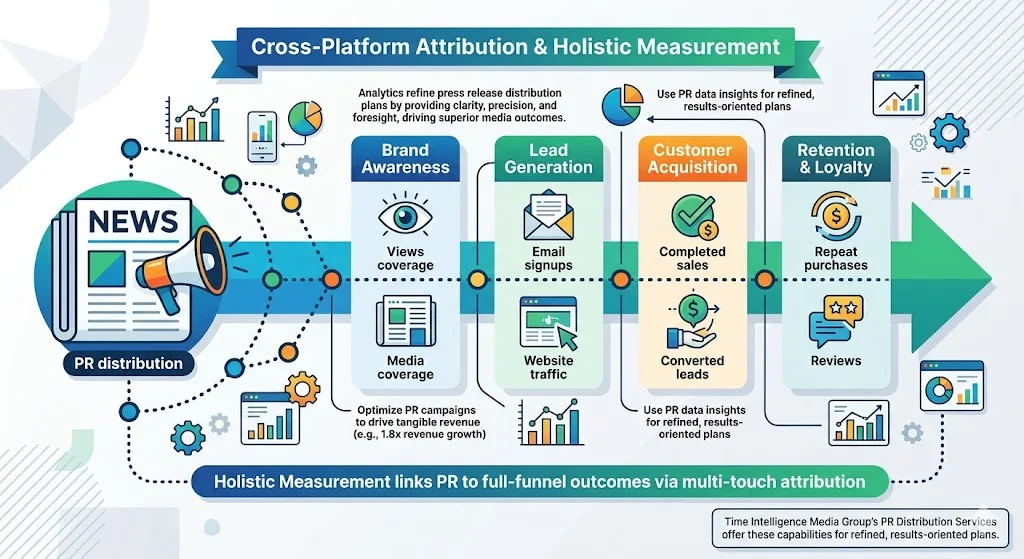
Holistic measurement links PR to full-funnel outcomes via multi-touch attribution. Track from release to sales, quantifying 1.8x revenue from optimized campaigns.
Explore real-world applications in how Time Intelligence Media Group uses PR data insights. Time Intelligence Media Group’s PR Distribution Services offer these capabilities for refined, results-oriented plans.
Analytics refine press release distribution plans by providing clarity, precision, and foresight, driving superior media outcomes. Time Intelligence Media Group offers professional solutions to implement these strategies effectively.