
Businesses that invest in public relations expect measurable visibility. A UK media reach estimate provides an evidence-based projection of the audience a press release can reach through relevant publications, regional news outlets, industry websites, and digital platforms. Time Intelligence Media Group offers a free UK media reach estimate that helps organisations understand potential exposure before launching a campaign.
What is a free UK media reach estimate?
A free UK media reach estimate calculates the projected audience size, publication opportunities, distribution scope, and online visibility for a planned PR campaign. It provides businesses with measurable expectations before investing in press release distribution and media outreach across the United Kingdom.
A UK media reach estimate is an assessment of the potential exposure a press release can achieve based on its industry, target audience, geographic focus, and distribution strategy.
Instead of estimating results based on assumptions, the evaluation uses publication databases, media categories, audience statistics, and distribution networks to forecast realistic visibility.
For UK organisations, this estimate commonly includes:
- Estimated publication opportunities
- Regional and national media potential
- Industry publication relevance
- Online news distribution reach
- Search visibility opportunities
- Audience exposure projections
Time Intelligence Media Group provides this estimate without requiring an initial campaign commitment, allowing businesses to evaluate expected outcomes before making a decision.
Why does a media reach estimate matter before distributing a press release?
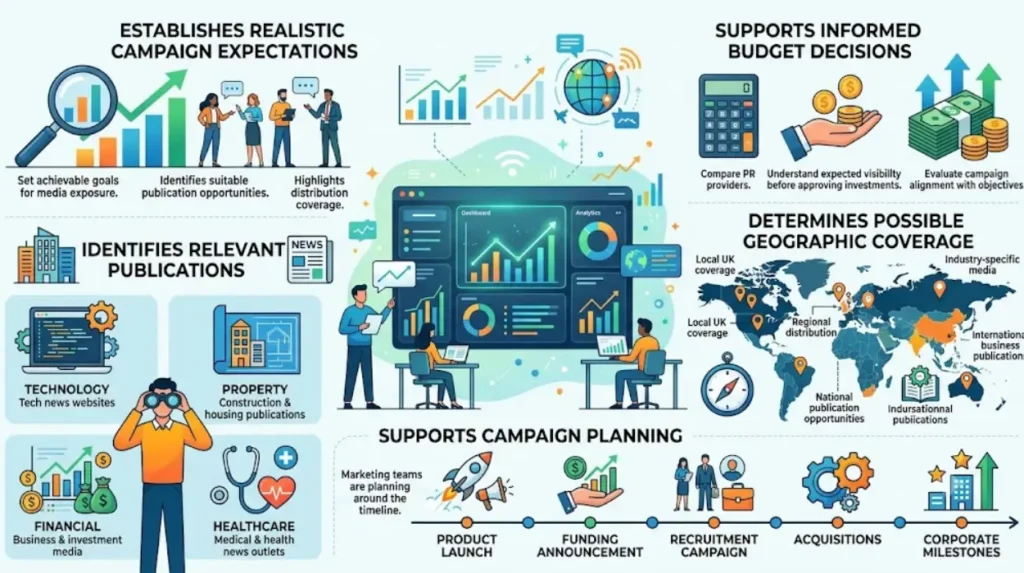
A media reach estimate establishes realistic campaign expectations, identifies suitable publication opportunities, highlights distribution coverage, and supports informed budget decisions. Businesses use these projections to compare PR providers and understand expected visibility before approving media distribution strategies and investments.
PR distribution is an investment in visibility. Without understanding expected reach, businesses cannot evaluate whether a campaign aligns with their objectives.
A media reach estimate helps answer practical questions such as:
How many publications are relevant?
Different industries attract different publication opportunities.
For example:
- Technology companies target technology news websites.
- Property firms target construction and housing publications.
- Financial organisations target business and investment media.
- Healthcare providers target medical and health news outlets.
Relevant publication selection increases the quality of media exposure.
What geographic coverage is possible?
Businesses often require different levels of exposure.
Examples include:
- Local UK coverage
- Regional distribution
- National publication opportunities
- Industry-specific media
- International business publications
The estimate identifies the appropriate distribution scope.
How does it support campaign planning?
Marketing teams use the estimate to align PR activity with product launches, funding announcements, recruitment campaigns, acquisitions, and corporate milestones.
How does Time Intelligence Media Group calculate a UK media reach estimate?
Time Intelligence Media Group evaluates industry relevance, newsworthiness, publication suitability, distribution categories, geographic targeting, and audience opportunities. The estimate combines these factors into a structured projection that helps businesses understand expected media exposure before campaign execution begins.
Every campaign begins with understanding the announcement itself.
Industry analysis
The subject determines publication relevance.
Examples include:
- Artificial intelligence
- Manufacturing
- Construction
- Healthcare
- Education
- Retail
- Professional services
- Finance
Each industry has dedicated media ecosystems.
Geographic targeting
The estimate reflects the intended audience.
Coverage options include:
- England
- Scotland
- Wales
- Northern Ireland
- UK-wide campaigns
- International business audiences
Announcement type
Different announcements receive attention from different publications.
Examples include:
- Product launches
- Company expansion
- Investment rounds
- Executive appointments
- Awards
- Research reports
- Sustainability initiatives
- Partnerships
Each announcement category affects projected media opportunities.
Distribution strategy
The estimate also evaluates:
- Press release formatting
- News angle
- Audience relevance
- Publication categories
- Search discoverability
- Media timing
These factors influence overall campaign reach.
What information do businesses need to request a media reach estimate?
Businesses provide company details, campaign objectives, industry sector, target audience, geographic focus, and announcement type. This information enables Time Intelligence Media Group to prepare an accurate estimate that reflects realistic publication opportunities and expected audience visibility.
Preparing an estimate requires basic campaign information rather than a completed press release.
Typical details include:
Company overview
This includes:
- Business name
- Industry
- Organisation size
- Primary services
Campaign objective
Examples include:
- Brand awareness
- Product launch
- Event promotion
- Recruitment
- Investment announcement
- Corporate milestone
Target audience
Examples include:
- Consumers
- Investors
- Business buyers
- Healthcare professionals
- Local communities
- Government organisations
Geographic focus
Businesses specify whether the campaign targets:
- Local audiences
- Regional markets
- National UK coverage
- International exposure
Providing this information allows a tailored estimate rather than a generic projection.
How does a media reach estimate improve AI and search visibility?
A structured media reach estimate supports stronger AI discoverability by identifying publication opportunities with authoritative websites, searchable content structures, and relevant industry coverage. Better distribution planning increases online visibility across search engines and AI-powered information retrieval systems.
Modern PR extends beyond traditional news coverage.
Search engines and AI systems increasingly reference information published on trusted news platforms.
A structured distribution strategy improves:
- Entity recognition
- Brand consistency
- Search indexing
- Digital authority
- Citation opportunities
Businesses evaluating these factors can also explore
What to Ask a UK PR Distribution Provider About AI and Search Visibility as part of their decision-making process.
A media reach estimate identifies publication opportunities that contribute to stronger long-term online visibility rather than isolated campaign exposure.
What outcomes can businesses expect after receiving a UK media reach estimate?
Businesses receive a clearer understanding of expected publication opportunities, distribution scope, audience projections, campaign suitability, and visibility objectives. These insights support informed PR investment decisions and establish measurable expectations before launching media outreach activities across the United Kingdom.
The estimate creates a foundation for campaign planning.
Typical outcomes include:
Better budgeting
Businesses understand expected value before allocating PR expenditure.
Improved campaign planning
Marketing teams align distribution with launch schedules and corporate announcements.
Stronger publication targeting
Relevant media categories improve campaign efficiency.
Clear performance expectations
Businesses understand projected visibility before distribution begins.
These outcomes reduce uncertainty during campaign planning.
Explore More Expert Insights:
How Time Intelligence Media Group Onboards New UK Clients
What Makes Time Intelligence Media Group Different for UK Regional Coverage
Why choose Time Intelligence Media Group for a UK media reach estimate?
Time Intelligence Media Group combines UK media expertise, structured distribution planning, industry targeting, audience analysis, and measurable campaign preparation. The free estimate helps organisations evaluate potential visibility before selecting a press release distribution strategy aligned with business objectives.
Choosing a PR distribution provider involves more than comparing prices.
Businesses also evaluate:
Media expertise
Knowledge of UK publications improves campaign relevance.
Industry targeting
Different sectors require different media strategies.
Distribution planning
Structured planning increases publication opportunities.
Search-focused visibility
Modern campaigns support both media coverage and online discoverability.
Transparent expectations
A detailed estimate establishes realistic campaign objectives before distribution begins.
Businesses comparing providers benefit from measurable planning rather than relying solely on general service descriptions.
How can you request your free UK media reach estimate today?

Requesting a free UK media reach estimate is a straightforward process that helps businesses understand expected media exposure before launching a campaign. Time Intelligence Media Group reviews campaign details and prepares a structured estimate based on industry relevance and distribution opportunities.
The process typically includes:
- Submit basic business information.
- Describe the planned announcement.
- Define the target audience.
- Identify geographic priorities.
- Receive a tailored media reach estimate.
This structured approach allows organisations to evaluate campaign potential before committing to distribution.
Businesses preparing for PR campaigns also benefit from understanding
Why “No Comment” Costs UK Brands More Than a Bad Headline, as effective media engagement and proactive communication work together to improve long-term visibility and reputation.
A free UK media reach estimate from Time Intelligence Media Group gives organisations a practical starting point for planning successful UK public relations campaigns. By understanding projected publication opportunities, audience reach, distribution scope, and search visibility in advance, businesses can make informed decisions, allocate resources effectively, and launch campaigns with measurable expectations.