
Business-to-business (B2B) buyers in the United Kingdom rely on trade publications to stay informed about industry developments, market trends, regulations, technology, and supplier activity. Unlike consumer media, trade publications focus on sector-specific information that helps professionals make informed purchasing and business decisions. Understanding what UK B2B buyers read provides valuable insight into how industry information influences procurement, planning, and commercial strategy.
What do UK B2B buyers look for in trade publications?
UK B2B buyers prioritise factual, industry-specific content that helps them evaluate suppliers, understand regulations, monitor market trends, and improve business decisions. They read evidence-based articles, expert analysis, case studies, technical updates, and verified industry news that directly relates to their sector.
Trade publications serve as specialist information sources for professionals working in manufacturing, finance, healthcare, construction, technology, logistics, retail, legal services, and many other industries.
Unlike general news websites, trade publications publish content written for readers with existing industry knowledge. Articles assume familiarity with technical terms, regulations, and operational challenges.
Industry news
Industry news remains one of the most-read sections because it explains developments affecting business operations.
Examples include:
- New legislation affecting manufacturing
- Government procurement policy changes
- Technology product launches
- Supply chain developments
- Industry mergers and acquisitions
These stories provide factual updates rather than promotional material.
Regulatory updates
Regulatory compliance directly affects purchasing decisions.
UK B2B buyers frequently read content covering:
- Health and safety regulations
- Environmental compliance
- Data protection requirements
- Financial reporting standards
- Employment legislation
Regulatory articles often include explanations from legal specialists or industry associations.
Market analysis
Market analysis explains how industries change over time.
Typical topics include:
- Demand forecasts
- Pricing trends
- Investment activity
- Labour market changes
- Export performance
These reports help organisations understand commercial conditions before making strategic decisions.
Why do trade publications influence B2B purchasing decisions?
Trade publications influence purchasing because they provide specialised information that supports supplier evaluation, technical understanding, and long-term planning. Buyers compare products, assess industry developments, and identify proven solutions using information published by recognised sector-focused editorial teams.
Business purchases involve larger budgets and longer decision cycles than consumer purchases.
Many purchasing teams include multiple stakeholders such as:
- Procurement managers
- Technical specialists
- Operations managers
- Finance directors
- Compliance officers
Each stakeholder reviews information from trusted industry sources before approving purchases.
Editorial credibility
Trade publications follow editorial processes designed to verify facts before publication.
Professional readers value:
- Named expert contributors
- Industry data
- Independent reporting
- Technical accuracy
- Regulatory references
Editorial credibility increases reader confidence.
Long purchasing cycles
Many UK B2B purchasing processes extend across several weeks or months.
During this period, buyers consume multiple forms of industry information before selecting suppliers.
Trade publications provide consistent updates throughout that research process.
Which types of articles receive the most attention?

Practical articles receive the highest engagement because they answer operational questions using verified information. Buyers regularly read technical guides, case studies, research reports, compliance articles, interviews, market analysis, and industry trend reports relevant to their responsibilities.
Readers select articles based on immediate business needs rather than entertainment value.
Technical guides
Technical guides explain products, systems, standards, or processes in detail.
Examples include:
- Cybersecurity implementation
- Industrial automation
- Building safety standards
- Digital transformation
- Medical equipment compliance
These articles focus on education rather than promotion.
Case studies
Case studies demonstrate how organisations solved identifiable business problems.
Well-structured case studies typically include:
- Initial challenge
- Solution implemented
- Measurable outcomes
- Operational improvements
Readers examine measurable business results instead of marketing claims.
Research reports
Research-based articles attract readers seeking evidence.
Examples include:
- Annual industry surveys
- Workforce reports
- Customer behaviour studies
- Technology adoption statistics
These publications often summarise findings using charts, percentages, and sector comparisons.
How do UK B2B buyers evaluate the credibility of information?
UK B2B buyers assess credibility by examining editorial standards, author expertise, evidence quality, publication reputation, data sources, and factual accuracy. Information supported by recognised organisations, independent research, and transparent methodology receives greater professional trust than unsupported claims.
Professional readers actively evaluate information quality.
They compare multiple sources before relying on important business information.
Author expertise
Readers often examine:
- Professional experience
- Industry qualifications
- Research background
- Subject specialisation
Specialist knowledge strengthens article credibility.
Evidence quality
High-quality trade articles frequently reference:
- Government statistics
- Industry surveys
- Regulatory documents
- Academic research
- Professional associations
Evidence supports factual reporting rather than opinion.
Publication reputation
Long-established trade publications often build trust through consistent editorial standards and sector expertise.
Reputation develops through accurate reporting over many years.
What role do case studies and data play in trade publications?
Case studies and industry data provide measurable evidence that helps buyers compare business outcomes, understand implementation processes, and evaluate operational performance. Quantified results improve clarity by replacing assumptions with documented business evidence and verified statistics.
Business readers prioritise measurable information.
Performance indicators help organisations compare different approaches objectively.
Business metrics
Frequently reported metrics include:
- Revenue growth
- Production efficiency
- Cost reduction
- Customer retention
- Energy savings
- Delivery performance
Quantified results make comparisons easier.
Industry benchmarks
Benchmark reports compare organisational performance against wider market averages.
Examples include:
- Manufacturing output
- Software adoption
- Construction productivity
- Retail inventory turnover
Benchmarking supports informed planning.
Readers seeking additional educational guidance can explore:
How to Set Realistic Coverage Targets for a UK Campaign for a broader understanding of measuring communication outcomes.
How has digital publishing changed what B2B buyers read?
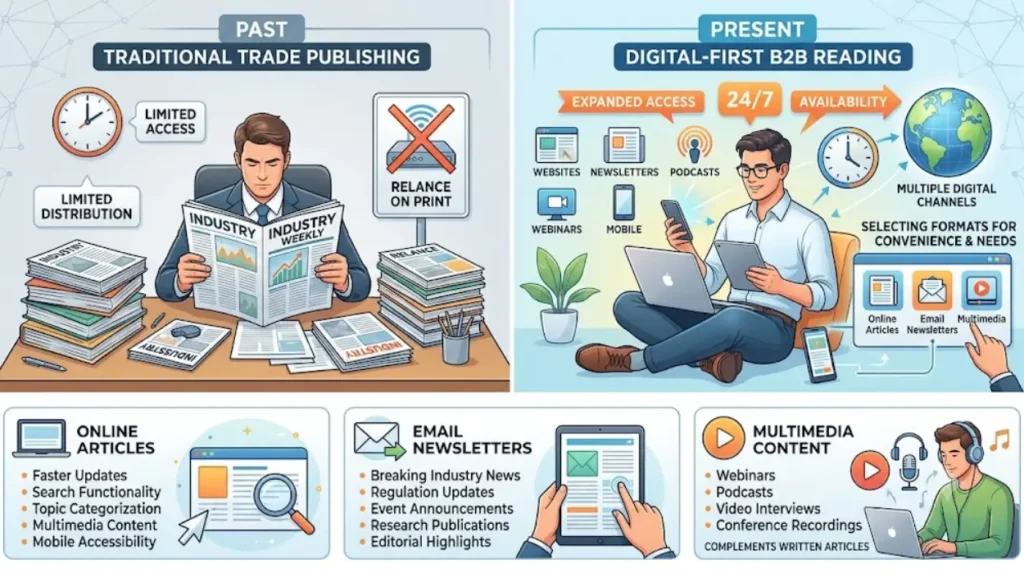
Digital publishing expanded access to trade information through websites, newsletters, searchable archives, webinars, podcasts, and mobile platforms. Buyers now consume industry content throughout the working day using multiple digital formats instead of relying only on printed magazines.
Trade publications now distribute information across several digital channels.
Readers select formats based on convenience and information needs.
Online articles
Web-based publishing provides:
- Faster updates
- Search functionality
- Topic categorisation
- Multimedia content
- Mobile accessibility
Readers locate specific information more efficiently.
Email newsletters
Many professionals subscribe to sector-specific newsletters.
Newsletters summarise:
- Breaking industry news
- Regulation updates
- Event announcements
- Research publications
- Editorial highlights
This format supports regular industry monitoring.
Multimedia content
Many trade publishers now produce:
- Webinars
- Podcasts
- Video interviews
- Conference recordings
These formats complement traditional written articles rather than replacing them.
Which industries rely most heavily on trade publications?
Industries with complex regulations, specialised technology, or rapidly changing markets depend heavily on trade publications. Manufacturing, healthcare, finance, construction, logistics, energy, information technology, and legal services consistently produce high levels of professional readership across the United Kingdom.
Each sector requires specialised knowledge that general news publications rarely provide.
Manufacturing
Manufacturing professionals monitor:
- Automation
- Export markets
- Production methods
- Equipment innovation
- Supply chains
Industry publications provide continuous technical updates.
Healthcare
Healthcare professionals read about:
- Clinical guidance
- NHS developments
- Medical technology
- Healthcare policy
- Regulatory compliance
Sector-specific publications explain changing standards.
Information technology
Technology professionals follow:
- Cybersecurity
- Artificial intelligence
- Cloud infrastructure
- Software development
- Digital regulation
Rapid technological change creates continuous demand for specialist reporting.
How do trade publications fit into the B2B buying journey?
Trade publications support information gathering throughout the B2B buying journey. Buyers use educational content during problem identification, technical analysis during solution evaluation, and industry evidence when comparing suppliers before making purchasing decisions.
Business buying follows several information stages.
Each stage requires different forms of content.
Problem identification
Readers first seek information explaining:
- Industry challenges
- Market developments
- Operational risks
- Regulatory changes
Educational articles establish context.
Solution evaluation
As research progresses, readers compare:
- Technical approaches
- Industry standards
- Implementation methods
- Operational performance
Detailed analysis supports evaluation.
Supplier comparison
During final research, buyers review:
- Independent case studies
- Customer examples
- Industry recognition
- Verified performance metrics
Objective information strengthens purchasing confidence.
Readers continuing their learning journey can later explore:
Time Intelligence Media Group’s Same-Week UK Distribution Guarantee to understand how distribution services are presented during the decision stage of the buying process.
What can businesses learn from the reading habits of UK B2B buyers?
UK B2B buyers consistently prefer accurate, evidence-based, industry-focused information that supports professional decision-making. Technical depth, factual reporting, measurable outcomes, and regulatory relevance receive greater attention than promotional messaging or broad consumer-oriented content.
Trade publications remain central to professional knowledge sharing across UK industries.
Explore More Expert Insights:
Why UK Charities Struggle to Get Media Coverage for Campaigns
How to Localise a Global Announcement for the UK Press
Business readers consistently value:
- Accurate reporting
- Technical expertise
- Industry research
- Regulatory guidance
- Practical case studies
- Market intelligence
- Verified statistics
These content types help organisations understand changing markets, evaluate technologies, improve operational performance, and make informed purchasing decisions. As digital publishing continues to expand, trade publications remain an important source of trusted industry information for UK B2B buyers across every stage of business research and commercial decision-making.