
Setting realistic coverage targets is a core part of planning a successful UK public relations campaign. Clear targets help organisations measure results against defined objectives instead of relying on assumptions. They also improve budget planning, campaign reporting, and media outreach decisions.
A realistic coverage target reflects the campaign’s news value, audience, industry, publication landscape, and available media opportunities. It focuses on measurable outcomes rather than unrealistic expectations of widespread national exposure.
What are realistic coverage targets for a UK campaign?
Realistic coverage targets define measurable media outcomes based on campaign objectives, target publications, industry relevance, media availability, and newsworthiness. They establish achievable expectations for earned media coverage across national, regional, trade, and digital publications while supporting accurate campaign evaluation and continuous performance improvement.
Coverage targets describe the expected amount and quality of media exposure during a campaign. They help communications teams determine whether campaign performance aligns with the original objectives.
Rather than setting a fixed number without context, realistic targets consider several measurable factors, including:
- Number of media placements
- Target publication categories
- Audience reach
- Share of relevant industry coverage
- Quality of publication authority
- Message accuracy
- Geographic relevance
For example, a UK manufacturing company launching specialist equipment often focuses on trade publications rather than national newspapers. In contrast, a nationwide consumer product launch typically includes national, regional, and online media.
Coverage targets become meaningful only when they match the intended audience.
Why do coverage targets vary between UK campaigns?
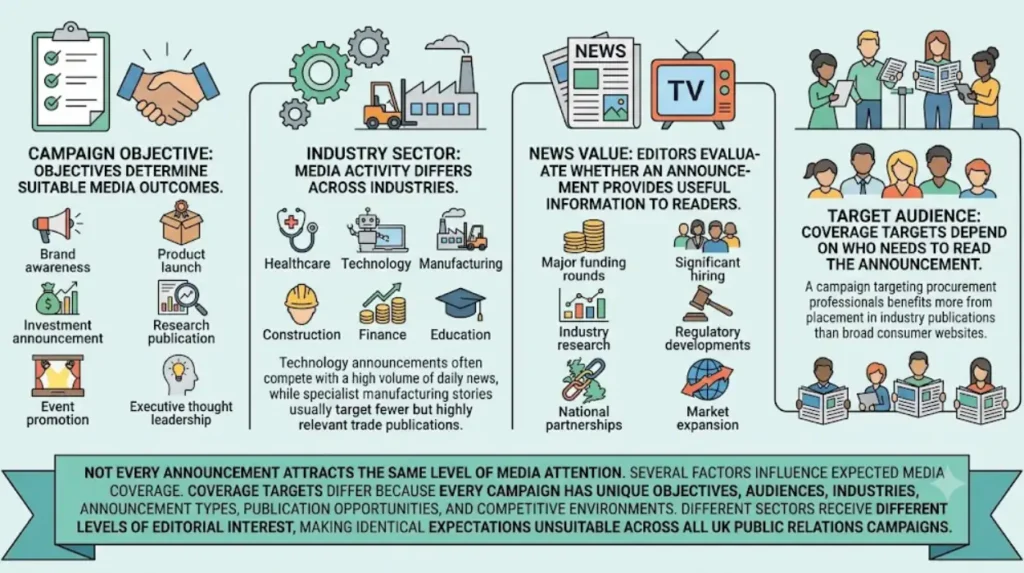
Coverage targets differ because every campaign has unique objectives, audiences, industries, announcement types, publication opportunities, and competitive environments. Different sectors receive different levels of editorial interest, making identical expectations unsuitable across all UK public relations campaigns.
Not every announcement attracts the same level of media attention.
Several factors influence expected media coverage.
Campaign objective
Objectives determine suitable media outcomes.
Examples include:
- Brand awareness
- Product launch
- Investment announcement
- Research publication
- Event promotion
- Executive thought leadership
Each objective aligns with different publication types.
Industry sector
Media activity differs across industries.
Examples include:
- Healthcare
- Technology
- Manufacturing
- Construction
- Finance
- Education
Technology announcements often compete with a high volume of daily news, while specialist manufacturing stories usually target fewer but highly relevant trade publications.
News value
Editors evaluate whether an announcement provides useful information to readers.
High-news-value announcements include:
- Major funding rounds
- Significant hiring
- Industry research
- Regulatory developments
- National partnerships
- Market expansion
Routine company updates generally receive less editorial attention.
Target audience
Coverage targets depend on who needs to read the announcement.
A campaign targeting procurement professionals benefits more from placement in industry publications than broad consumer websites.
Readers comparing publication strategies can also explore:
Time Intelligence Media Group’s Same-Week UK Distribution Guarantee for examples of distribution approaches.
How do you set realistic media coverage goals?
Realistic media coverage goals begin with campaign objectives, publication research, audience analysis, previous campaign data, and measurable success indicators. Each target reflects achievable editorial opportunities rather than estimated exposure without supporting evidence or historical performance data.
Coverage planning follows a structured process.
Define campaign objectives
Start with measurable outcomes.
Examples include:
- Ten trade publication mentions
- Five regional newspaper placements
- Three interviews
- One national feature
- Twenty online articles
Objectives remain specific and measurable.
Build a publication list
Identify relevant media outlets.
Publication categories include:
- National newspapers
- Regional newspapers
- Trade magazines
- Industry websites
- Business publications
- Professional associations
Each category contributes differently to campaign goals.
Analyse previous campaigns
Historical performance provides useful benchmarks.
Review:
- Number of placements
- Publication quality
- Audience reach
- Journalist engagement
- Coverage timing
Historical results improve forecasting accuracy.
Match targets to available resources
Campaign resources influence achievable outcomes.
Consider:
- Campaign duration
- Available spokespersons
- Supporting data
- Press materials
- Media relationships
A two-week campaign differs significantly from a six-month communications programme.
Which UK publications should count towards coverage targets?
Coverage targets include publications that reach the intended audience, maintain editorial standards, and align with campaign objectives. National newspapers, regional publications, specialist trade magazines, professional journals, and recognised online news platforms each provide different strategic value.
Not every publication contributes equally.
Quality often matters more than quantity.
National media
National publications offer broad visibility.
Examples include major newspapers, business news platforms, and national online publishers.
National placements generally require stronger news value.
Regional publications
Regional media support geographically focused campaigns.
Examples include:
- Local newspapers
- Regional business publications
- City news websites
Regional coverage supports local investment announcements, community initiatives, and recruitment campaigns.
Trade publications
Trade publications reach specialist decision-makers.
Examples include:
- Construction magazines
- Healthcare journals
- Manufacturing publications
- Technology websites
Trade coverage often produces highly relevant business engagement.
Readers planning publication targeting can explore:
What UK B2B Buyers Actually Read in Trade Publications for additional context.
Which metrics measure campaign coverage effectively?
Effective campaign measurement combines coverage volume, publication quality, audience relevance, message accuracy, authority, geographic distribution, and campaign objectives. Multiple metrics provide a more accurate assessment than relying only on article counts or estimated audience reach.
Coverage evaluation extends beyond counting articles.
Several performance indicators work together.
Number of placements
Count confirmed editorial mentions.
Separate results by:
- National
- Regional
- Trade
- Online
This improves reporting clarity.
Publication authority
Assess publication credibility within the intended sector.
Industry-specific publications often provide stronger commercial relevance than unrelated high-traffic websites.
Audience relevance
Measure whether publications reach the intended readers.
Relevant audiences include:
- Procurement managers
- Investors
- Healthcare professionals
- Engineers
- Retail buyers
Audience alignment supports campaign objectives.
Message consistency
Review whether published articles accurately communicate key messages.
Consistency protects campaign quality.
Geographic coverage
National campaigns often seek balanced exposure across multiple UK regions.
Regional campaigns focus on defined locations.
What factors affect achievable media coverage?

Editorial interest, campaign timing, industry competition, publication schedules, journalist availability, announcement quality, supporting evidence, and seasonal news cycles all influence achievable media coverage within the United Kingdom.
Coverage depends on external conditions as well as campaign quality.
Editorial calendars
Many trade publications follow scheduled editorial themes.
Submitting relevant announcements before editorial deadlines increases publication opportunities.
Competing news
Large national events reduce available editorial space.
Examples include:
- Government announcements
- General elections
- Major sporting events
- National emergencies
- Economic policy updates
Campaign timing affects visibility.
Supporting evidence
Announcements supported by data receive stronger editorial consideration.
Examples include:
- Industry surveys
- Market research
- Financial figures
- Independent reports
- Official statistics
Evidence strengthens media relevance.
Spokesperson availability
Journalists often request interviews or comments.
Accessible spokespeople improve response times and publication opportunities.
What are common mistakes when setting coverage expectations?
Common mistakes include targeting unrealistic publication numbers, ignoring audience relevance, measuring only article volume, overlooking industry competition, and failing to align objectives with available campaign resources and editorial opportunities.
Several planning errors reduce campaign accuracy.
These include:
- Expecting national coverage for routine announcements
- Ignoring specialist trade media
- Setting targets without historical benchmarks
- Counting duplicate syndications as separate achievements
- Measuring quantity instead of relevance
- Ignoring publication quality
- Changing objectives during campaign delivery
Avoiding these mistakes improves reporting accuracy.
Campaign evaluation becomes more meaningful when objectives remain consistent throughout the campaign.
How can organisations improve future coverage targets?
Future coverage targets improve through performance analysis, publication research, campaign benchmarking, journalist feedback, audience measurement, and continuous reporting. Each completed campaign provides measurable evidence for setting increasingly accurate objectives.
Campaign planning improves with experience.
Organisations benefit from documenting:
- Publication response rates
- Successful story themes
- Industry publication trends
- Coverage timing
- Journalist engagement
- Audience interaction
These records create practical benchmarks for future campaigns.
Regular benchmarking identifies patterns across multiple campaigns instead of relying on isolated results.
Campaign teams also benefit from reviewing changing media landscapes, publication priorities, and editorial formats to keep future targets aligned with current industry conditions.
Explore More Expert Insights:
Free Press Release Sites vs Paid UK Distribution: The Real Trade-Off
How to Benchmark Your UK PR Distribution Against Competitors
Realistic coverage targets provide a structured framework for planning, measuring, and improving UK public relations campaigns. They replace assumptions with measurable objectives based on campaign purpose, publication relevance, audience needs, and historical performance.
Effective coverage planning combines achievable placement goals, appropriate publication selection, audience-focused measurement, and ongoing performance analysis. By evaluating multiple metrics instead of article volume alone, organisations gain a more accurate understanding of campaign effectiveness and establish stronger benchmarks for future UK media campaigns.