
Small and medium-sized enterprises (SMEs) in the United Kingdom use public relations (PR) distribution to share company news with journalists, editors, trade publications, and online media. Choosing between a retainer model and a project-based approach affects budgeting, planning, media consistency, and long-term communication outcomes.
This guide explains how both models work, compares their strengths, and outlines the situations where each option fits different business objectives.
What is the difference between retainer and project-based PR distribution?
A retainer provides ongoing PR distribution support through a recurring agreement, while project-based PR distribution delivers services for a single campaign or defined objective. The main differences involve duration, planning, cost structure, media continuity, and communication frequency.
PR distribution is the process of delivering press releases and company announcements to relevant media outlets. UK SMEs commonly choose between two engagement models.
A retainer is an ongoing agreement that covers continuous PR planning and distribution over a fixed period, typically monthly.
A project-based arrangement focuses on one campaign, announcement, event, funding round, product launch, or milestone. Once the agreed work finishes, the engagement ends.
Both models use similar distribution methods, including:
- National media
- Regional newspapers
- Trade publications
- Industry journalists
- Online news platforms
The difference lies in planning rather than distribution channels.
How does a retainer work?
A retainer provides scheduled communication throughout the year.
Typical activities include:
- Press release planning
- Editorial calendar management
- Media distribution
- Journalist outreach
- Performance reporting
- Ongoing communication advice
The business pays a recurring fee for continuous service.
How does project-based PR work?
Project-based PR starts with one clearly defined objective.
Examples include:
- Product launches
- Funding announcements
- Annual reports
- Award wins
- New partnerships
- Office openings
The scope, timeline, and deliverables are agreed before work begins.
When does a retainer suit a UK SME?

A retainer suits UK SMEs that generate regular news, maintain continuous media relationships, and require structured communication throughout the year. It supports consistency, planned storytelling, and predictable PR activity across multiple business milestones.
Businesses with frequent announcements benefit from continuous media engagement.
Examples include:
- SaaS companies releasing quarterly product updates
- Fintech firms announcing partnerships
- Manufacturing companies expanding operations
- Professional service firms publishing research
- Technology startups securing multiple investment stages
Instead of treating each announcement separately, a retainer connects them into an ongoing communications strategy.
Benefits of continuous planning
A retainer enables:
- Editorial calendar development
- Consistent messaging
- Faster response to industry developments
- Regular media visibility
- Long-term relationship building
Planning several months ahead also reduces last-minute communication challenges.
Budget predictability
Retainers normally involve fixed monthly fees.
This structure helps finance teams forecast communication expenses across the financial year instead of approving individual campaign budgets.
For businesses planning multiple announcements, predictable costs simplify resource allocation.
When is project-based PR distribution the better option?
Project-based PR distribution fits UK SMEs with occasional announcements, fixed budgets, or single communication objectives. It concentrates resources on one defined campaign without requiring an ongoing contractual commitment after project completion.
Many SMEs do not generate news every month.
Instead, communication happens around significant business events.
Examples include:
- Launching a new product
- Opening a regional office
- Completing a funding round
- Publishing annual financial results
- Winning a national industry award
In these situations, one focused campaign often matches business needs.
Advantages of project work
Project-based PR offers:
- Defined deliverables
- Fixed campaign scope
- Clear timelines
- Single approval process
- Budget flexibility
Businesses only invest when they have news to announce.
Suitable business stages
Project work often fits:
- Early-stage startups
- Seasonal businesses
- Companies testing PR for the first time
- Organisations with one annual announcement
- SMEs preparing a single launch campaign
How do costs differ between retainer and project-based PR distribution?
Retainers spread communication costs across recurring monthly payments, while project-based PR concentrates spending into individual campaigns. The best financial structure depends on communication frequency rather than company size alone.
Cost comparison involves more than headline pricing.
Businesses should evaluate:
- Number of announcements each year
- Internal marketing resources
- Communication priorities
- Required reporting
- Media outreach frequency
Retainer cost structure
Retainers generally include recurring services such as:
- Strategic planning
- Press release reviews
- Distribution
- Media outreach
- Performance analysis
Costs remain relatively stable each month.
Project pricing
Project pricing typically covers:
- Campaign planning
- Press release preparation
- Distribution
- Campaign reporting
Each campaign has its own separate budget.
Businesses planning several campaigns annually often compare the combined project costs against an annual retainer.
How does each model affect media relationships?
Retainer PR supports ongoing journalist engagement through regular communication, while project-based PR focuses attention on individual announcements. Media relationships strengthen through consistent, relevant communication over time rather than isolated campaigns.
Journalists value relevant, newsworthy information delivered consistently.
Repeated communication enables PR teams to understand:
- Publication preferences
- Editorial deadlines
- Sector interests
- Industry developments
Over time, this creates familiarity between organisations and media contacts.
Retainers support continuity
Continuous engagement helps businesses:
- Share industry insights
- Respond to breaking news
- Provide expert commentary
- Maintain visibility between major announcements
This consistent activity supports long-term communication planning.
Project campaigns prioritise specific news
Project-based campaigns focus resources on one objective.
For businesses with limited news activity, this approach aligns communication effort with genuine business developments.
For organisations planning annual communication calendars,
How Bank Holidays and Parliament Recess Affect UK PR Timing provides useful context on scheduling announcements around the UK news cycle.
Which model offers greater flexibility?
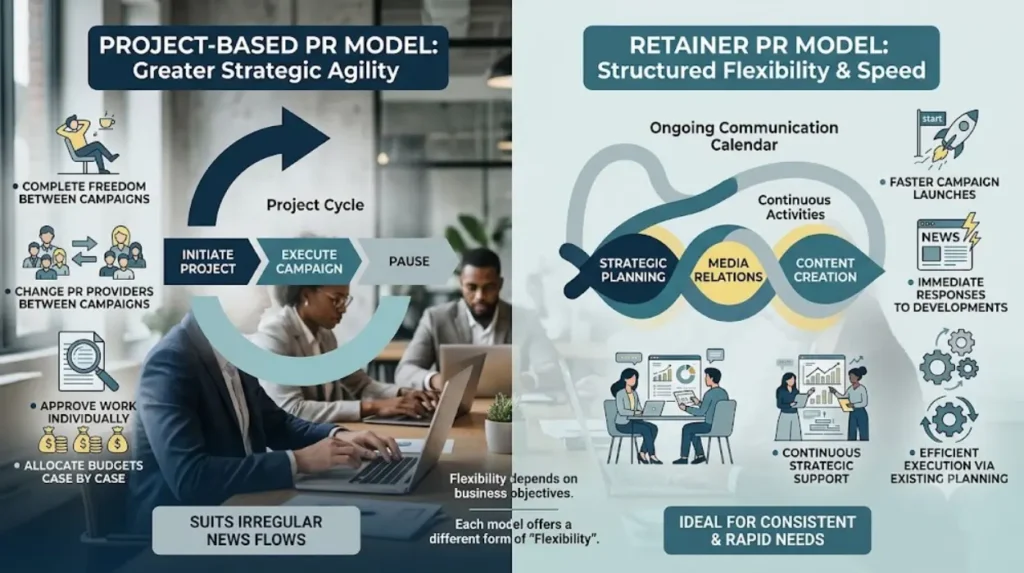
Project-based PR provides greater flexibility for businesses with changing communication needs, while retainers provide structured flexibility through ongoing planning, faster execution, and continuous strategic support across multiple campaigns.
Flexibility depends on business objectives.
Some organisations value complete freedom between campaigns.
Others value rapid access to experienced PR support throughout the year.
Project flexibility
Project arrangements allow businesses to:
- Pause communication
- Change providers between campaigns
- Approve work individually
- Allocate budgets case by case
This suits businesses with irregular news flow.
Retainer flexibility
Retainers support flexibility differently.
They enable:
- Faster campaign launches
- Planned communication calendars
- Immediate responses to industry developments
- Continuous refinement of messaging
Because planning already exists, execution often becomes more efficient.
What factors should UK SMEs evaluate before choosing?
UK SMEs should compare communication frequency, annual budgets, internal resources, business growth plans, and media objectives before selecting a PR distribution model. The right choice aligns communication activity with long-term business requirements.
Choosing between the two models begins with understanding business activity rather than comparing prices alone.
Communication frequency
Businesses releasing:
- Monthly updates
- Quarterly reports
- Product enhancements
- Research findings
- Industry commentary
often benefit from continuous planning.
Businesses announcing news once or twice annually often prefer project work.
Internal marketing capacity
An experienced in-house marketing team often manages planning between individual projects.
Smaller teams frequently benefit from external planning support provided through retainers.
Growth objectives
Rapidly expanding businesses usually generate increasing volumes of news.
Examples include:
- Recruitment
- Investment
- Partnerships
- Product development
- Geographic expansion
As communication frequency grows, engagement models often evolve from projects to ongoing support.
Businesses comparing distribution providers can also explore:
Why UK Fintech Founders Choose Time Intelligence Media Group for Distribution to understand how service selection differs during later-stage purchasing decisions.
Which PR distribution model suits different types of UK SMEs?
Different industries produce news at different frequencies. Selecting a retainer or project-based model depends on communication patterns, business maturity, and the number of media opportunities generated throughout the year.
There is no universal model for every SME.
The choice depends on operational activity.
Businesses commonly suited to retainers
Examples include:
- Software companies
- Fintech firms
- Healthcare technology providers
- Professional consultancies
- Manufacturing businesses with continuous innovation
These organisations frequently publish updates throughout the year.
Businesses commonly suited to project-based campaigns
Examples include:
- Retail businesses launching seasonal collections
- Construction firms announcing completed developments
- Local hospitality businesses opening new locations
- Charities running annual fundraising campaigns
- Event organisers promoting specific programmes
These organisations communicate around defined milestones rather than continuous news cycles.
Explore More Expert Insights:
How to Choose Between UK National, Regional, and Trade Distribution
How to Choose a PR Distribution Service That Understands UK Fintech
Retainer and project-based PR distribution both help UK SMEs deliver news to relevant media audiences. The difference lies in communication planning rather than distribution methods.
A retainer supports businesses with regular announcements, structured planning, ongoing media engagement, and predictable budgeting. It aligns with organisations that communicate consistently throughout the year.
Project-based PR distribution focuses on individual campaigns with defined objectives, timelines, and budgets. It suits SMEs with occasional announcements or businesses seeking communication support for a specific milestone.
Evaluating communication frequency, internal resources, growth plans, and annual news activity provides a practical framework for selecting the most appropriate PR distribution model. The right approach aligns media activity with genuine business communication needs rather than applying the same engagement structure to every organisation.