
Regulated sector announcements require accuracy, legal compliance, and precise media distribution. In the United Kingdom, industries such as financial services, healthcare, legal services, energy, public sector organisations, and listed companies operate under strict regulatory frameworks. A communication strategy for these sectors must protect reputation while ensuring information reaches the correct audiences.
Time Intelligence Media Group applies a structured approach that combines regulatory awareness, editorial planning, targeted media distribution, and measurable reporting. This process supports organisations that need reliable communications across complex regulatory environments.
What is Time Intelligence Media Group’s approach to regulated UK sector announcements?
Time Intelligence Media Group delivers regulated UK sector announcements through a structured process that combines regulatory compliance, editorial quality, sector-specific media targeting, distribution monitoring, and performance reporting. Every announcement follows defined workflows that prioritise accuracy, credibility, and timely publication across relevant UK media channels.
Regulated announcements involve more than distributing a press release. Every communication must reflect current regulations, protect sensitive information, and maintain factual accuracy.
Time Intelligence Media Group develops announcement strategies around several core principles:
- Regulatory compliance
- Editorial verification
- Audience targeting
- Media relevance
- Performance measurement
The process supports organisations operating within sectors that receive greater public and regulatory scrutiny.
Which sectors benefit from this approach?
Examples include:
- Financial services
- Healthcare providers
- Pharmaceutical companies
- Energy organisations
- Public sector bodies
- Legal firms
- Listed companies
- Insurance providers
- Technology companies operating under UK regulation
Each sector has different communication requirements, making industry knowledge essential.
Why do regulated UK announcements require a specialised communications process?

Regulated announcements contain information that influences investors, customers, regulators, employees, and journalists. Every communication requires legal accuracy, clear messaging, controlled timing, and appropriate distribution to reduce reputational and compliance risks throughout the publication process.
Generic press release distribution does not satisfy the requirements of regulated industries.
A specialised communications process introduces structured review stages before publication.
Regulatory review
Announcements undergo checks for:
- Legal terminology
- Regulatory obligations
- Sensitive disclosures
- Accuracy of factual statements
- Executive approval
This review reduces the likelihood of publishing incorrect or incomplete information.
Editorial review
Editorial specialists improve readability without changing the meaning of regulated information.
This includes:
- Clear headlines
- Concise summaries
- Accurate quotations
- Logical structure
- Consistent terminology
The objective remains factual communication rather than promotional language.
How does Time Intelligence Media Group prepare regulated announcements?
Preparation follows a documented workflow beginning with stakeholder consultation, regulatory assessment, editorial development, approval management, targeted distribution, publication monitoring, and post-campaign reporting. Every stage supports compliance while increasing media relevance and audience visibility.
Successful regulated communications begin long before distribution.
Stakeholder briefing
The initial stage identifies:
- Business objectives
- Regulatory obligations
- Target audiences
- Publication deadlines
- Internal approval requirements
This information shapes the communication strategy.
Editorial development
Editors transform technical information into clear news content.
This includes:
- News angle development
- Supporting facts
- Executive quotations
- Context for journalists
- SEO-friendly structure for digital publication
Compliance approval
Before distribution, the announcement receives final approval from relevant stakeholders.
Typical reviewers include:
- Legal teams
- Compliance officers
- Executive leadership
- Investor relations teams
- Communications departments
Only approved content proceeds to distribution.
How does targeted media distribution improve regulated announcements?
Targeted media distribution places announcements with journalists, editors, publishers, and industry publications covering specific regulated sectors. Focused distribution improves relevance, increases publication quality, and strengthens relationships with specialist media across the United Kingdom.
Sending announcements to every newsroom reduces relevance.
Instead, Time Intelligence Media Group matches announcements with media that actively report on each industry.
Sector-specific media targeting
Examples include:
- Financial publications
- Healthcare journals
- Legal news outlets
- Energy publications
- Technology media
- Regional business publications
Relevant journalists receive announcements aligned with their reporting interests.
This improves editorial consideration.
Readers exploring broader distribution planning can also review:
Building a Quarterly PR Distribution Plan for a UK Scale-Up for additional planning strategies.
How does Time Intelligence Media Group maintain compliance during distribution?
Compliance continues after editorial approval through controlled distribution, accurate publication records, transparent reporting, and ongoing monitoring. Every stage documents how announcements move through media channels while maintaining regulatory consistency and communication integrity.
Distribution is only one stage of regulated communications.
Monitoring continues throughout publication.
Distribution controls
These include:
- Scheduled release timing
- Approved distribution lists
- Version control
- Publication tracking
- Media confirmation
Maintaining documented records supports governance requirements.
Monitoring media coverage
Coverage monitoring identifies:
- Published articles
- Syndicated content
- Industry mentions
- Regional coverage
- Online visibility
Organisations receive clear evidence of communication performance.
What outcomes do organisations achieve from this approach?
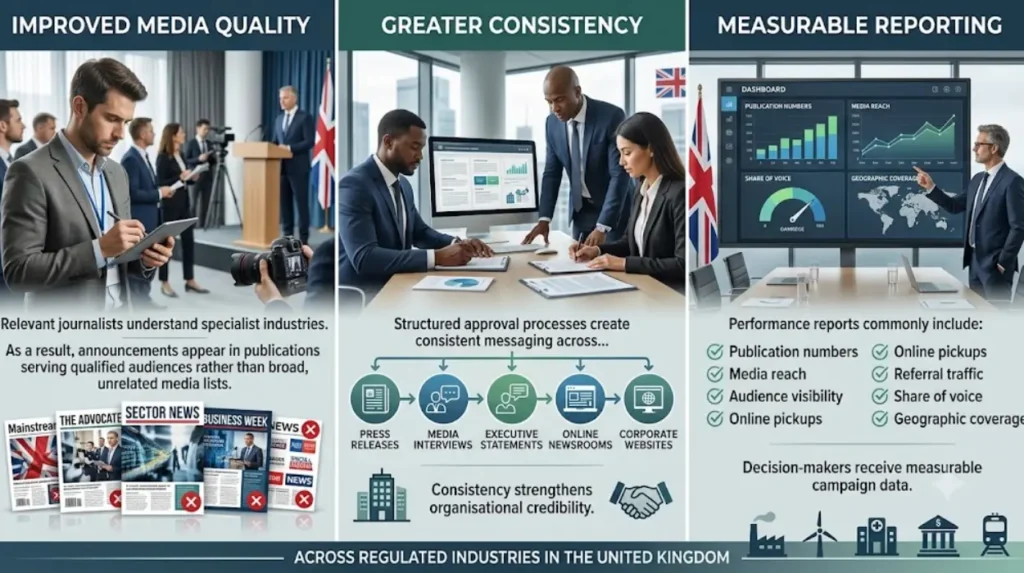
A structured regulated communications strategy produces consistent messaging, stronger media relevance, improved stakeholder confidence, measurable publication performance, and reduced communication risk across regulated industries operating within the United Kingdom.
Regulated communications influence several organisational objectives.
Improved media quality
Relevant journalists understand specialist industries.
As a result, announcements appear in publications serving qualified audiences rather than broad, unrelated media lists.
Greater consistency
Structured approval processes create consistent messaging across:
- Press releases
- Media interviews
- Executive statements
- Online newsrooms
- Corporate websites
Consistency strengthens organisational credibility.
Measurable reporting
Performance reports commonly include:
- Publication numbers
- Media reach
- Audience visibility
- Online pickups
- Referral traffic
- Share of voice
- Geographic coverage
Decision-makers receive measurable campaign data.
When should an organisation use Time Intelligence Media Group for regulated announcements?
Organisations benefit from specialist communications support when announcements involve regulation, legal oversight, investor communication, corporate governance, healthcare compliance, financial disclosure, or reputation-sensitive public information requiring professional media management.
Certain communications demand specialist expertise.
Examples include:
- Regulatory updates
- Corporate acquisitions
- Funding announcements
- Executive appointments
- Clinical research milestones
- Public consultations
- Sustainability reporting
- Annual financial reporting
- Compliance initiatives
Each announcement affects multiple stakeholder groups simultaneously.
How does Time Intelligence Media Group support decision-makers choosing a regulated communications partner?
Decision-makers require evidence of regulatory understanding, editorial expertise, sector media relationships, transparent reporting, and structured workflows. Time Intelligence Media Group combines these capabilities into a repeatable communications framework designed specifically for regulated UK organisations.
Selecting a communications partner involves evaluating operational capability rather than promotional claims.
Key assessment criteria include:
Regulatory knowledge
Teams understand communication requirements affecting regulated industries.
This knowledge reduces unnecessary publication risks.
Editorial capability
Professional editors convert technical information into accurate, journalist-ready announcements without altering regulatory meaning.
Distribution expertise
Sector-focused media databases connect announcements with journalists covering relevant industries.
Examples include finance correspondents, healthcare editors, legal reporters, energy journalists, and regional business publications.
Transparent reporting
Clients receive measurable reporting that demonstrates communication outcomes using objective performance metrics.
Repeatable processes
Documented workflows improve consistency across every announcement, regardless of sector or campaign size.
Explore More Expert Insights:
How Time Intelligence Media Group Handles Same-Day PR Distribution in the UK
What UK Clients Get With Time Intelligence Media Group’s Distribution Service
Regulated UK sector announcements require structured communication rather than standard press release distribution. Legal oversight, editorial accuracy, sector-specific media targeting, and measurable reporting all contribute to successful outcomes.
Time Intelligence Media Group applies a repeatable communications framework that supports organisations operating in highly regulated industries across the United Kingdom. By combining compliance-focused workflows, specialist editorial expertise, targeted distribution, and transparent reporting, the organisation helps clients deliver accurate announcements to the right audiences while maintaining regulatory integrity and communication consistency.