Ask a headteacher why their school rarely appears in the local news, and the answer is rarely “we don’t want to”. It is some version of “nothing newsworthy happens here” — usually said in a building where three hundred children learned something remarkable that morning, a teacher quietly reached a twenty-year milestone last week, and the Year 6 charity bake sale just raised more than anyone expected.
The truth, as any local news editor will tell you, is that schools are among the most story-rich organisations in any community. What most schools lack is not stories but a system for spotting, telling and publishing them — and in 2026, with pupil rolls falling across the UK and per-pupil funding making every enrolment decision worth thousands of pounds, that system has become a strategic necessity rather than a nice-to-have.
This article provides that system: a month-by-month media calendar for the 2026/27 academic year, an honest look at what professional coverage involves, and the budget arithmetic that lets a school leader defend the investment in front of any governing body.
Why Do School Leaders Believe They Have Nothing Newsworthy?
Three assumptions cause it, and all three are wrong.
“News means big news.” School leaders imagine local news wants the extraordinary — national awards, celebrity visits, record-breaking results. In reality, local journalism runs on the relatable: the pupil who organised a food-bank drive, the caretaker retiring after thirty years, the reception class writing to a local care home. Ofcom’s research into UK news consumption shows 93% of UK adults use local news and information — and what they read most eagerly is precisely this fabric of community life. Schools generate it daily.
“If it were newsworthy, journalists would already be here.” Local newsrooms are smaller than they were a decade ago; stories no longer get discovered; they get supplied. The schools that appear in the local press are not the ones where more happens — they are the ones that tell someone.
“We did a press release once, and nothing changed.” Quite possibly true — because a single story, as we explored in our analysis of search behaviour, is one entry in a Google index that parents judge by its first page. Visibility is cumulative, or it is nothing, which is exactly why the answer is a calendar, not a one-off.
The 2026/27 Story Calendar
A year of stories every school is already sitting on
Tap a term to explore its stories. Highlighted entries mark the statutory admissions moments when visibility matters most.
The shop window term
The proof term
The evidence term
What Does a Full Academic Year of School Stories Look Like?
Here is the 2026/27 academic year, term by term, with the stories every UK school is sitting on. Note how the calendar aligns with the admissions cycle — the statutory deadlines of 31 October 2026 for secondary applications and 15 January 2027 for primary applications (GOV.UK school admissions) mean autumn visibility directly precedes the weeks when families formally decide.
Autumn term (September – December 2026): the shop window term.
- September: new starters’ first day (an evergreen photo story), new staff and headteacher appointments, building works completed over the summer, the year’s vision
- October: open days and open evenings — covered, not just held — Black History Month projects, harvest festivals and community giving, and a final visibility push before the 31 October secondary deadline
- November: Remembrance projects, anti-bullying week, science and careers fairs, sports season results
- December: Christmas performances and fairs, charity totals announced, a “year in review” reflection — published while primary-application families are still deciding
Spring term (January – April 2027): the proof term.
- January: a last, well-timed story before the 15 January primary deadline, New Year initiatives, entrepreneurial and enterprise projects
- February: national offer-day preparation, Safer Internet Day, half-term community programmes
- March: World Book Day, science week, secondary offer day (1 March) — a warm “welcome to our new families” story converts offers into acceptances, which is where schools quietly lose pupils
- April: Easter productions, spring fairs, primary offer day (16 April) with the same conversion story, trips and expeditions
Summer term (May – August 2027): the evidence term.
- May: exam-season features that humanise the school — revision support, wellbeing programmes, staff going the extra mile
- June: sports days, arts festivals, anniversaries and milestones, transition events for incoming Year 7s
- July: leavers’ stories and destinations, prize-givings, retiring staff tributes — the most-shared school content of the entire year
- August: results days, individual success stories (the pupil who overcame, the first-in-family university place), and a look ahead that seeds September
Read that list again as a parent rather than a marketer. Every entry maps onto what parents told YouGov they choose schools for — wellbeing, culture, ethos, enrichment — but demonstrated rather than claimed. A prospectus asserts a school’s character; a year of published stories proves it.
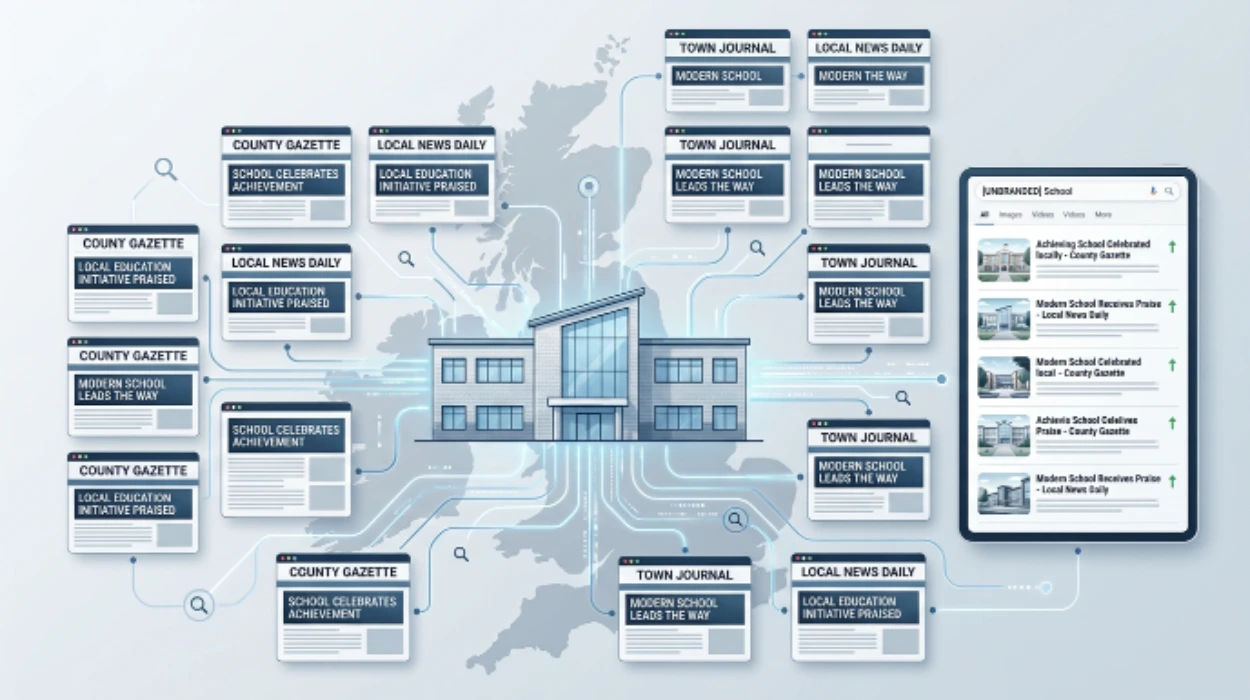
Two practical notes on making the calendar work. First, distribution matters as much as the story: each of these, syndicated across the relevant titles in a sixteen-site local news network through our PR Distribution service, becomes multiple indexed, trusted results rather than one. Second, the admissions-window moments — October, January, and the two offer days — are when timed banner advertising across local titles earns its place, putting the school’s name in front of catchment families in the exact weeks they are deciding and pointing them to the coverage that persuades.
What Does Professional Event Coverage Actually Involve?
“Event coverage” is another phrase schools hear loosely, so here is precisely what it means when done properly — using an open day as the example, though the same applies to fairs, anniversaries and award evenings.
Before the event, the story is planned: what makes this open day worth reading about — the new science block, the record bookings, the head’s first September. On the day, a journalist and photographer attend; they gather the quotes (head, staff, visiting parents, pupils showing families around) and the images that a school office simply cannot produce to editorial standard while also running the event. Afterwards, a full article is written, published across the relevant local titles, and indexed — with photography the school also receives for its own prospectus and website.
The contrast with the usual approach is stark. An uncovered open day reaches the two hundred families who attended and then evaporates. A covered one reaches those families plus the thousands of local readers who didn’t attend, plus every parent who Googles the school for years afterwards — and next autumn, when a hesitant family searches, the article is still there saying “this school’s open day drew record numbers”. That conversion of a single afternoon into a permanent recruiting asset is the entire logic of our Events Media Coverage service.
Some school stories, of course, are bigger than any single event — a turnaround journey, a distinctive pastoral philosophy, a decade of investment. These deserve long-form editorial treatment, clearly labelled, on the titles parents already read: the role of Sponsored Content, and the natural depth layer on top of a story calendar.
Is a Media Partnership a Better Value Than One-Off Press Releases?
Any school can commission coverage story by story, and for testing the water, that is a perfectly sensible start. But the schools that get the most from local media across our network work differently — on a partnership model — and the economics explain why.
One-off coverage is reactive: something happens, someone remembers the local paper exists, a release is written from scratch, and the moment has often half-passed. Each story carries its own setup cost in time and coordination, and gaps between stories are exactly when a school fades from view.
A Media Partnership inverts this. The story calendar above is agreed in advance and aligned to the school’s own year; coverage is planned before events happen rather than scrambled after; the publisher’s team learns the school, so each story takes less of the school’s time, not more; and the annual cost is known on day one — a fixed line a bursar can budget, rather than unpredictable ad hoc spending. Most importantly, partnership produces the one thing one-offs never can: rhythm. A story or two every term, all year, every year — which is what compounding visibility actually requires.
What Is the Budget Maths of Sustained Visibility?
Here is the section to take to the governors, because in 2026 the arithmetic is unusually clear.
Department for Education funding statistics put per-pupil funding for 2026-27 at £8,580 per year in cash terms. Follow one child through their school journey and the sums compound: a single pupil enrolled into reception represents roughly £60,000 of funding across seven primary years; a Year 7 enrolment, around £43,000 across five secondary years — more where sixth form follows. For independent schools, with average day fees exceeding £20,000 post-VAT, a single seven-year enrolment can represent well over £140,000 in fee income.
Now run the comparison every bursar should see. A school that gains — or simply retains — three pupils a year as a result of being visibly, credibly present in its community has secured roughly £25,000 per year in funding, and around £180,000 across those pupils’ school careers. Set the cost of a year-round programme of local coverage against that, and sustained visibility is not a marketing expense competing with teaching assistants; it is one of the few investments on a school’s books with a plausible multiple return. And that is before counting the harder-to-price returns: the stronger field for every staff vacancy (candidates Google schools too), the goodwill bank that cushions a difficult inspection, and the community standing that makes every future ask easier.
The falling-rolls era sharpens all of this. When there were more children than places, invisibility cost schools nothing. In 2026, with rolls declining across the UK and 90% of funding following the pupil, invisibility is the most expensive thing a school does for free.
What Should a School Take Into September?
A simple resolution: stop treating coverage as something that occasionally happens to the school, and start running it as a calendar the school owns. The stories already exist — this September’s new starters, October’s open day, December’s charity total, March’s welcome to offer-holders, July’s leavers, August’s results. All that has ever been missing is the system that gets them told, published and working.
A school with a story calendar never disappears from its community’s view — not in admissions season, not between inspections, not in the years when the demographics turn against everyone. If you would like to see what a 2026/27 calendar would look like for your school specifically, explore our services or contact us — the first conversation costs nothing and usually surprises school leaders with how many stories they are already sitting on.
Do schools need parental consent before pupils appear in local news coverage?
Yes. Under UK GDPR, schools should hold written photo and media consent from parents or carers before pupils are named or photographed in press coverage. Most schools collect this once at admission through a media consent form. A professional media partner will always check consent status with the school office before publishing, and children without consent are simply kept out of shot.
How far in advance should a school plan a press release or event coverage?
Two to three weeks is ideal for planned stories such as open days, fairs or anniversaries, as it allows time for interviews, photography and scheduling. Reactive stories — exam results or an award win — can be published within two to three days. Working from a term-by-term calendar removes most of the last-minute pressure entirely.
Who writes the story — the school or the publisher?
The publisher. The school supplies the facts, quotes and access; a professional journalist writes the article to editorial standard. Schools review factual accuracy before publication, but the independent editorial voice is what makes the coverage credible to parents — a story written entirely by the school would simply read as advertising.
How much staff time does a year of media coverage actually take from the school?
Far less than most heads expect — typically one to two hours per story. That covers a short briefing call, arranging access on the day, and a quick factual check of the draft. Under a partnership model, the publisher’s team drives the calendar, so the school’s role is to say yes, not to project-manage.
Does local press coverage affect a school’s Ofsted inspection?
Not directly — inspectors judge against the inspection framework, not media presence. Indirectly, however, coverage documents the enrichment, community engagement and personal development work that inspections do assess, and it shapes the parent and community perception that inspectors encounter. It is evidence of a school’s story, not a substitute for it.
How should a school measure whether media coverage is working?
Track four things: where the school appears when its name is searched on Google, website and open-day enquiry numbers during admissions windows, first-preference application numbers year on year, and article readership figures supplied by the publisher. Meaningful movement shows within one to two admissions cycles, as coverage compounds rather than spikes.
Can small primary or village schools benefit, or is this only for large secondaries?
Small schools often benefit most. They face the sharpest risk from falling rolls, where losing even ten pupils can threaten viability, and local news audiences respond strongly to small-community stories. A village school’s centenary or a 40-pupil school’s charity drive is exactly the human-interest coverage local titles want — and for a small school, three retained pupils can be the difference between staying open and closing.