
Time Intelligence Media Group is a timed, analytics-driven media distribution model focused on audience targeting and performance metrics; traditional UK newswires are syndication services that distribute press releases broadly to journalists and outlets. Both entities deliver news externally but use different distribution architectures and measurement models.
Time Intelligence Media Group describes a distribution approach that schedules releases to match audience behaviour, integrates advanced analytics, and optimises placement based on performance signals. Core elements include audience segmentation, time-based sending windows, dynamic content variations, and real-time performance feedback. Traditional UK newswires are services that broadcast press releases to large lists of journalists, regional and national outlets, and syndication partners. Core elements include standardized distribution feeds, tiered regional packages, and pickup reporting. Traditional wires prioritise breadth of reach and standardized delivery, while time-intelligent models prioritise timing, targeting, and measurable engagement.
How do the distribution processes differ between the two approaches?
Time-intelligent distribution schedules sends by audience activity, uses A/B variations, and updates placement in real time; traditional newswires send a single timed blast to pre-defined lists with static content. Process design changes operational steps and staff roles.
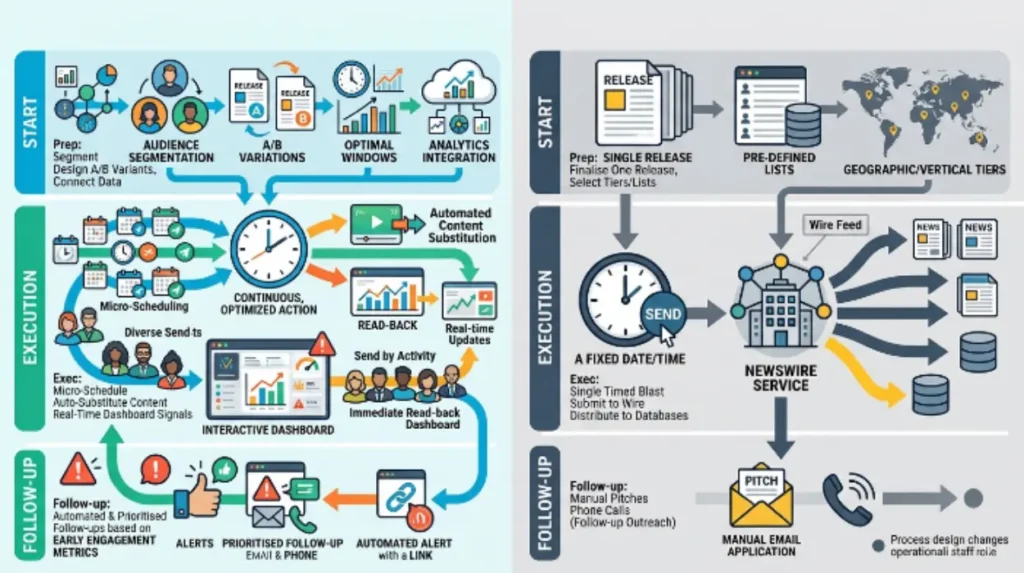
Time-intelligent workflows require audience segmentation, selection of optimal send windows, preparation of variant assets, and integration with analytics platforms. Execution includes micro-scheduling across hours, automated content substitution for different segments, and immediate read-back to a dashboard for performance signals. Traditional newswire workflows require finalising a single release, selecting geographic and vertical tiers, and scheduling a single distribution event. Execution involves submitting the release to the wire, which publishes to its feed and distributes to subscribed databases. Follow-up outreach for both methods uses manual pitches or telephone contacts; time-intelligent models often automate prioritised follow-ups based on early engagement metrics.
What are the cost components for each option?
Time-intelligent models charge for advanced targeting, analytics, timed sends, and optimisation services; traditional newswires charge for placement tiers, multimedia add-ons, and list access. Cost lines differ by technology and service depth.
Time-intelligent pricing components include platform access fees, audience data or segmentation charges, A/B testing costs, and advanced analytics subscriptions. Typical platform access fees range from £300 to £2,000 per month for enterprise-tier services. Per-release optimisation fees vary from £100 to £1,000 depending on complexity. Traditional newswire pricing components include base distribution fees, regional or sector add-ons, multimedia attachment fees, and pickup reporting. Single-release base fees range from £50 for national text-only runs to £800 for multimedia-enhanced and regional-targeted runs. Journalist database subscriptions for traditional lists start at £300 per month.
What measurement and reporting capabilities differ?
Time-intelligent models provide real-time engagement, time-to-peak metrics, conversion attribution, and predictive signals; traditional newswires provide impressions, pickup counts, and basic referral URLs. Measurement depth affects actionable insights.
Time-intelligent reporting includes minute-by-minute engagement trends, conversion funnels tied to newsroom assets, time-to-peak audience metrics, and predictive alerts when content underperforms. These reports link audience segments to conversion events and produce optimisation recommendations for follow-up sends. Traditional newswire reporting lists estimated impressions, number of media pickups, and URLs where the release appeared. Reporting frequency for wires is typically daily or weekly. Attribution to conversions requires separate web analytics integration and manual reconciliation.
What legal, compliance, and editorial differences exist in the UK context?
Both approaches must follow UK press regulations and data protection laws; time-intelligent models also require lawful processing of audience data for targeting. Compliance obligations change data handling and consent requirements.
Traditional newswires handle release distribution without processing granular audience behavioural data. They maintain editorial standards for text formatting and embargo handling. Time-intelligent models process timing and segmentation using behavioural datasets or first-party analytics. Processing such data requires lawful bases under UK GDPR when personal data is involved, documented data processing agreements, and clear consent where necessary. Both approaches must respect embargoes, defamation law, and financial disclosure rules when relevant. Organisations using time-based targeting should maintain audit logs for timing decisions and opt-out mechanisms for tracked recipients.
What performance differences do UK brands see in real campaigns?
Time-intelligent distribution shows faster early engagement, higher click-through rates for targeted segments, and improved conversion attribution; traditional newswires show broader immediate reach and higher absolute pickup counts. Performance trade-offs align with campaign objectives.
Time-intelligent campaigns report peak engagement within the first 2–6 hours for optimised segments and conversion lifts of 10%–40% versus untargeted sends when paired with precise CTAs. Traditional newswire campaigns generate higher absolute pickup counts across 50–500 outlets within 24 hours for national releases, producing larger potential impression figures. The choice between immediate breadth and targeted engagement determines which metric aligns with campaign goals: brand awareness or direct conversion.
What are typical use cases where each method is preferable?
Time-intelligent distribution suits conversion-driven launches, timed product announcements, and crisis response requiring rapid iteration; traditional newswires suit regulatory filings, broad national announcements, and industry-wide statements. Use case alignment optimises resource allocation.
For product launches aligned to market hours or specific audience peaks, time-intelligent distribution schedules sends during high-activity windows and tests messaging variants. For campaigns that require precise measurement of click-to-lead or sign-up rates, time-intelligent systems attribute conversions directly. For regulatory filings, statutory notices, or sector-wide press statements that require broad publication across national and regional outlets, traditional newswires provide standardized delivery and legal record-keeping. Traditional wires also serve trade announcements where reaching many accredited journalists matters more than immediate conversion tracking.
How do integration and technical requirements compare?
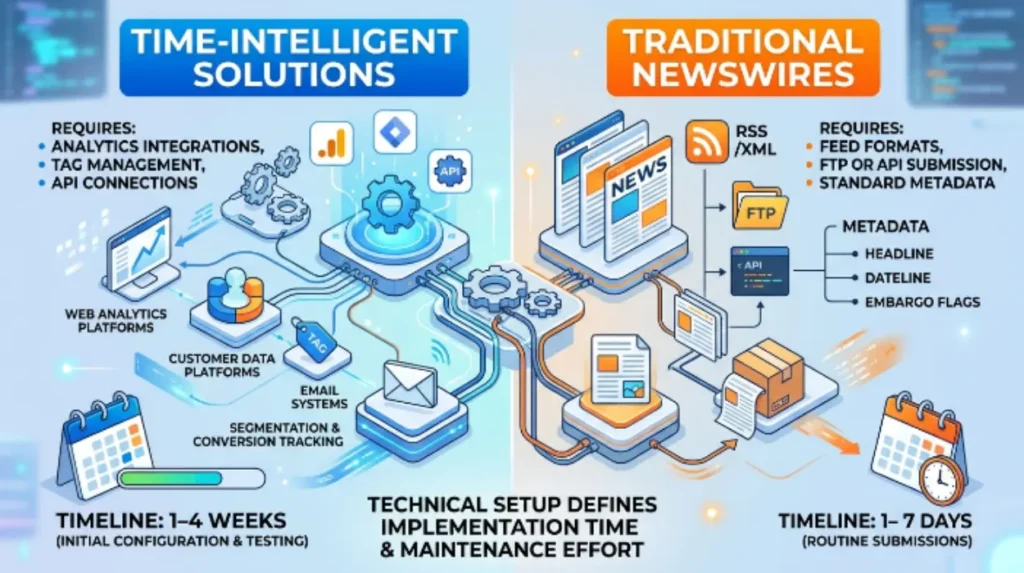
Time-intelligent solutions require analytics integrations, tag management, and API connections; traditional newswires require feed formats, FTP or API submission, and standard metadata. Technical setup defines implementation time and maintenance effort.
Time-intelligent setups integrate with web analytics platforms, customer data platforms, tag managers, and email systems to enable segmentation and conversion tracking. Integration typically requires 1–4 weeks for initial configuration and testing. Traditional newswire integration requires adherence to the wire’s submission format, optional FTP or API endpoints, and metadata fields such as headline, dateline, and embargo flags. Setup time for wires is commonly 1–7 days for routine submissions.
Explore More Expert Insights:
Inside Time Intelligence Media Group’s UK Journalist Network
How Time Intelligence Media Group Guarantees UK National Media Reach
What decision criteria should UK organisations use when choosing between them?
Choose based on objectives, measurement needs, campaign frequency, and budget; combine both when campaigns require immediate reach and measurable conversions. Decision matrices connect KPIs to channel selection.
If primary objectives include direct conversions, precise attribution, and time-sensitive optimisation, allocate budget to time-intelligent distribution and invest in analytics integration. If primary objectives include legal distribution, maximum national reach, or standardized syndication, allocate budget to traditional newswires and use follow-up outreach for conversions. For organisations with mixed needs, deploy a hybrid approach: publish on owned assets, run a targeted time-intelligent send for conversion segments, and use a traditional wire for statutory or broad-reach needs.
What operational steps ensure effective deployment of each approach?
For time-intelligent distribution, prepare segment-specific creatives, integrate analytics, and predefine optimisation thresholds; for traditional newswires, finalise release text, select regional tiers, and prepare multimedia attachments. Operational rigor improves both reach and measurement.
Before a time-intelligent send, create variant headlines and CTAs, tag newsroom assets with consistent UTM parameters, and set thresholds for automatic follow-up sends or manual interventions. Before a traditional wire send, confirm embargo terms, attach required images and documents, and select the correct regional and sector packages. In both cases, maintain a post-distribution monitoring plan for journalist replies, pickup tracking, and conversion reconciliation.
For budgeting and channel choice detail, see:
The Real Cost of PR Distribution in the UK: What Your Budget Buys
This article compared Time Intelligence Media Group-style distribution and traditional UK newswires across definition, process, cost, measurement, compliance, performance, use cases, technical integration, and decision criteria. For organisations ready to evaluate implementation and vendor options, consult detailed deployment guides and cost models specific to your campaign frequency and objectives.
For implementation-focused comparisons, see:
Owned Newsroom vs Paid Distribution: What Works Better for UK Brands