Rising allocation reflects measurable shifts in buyer behavior, content consumption, and channel effectiveness that make media partnerships a higher-return investment for enterprise B2B firms.
Enterprises reallocate budgets when channels deliver systematic, measurable outcomes. In the UK B2B market, decision-makers consume long-form research, webinars, and specialist editorial content through partner media. Media partnerships deliver predefined audiences, contextually relevant placements, and often first-party data access. These attributes increase the efficiency of demand-generation campaigns, so procurement teams increase media partnership budgets to capture intent signals and accelerate pipeline stages.
A media partnership is a formal agreement between a brand and a publisher that combines editorial placement, sponsored content, event collaboration, and access to publisher audiences for lead generation, awareness, or thought leadership. Core elements include audience targeting, content co-creation, distribution rights, measurement frameworks, and data-sharing agreements.
How has buyer behaviour changed to justify higher spending on media partnerships?
Buyers now prefer verified expert content and third-party validation, and they use publisher channels for research and vendor shortlisting.
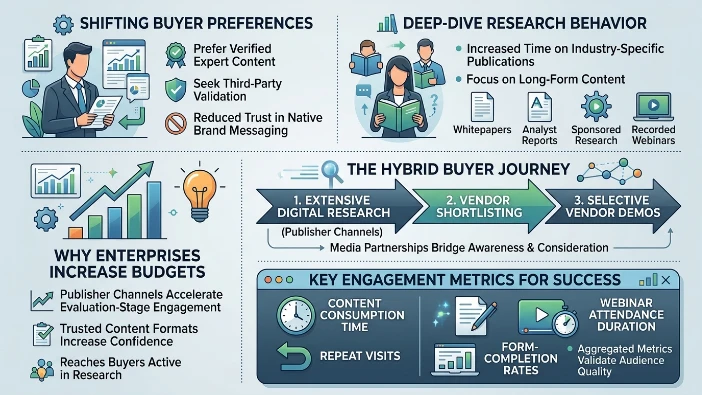
Business buyers spend more time on industry-specific publications and long-form content during vendor selection. Research consumption spans whitepapers, analyst reports, sponsored research, and recorded webinars hosted by trusted publishers. Enterprises increase media partnership budgets because publisher channels accelerate evaluation-stage engagement and provide content formats that users trust more than native brand messaging. The shift to hybrid buying journeys—digital research followed by selective vendor demos—creates demand for publisher-led content that bridges awareness and consideration.
Key metrics include content consumption time, repeat visits to publisher content, form-completion rates on publisher landing pages, and webinar attendance duration. Publishers offer aggregated metrics linked to campaign IDs that validate audience quality and guide budget increases.
What measurement improvements make media partnerships more attractive?
Standardised measurement frameworks and improved data integration give clear ROI signals that justify budget increases.
Publishers and marketers use unified tracking—UTM parameters, server-to-server events, and first-party audience matches—to attribute leads and pipeline value. Measurement now includes viewable impressions, attention time, assisted conversions, and revenue influenced. Enterprises prefer media partnerships when measurement ties directly to pipeline metrics inside CRM systems. This alignment reduces waste and increases budget allocation to channels demonstrating tangible contribution to sales.
H3: Measurement components required for attribution
Measurement requires agreement on target audiences, event mapping to buyer stages, unique campaign identifiers, and secure data transfer. These components produce campaign-level reports that translate publisher engagement into sales-qualified leads and revenue attribution.
Which content formats drive the largest increases in media partnership investment?
Webinars, co-authored research reports, and gated whitepapers produce higher lead quality and therefore attract larger budgets.
Enterprises invest where content yields actionable intent. Webinars produce live engagement metrics and attendance lists. Co-authored research reports with publishers provide credibility and long-term lead capture. Gated whitepapers convert high-intent researchers into leads. These formats deliver sustained engagement and measurable follow-up opportunities for account-based marketing and sales outreach. Contracts frequently include content syndication, email promotion, and social amplification to maximise reach and capture.
A recorded webinar promoted by a specialist publisher commonly achieves 25–40% attendance-to-lead conversion for qualified enterprise audiences. Co-authored reports secure longer average session durations and higher form-completion rates than standalone brand posts.
How do audience characteristics influence budget decisions?
Publishers maintain segmented audiences by industry, role, and buying intent. Enterprise B2B firms target decision-makers—procurement heads, IT directors, and C-suite—through publisher lists that match buyer personas. When publishers demonstrate role-based reach and past campaign success, firms allocate more budget to secure repeated placements and exclusive audience access. Audience exclusivity or priority placement for key verticals increases cost but raises expected return, prompting higher budgets.
Verification uses panel data, authenticated login records, corporate email domain filters, and publisher CRM matches. These methods ensure audience relevance and reduce mismatch risk.
What operational processes change when firms increase media partnership budgets?
Firms standardise campaign playbooks, centralise partner procurement, and enforce measurement SLAs to scale media partnership investments.
Scaling requires repeatable processes. Firms develop standard briefs, unified creative assets, and approval workflows to reduce time to market. Procurement centralises partner contracts and negotiates volume discounts. Marketing operations create tracking templates and SLAs for delivery and reporting. These process changes enable rapid campaign deployment across multiple publisher partners without sacrificing measurement fidelity.
Operational steps include template-based creative production, unified campaign tagging, centralised contract templates, and pre-negotiated reporting formats. These steps shorten campaign setup by measurable days and improve comparability across partners.
What are the financial considerations for increasing media partnership budgets?
Enterprises evaluate cost per qualified lead, pipeline influence, and lifetime value when justifying higher media partnership budgets.
Budget increases follow clear unit economics. Cost per qualified lead through a publisher is compared with other channels such as paid search and social. Firms calculate influenced pipeline value from publisher-led campaigns over 6–12 months and compare against historical close rates. When influenced revenue meets targets and acquisition costs align with customer lifetime value, firms increase media partnership budgets to scale predictable revenue channels.
Benchmarks include target cost per qualified lead by role and vertical, expected conversion rates from MQL to SQL, and average influenced deal size. Publishing partners often provide historical campaign benchmarks to inform these calculations.
What risks and controls exist when allocating more to media partnerships?
Risk centers on audience mismatch, poor measurement alignment, and content compliance; controls include strict SLAs, pre-campaign audience validation, and legal review.
Publishers vary in audience quality and delivery methods. Enterprises manage risk by requiring audience demos, historical performance case studies, and sample reporting. Legal and compliance teams review data-sharing and editorial scopes to prevent regulatory issues. Marketing operations set strict SLAs for delivery, viewability, and reporting cadence. These controls reduce variance and protect campaign ROI as budgets expand.
Contracts include delivery guarantees, data privacy clauses, content approval rights, and performance-based payment terms. These controls align incentives and limit exposure.
Explore More Expert Insights:
What B2B Creator Partnerships Look Like in 2026 Versus 2023 in the UK
The Rise of Publisher-Brand Alliances: How UK Media Is Monetising Differently
What benefits do enterprises report after increasing media partnership budgets?
Reported benefits include higher-quality leads, faster pipeline progression, improved content credibility, and clearer sales handovers.
Enterprises record higher average deal sizes from leads sourced via trusted publishers. Content credibility from neutral third-party channels accelerates evaluation, shortening sales cycles. Publisher collaborations produce richer lead metadata, aiding sales handovers and personalisation. These benefits justify continued and increased budget allocation to media partnerships.
Measured improvements commonly show reduced sales cycle length by measurable weeks, increased lead-to-opportunity conversion rates, and higher average deal size for publisher-sourced leads.
What use cases demonstrate the value of increased media partnership budgets?
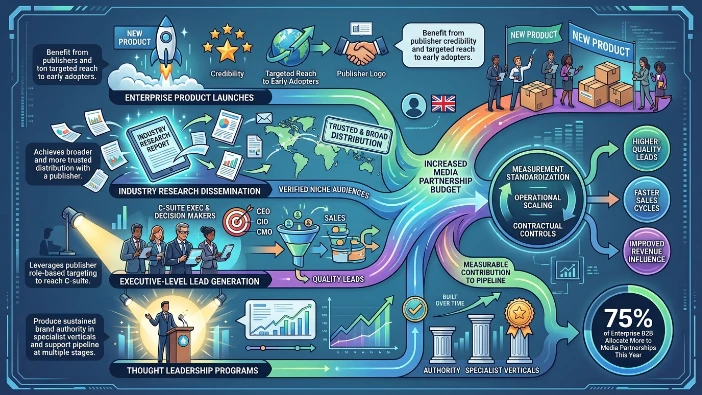
Use cases include enterprise product launches, industry research dissemination, executive-level lead generation, and thought leadership programmes.
Product launches benefit from publisher credibility and targeted reach to early adopters. Industry research dissemination with a publisher achieves broader and more trusted distribution. Executive-level lead generation leverages publisher role-based targeting to reach C-suite. Thought leadership programmes produce sustained brand authority in specialist verticals and support pipeline at multiple stages.
A research-led campaign distributed by a sector publisher commonly yields high-profile media coverage, repeat downloads, and direct introductions to procurement teams.
Click Here to Explore More:
KPIs That Actually Matter When Measuring a UK Media Partnership Performance
Enterprises in the UK increase media partnership budgets when publishers provide verified niche audiences, measurable contribution to pipeline, and content formats that drive intent. Measurement standardisation, operational scaling, and contractual controls make partnerships predictable and accountable. The result is higher-quality leads, faster sales cycles, and improved revenue influence, which explains why 75% of enterprise B2B firms allocate more to media partnerships this year.
Discover the Full Information:
Media Partnership Onboarding: What Happens After You Sign With a UK Group