

Scaling into UK media through partnerships is the planned expansion of content distribution and audience reach using commercial agreements with publishers, platforms, agencies, and distribution partners to achieve measurable business outcomes.
Scaling is a structured activity. Entities include licensors, licensees, publishers, programmatic platforms, and creative agencies. Each entity has defined roles: content creator, distributor, or amplification partner. Agreements specify usage rights, territorial limits for the United Kingdom, and financial terms in GBP. Objectives align to business outcomes such as subscription growth, lead generation, direct revenue, or brand metrics. Measurement links campaign activity to CRM records and revenue attribution over defined windows. Teams set numeric targets: unique UK users, cost per acquisition in GBP, and attributable revenue targets for evaluation.
How do partnership types differ and which deliver which outcomes?
Partnership types include licensing, co-produced content, sponsored placements, programmatic distribution, and affiliate or revenue-share deals; each type delivers distinct speed, cost, and outcome profiles.
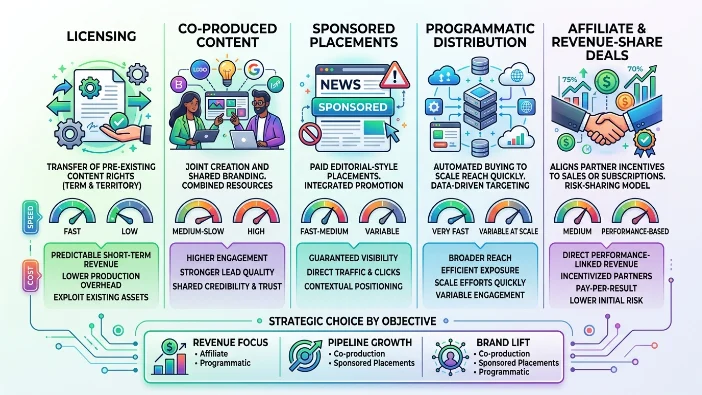
Licensing transfers controlled usage rights for pre-existing content for a defined term and territory. Outcomes for licensing include predictable short-term revenue and lower production overhead. Co-produced content involves joint creation and shared branding. Outcomes for co-production include higher engagement and stronger lead quality, at higher upfront cost. Sponsored placements are paid editorial-style placements; outcomes include guaranteed visibility and direct traffic.
Programmatic distribution uses automated buying to scale reach quickly; outcomes include broader reach with variable engagement. Affiliate or revenue-share deals align partner incentives to sales or subscriptions; outcomes include direct performance-linked revenue. Choose the model based on objective: revenue focus, pipeline growth, or brand lift.
What are realistic timelines for launching each partnership model?
Timelines vary: programmatic launches in 1–2 weeks, licensing and sponsored placements in 2–6 weeks, and co-produced editorial or broadcast content in 8–16 weeks due to creative and legal processes.
Programmatic distribution requires creative assets, audience parameters, and DSP setup; technical setup completes in 1–2 weeks. Licensing requires asset delivery, metadata preparation, and a licence agreement; typical lead time is 2–6 weeks. Sponsored placements need creative approval and publisher scheduling; expect 2–6 weeks. Co-produced editorial or broadcast projects require partner selection, joint creative briefs, production, legal review, and publisher calendars; plan 8–16 weeks. Regulated sectors add 2–4 weeks for compliance sign-off. Teams should build buffer time for legal negotiation and editorial calendar changes.
What are the main cost components when scaling into UK media?
Main cost components include production, partner fees or licence payments, paid distribution, legal and compliance, campaign management, and measurement tools; total campaign budgets typically range between £15,000 and £250,000.
Production costs cover creative concepting, copy, design, photography, and video. Partner fees vary by partner scale and format: licensing fees range from £2,000 to £50,000 per asset; sponsored placements on top-tier publishers cost between £20,000 and £150,000. Paid distribution budgets for social and programmatic commonly run from £5,000 to £100,000. Legal and compliance fees for contracting and data processing agreements range from £2,000 to £20,000. Campaign management fees and measurement tooling, including tagging and dashboarding, typically add £3,000 to £30,000. VAT treatment requires accounting consultation for cross-border services. Budget allocation depends on campaign objectives and expected UK audience scale.
What pricing and commercial structures should teams use?
Commercial structures include flat licence fees, CPM or CPA guarantees, revenue-share agreements, performance tiers, and hybrids combining upfront fees with performance bonuses.
Flat licence fees secure usage rights for a set term and territory. CPM and CPA guarantees tie payment to delivery metrics or conversions and often include minimum guarantees. Revenue-share agreements allocate a percentage of direct revenue to the partner and align incentives. Performance tiers increase fees when KPIs exceed targets. Hybrid agreements combine an upfront fee with performance-based bonuses to balance risk. Each agreement must define clear attribution windows, reporting cadence, and audit rights. For subscription or direct-sale models, include conversion tracking and reconciliation timelines in the contract.
How should legal and compliance be managed for UK partnerships?
Legal and compliance must define IP ownership, permitted uses, territorial limits, data processing roles under UK GDPR, VAT treatment, indemnities, and advertising standards adherence.
Contracts must assign ownership of newly created IP or specify joint ownership. Define permitted media, sublicensing rights, and exclusivity terms for the UK. Document data controller and processor roles with data processing agreements and lawful bases for data capture. Address VAT and tax implications for cross-border services. Include indemnities, warranties, audit rights, and termination triggers. Ensure consumer-facing claims comply with the CAP Code and ASA precedents. For regulated sectors add explicit compliance sign-off stages and record retention policies.
What measurement frameworks prove ROI for UK media partnerships?
Use multi-touch attribution tied to CRM for pipeline impact, brand-lift studies for awareness, viewability and engagement metrics for reach quality, and a 6–12 month revenue attribution window for long-sales-cycle outcomes.
Implement unified tagging and UTM conventions across partners. Track unique UK users, view-through rates, average time on asset, and video completion rates. Feed leads into CRM with source taxonomy to calculate lead-to-opportunity conversion and average deal value. Run brand-lift surveys within 1–3 months to measure awareness and consideration shifts. For licensing revenue, reconcile licence fee recovery within 1–3 months. For co-produced campaigns measure pipeline contribution over 6–12 months to capture long-sales-cycle effects. Use dashboards to aggregate publisher metrics and CRM outcomes for real-time monitoring.
What operational governance ensures consistent delivery at scale?
Operational governance requires a partnership playbook, standard commercial templates, a single campaign owner, weekly checkpoints, and centralised asset and rights management.
A playbook defines partner selection criteria, briefing templates, legal clause defaults, measurement standards, and escalation paths. Standard commercial templates reduce negotiation time and ensure consistent clauses. Assign a single campaign owner responsible for delivery, approvals, and partner liaison. Hold weekly checkpoints covering creative status, legal progress, media booking confirmations, and measurement readiness. Maintain a version-controlled repository with rights metadata for audits. Use quarterly performance reviews to refine partner tiers and formats.
Explore More Expert Insights:
How One B2B Brand Reached 4M UK Readers via a Single Partnership
Media Partnership Packages: What 10+ News Sites Deliver for Brands
What results should UK teams expect and how do they vary by model?
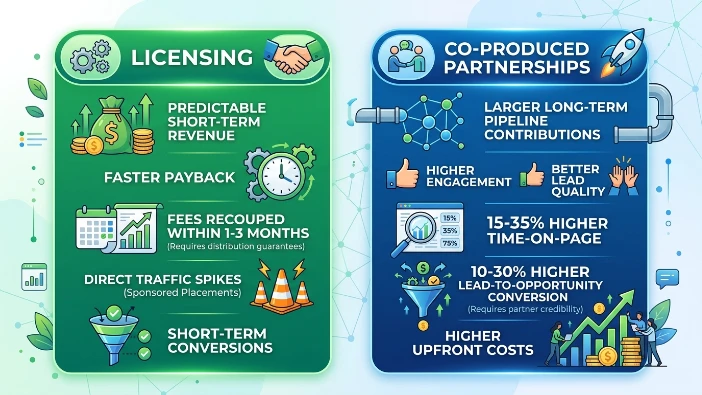
Licensing provides predictable short-term revenue and faster payback; co-produced partnerships produce higher engagement, better lead quality, and larger long-term pipeline contributions with higher upfront costs.
Licensing returns often recoup fees within 1–3 months when distribution guarantees exist. Sponsored placements deliver direct traffic spikes with measurable short-term conversions. Co-produced partnerships show higher engagement metrics; expect 15–35% higher time-on-page and 10–30% higher lead-to-opportunity conversion when partner credibility is relevant. Programmatic distribution scales reach quickly but yields variable engagement and conversion rates. Measure net ROI after subtracting production, legal, and management costs to determine true performance.
Read More to Understand Better:
Third-Party Validation Now Drives More Pipeline Than Owned Content
How should teams pilot and scale partnership models in the UK?
Run a 12-week pilot that tests two licensing deals and one co-produced campaign, allocate a combined budget of £50,000, and measure against predefined KPIs with CRM linkage; scale the model with higher net return.
Weeks 1–2: set pilot KPIs, select partners, and sign standard contracts. Weeks 3–6: produce assets, apply unified tracking, and launch distribution. Weeks 7–12: collect reach, engagement, and lead data, reconcile licence payments, and measure early revenue signals. At week 12 conduct a performance review using cost per qualified lead, lead-to-opportunity rate, and projected 12-month attributable revenue. Scale by increasing budgets on models that show superior net returns and refine contract templates and measurement processes for replication.
Get the Full Insights Here:



