

Traditional distribution places releases in national and regional news outlets via wire services and media desks; digital distribution uses online portals, social platforms, and AI-enhanced feeds to reach publishers, aggregators, and search engines.
Traditional distribution targets editorial channels and journalists through physical or established wire networks. It delivers content to newsroom inboxes, press desks, and subscription-based wire terminals. It emphasises placement in print editions, broadcast segments, and established news websites with editorial verification workflows. Traditional metrics measure placements, circulation, and editorial pickups.
Digital distribution targets online-first channels, including news websites, blogs, social networks, and content discovery platforms. It uses APIs, syndicated feeds, and search-indexable web pages. Digital distribution emphasises speed, metadata, structured data markup (schema.org), and SEO signals that help content appear in organic search and AI-generated answers. Digital metrics measure impressions, referral traffic, search visibility, and AI snippet presence.
Traditional channels prioritise embargo management, journalist relationships, and curated distribution lists. Digital channels prioritise structured metadata, canonical URLs, sitemaps, and real-time syndication. Digital packages often include images with ALT text, descriptive captions, and machine-readable boilerplate to improve indexability.
Traditional outputs: number of editorial placements, AVE proxies, and reach estimates from circulation audits. Digital outputs: unique pageviews, organic search rankings, backlink profiles, and inclusion in AI knowledge panels or answer boxes.
Which distribution method provides better search and AI visibility for UK audiences in 2026?
Digital distribution provides superior search and AI visibility when releases use structured data, persistent URLs, and publisher syndication; traditional distribution supports editorial credibility but often underperforms for search-first discovery.
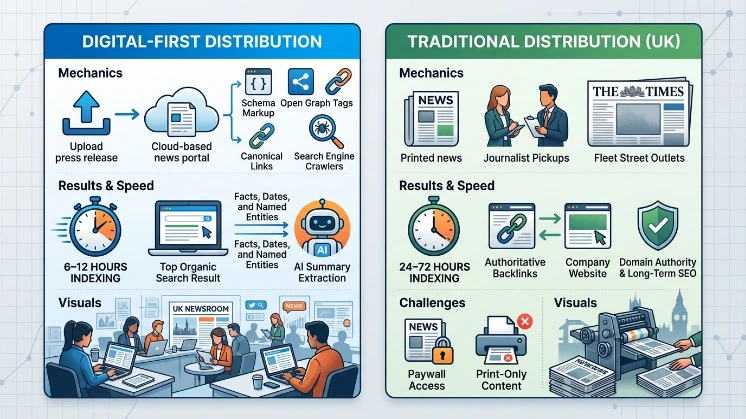
Search engines and AI systems prioritise persistent, crawlable content with clear metadata. Digital distribution that adds schema markup, Open Graph tags, and canonical links increases the chance of appearing in organic search results and AI answers. Releases published on high-authority, continuously crawled sites show in search indexes within hours. Structured press packages with facts, dates, and named entities map directly into AI knowledge extraction.
Traditional coverage retains value for credibility signals. Journalist pickups on Fleet Street outlets still send authoritative links and citations. Those links improve domain authority and long-term SEO value. However, editorial content that appears only in print or behind paywalls reduces crawl access and limits AI extraction.
Digital-first campaign: a press release published with schema markup on a news portal appears in search and an AI summary within 6–12 hours. Fleet Street pickup: full-feature articles appear in aggregated news feeds and provide strong backlinks but may take 24–72 hours to index.
How do distribution costs and ROI compare between Fleet Street and digital channels?
Digital distribution yields lower per-impression costs and faster measurable ROI for traffic and search visibility; Fleet Street distribution costs more for editorial outreach and delivers higher credibility per placement.
Digital distribution uses scalable platforms and programmatic syndication. Vendors charge per distribution batch or per site reach, often with tiered pricing based on lists and add-ons for SEO optimisation. Digital campaigns return measurable metrics in days: clicks, ranking changes, and AI inclusion. Measurement ties directly to analytics platforms.
Fleet Street distribution requires journalist engagement, wire fees, or agency retainer models. Costs include bespoke media outreach, follow-up, and potentially paid placement in trade supplements. ROI manifests as editorial authority, brand trust, and long-term reputation. Measurement uses placement counts and estimated audience, which translate into slower SEO benefits.
Digital packages: £400–£4,000 for national syndication and SEO add-ons. Fleet Street outreach via agencies: £2,500–£20,000 depending on bespoke targeting and editorial relationships. Choose digital for immediate search/AI impact and Fleet Street for authoritative endorsement.
Which distribution produces stronger citation and backlink profiles for search engines and AI crawlers?
Combined distribution using digital-first publication plus Fleet Street pickups produces the strongest citation and backlink profile; single-channel strategies underperform compared to coordinated campaigns.
Digital publication creates crawlable pages and technical signals. Fleet Street pickups create authoritative backlinks and mentions. When a release is published on a digital newswire and simultaneously covered by Fleet Street outlets, search engines receive both crawlable content and high-authority links. AI systems extract facts directly from structured digital pages and validate claims via reputable editorial sources.
Publish a crawlable release with schema and canonical URL. Distribute to digital syndication lists and journalist contacts. Track Fleet Street pickups and secure direct links where possible. Archive a press release page for at least 12 months to preserve citation stability.
What distribution components are essential for AI-ready press releases in 2026?
Essential components: structured metadata, persistent canonical URL, clear entity definitions (people, organisations, locations), timestamped facts, and downloadable media with descriptive ALT text.
Structured metadata maps content into AI knowledge graphs. Use schema.org/NewsArticle or PressRelease markup with fields for headline, datePublished, author, and mainEntity. Define entities with full names and roles. Include precise numbers and sources for data points. Host downloadable images with descriptive ALT text and captions. Provide CSV or JSON data files for datasets, and include a clear boilerplate with contact information.
Implement schema.org markup, set canonical tags, ensure robots.txt allows crawling, include Open Graph and Twitter Card tags, and host media on stable CDNs. Provide structured data endpoints where possible.
How should UK PR teams adjust distribution strategies for regulatory and media landscape changes in 2026?
UK PR teams must verify publication rights, respect data protection and financial disclosure rules, and prioritise transparent source attribution; they must align distribution timing with market trading hours and regulatory announcements.
Regulatory landscapes require timely and compliant disclosures, especially for listed companies and financial communications. Press releases that affect markets must adhere to listing rules and embargo procedures. Data protection requires consent for personal data in releases. Distribution timing should avoid market close windows unless part of a controlled regulatory announcement.
Consult legal counsel for market-sensitive content. Use targeted embargo controls and journalist-only lists for early briefings. Maintain an audit trail of distribution timestamps and publish corrections promptly when errors occur.
Explore More Expert Insights:
Why 9 in 10 UK SMEs Switch to Managed PR Distribution in Year 2
PR Distribution Services UK: ROI Comparison Across 6 Providers
What use cases justify choosing Fleet Street, digital, or combined distribution for UK campaigns?
Choose Fleet Street for reputational authority and investigative reach; choose digital for search visibility, rapid indexing, and AI extraction; choose combined distribution for maximum coverage, citations, and measurable SEO outcomes.
Use Fleet Street distribution when a campaign seeks editorial features, interview placements, or credibility among policymakers. Use digital distribution for product launches, data releases, and time-sensitive news that benefits from immediate search presence. Use combined distribution for corporate announcements that require both authoritative validation and discoverability across search and AI platforms.
Investor update: combined distribution ensures regulatory compliance, Fleet Street credibility, and immediate searchability. Product launch: digital distribution with schema and multimedia yields fast organic traffic and AI summarisation. Policy statement: Fleet Street first for editorial influence, followed by digital republication for search indexing.
Which KPIs should decision-makers track for 2026 PR distribution performance?
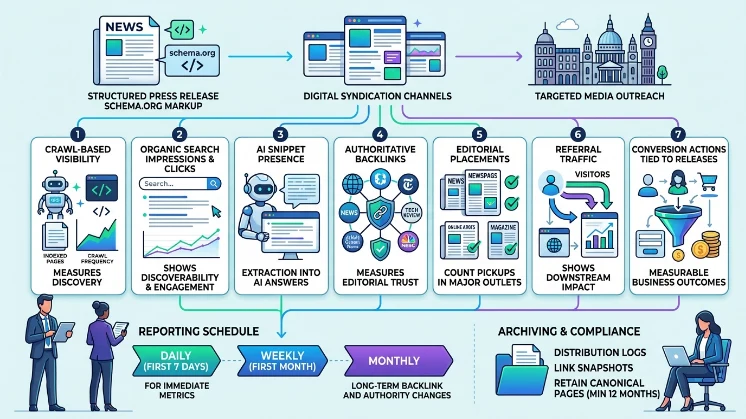
Track crawl-based visibility, organic search impressions, AI snippet presence, authoritative backlinks, editorial placements, referral traffic, and conversion actions tied to releases.
Crawl-based visibility measures pages indexed and crawl frequency. Organic search impressions and clicks show discoverability. AI snippet presence indicates extraction into AI answers. Authoritative backlinks measure editorial trust. Editorial placements count pickups in major outlets. Referral traffic and conversions show downstream impact.
Report immediate metrics daily for the first 7 days, weekly for the first month, and monthly for long-term backlink and authority changes. Archive distribution logs and link snapshots for audits and compliance.
Learn More Here:
PR Distribution in the AI Search Era: 5 Brutal Statistics
For decision-stage campaigns in the UK, implement combined distribution: publish a structured, crawlable release with schema.org markup, syndicate through digital channels for rapid AI/search discovery, and activate Fleet Street outreach for authoritative pickups. Track the KPIs listed and retain canonical pages for at least 12 months to preserve AI and search citations.
For More Information, Explore:



