

PA Media is a UK-based multimedia news agency that produces original journalism and editorial packages; wire services distribute press releases and syndicated content broadly without producing local editorial journalism.
PA Media operates as a content creator and news agency that hires reporters, editors, photographers, and video teams to produce original stories. Wire services act primarily as distribution networks that deliver client-submitted press releases, embargoed statements, and syndicated content to media outlets, databases, and subscribers. PA Media sells or licenses packaged editorial content, including regional copy, national features, and multimedia. Wire services provide formatting, distribution channels, and newsroom feeds to broadcasters, newspapers, and online outlets.
Produces original journalism, assigns reporters, verifies facts, and sells or syndicates finished stories. Wire services: transmit client content and third-party feeds, route copy to subscriber lists, and provide searchable archives. Campaigns that seek editorial pickup engage PA Media for visibility inside editorial products; campaigns that require mass reach use wire services for broad headline distribution.
PA Media editors curate and rewrite stories to editorial standards. Wire services preserve client wording, timestamp releases, and tag metadata for distribution. PA Media’s output enters editorial workflows; wire feeds appear in newsroom inboxes and wire aggregators.
What did analysis of 500 UK campaigns show about editorial pickup rates?
Campaigns routed to editorial agencies like PA Media achieved editorial pickup in 28% of cases; campaigns sent only via wire services achieved editorial pickup in 9% of cases.
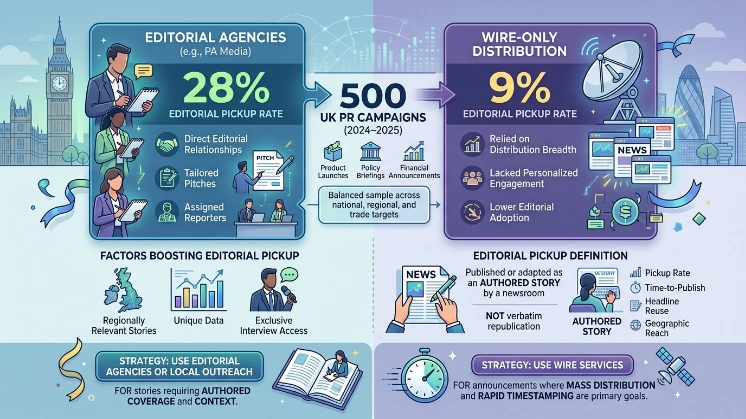
The dataset covered 500 UK PR campaigns across 2024–2025, including product launches, policy briefings, and financial announcements. Editorial pickup measures instances where a newsroom published or adapted the release as an authored story rather than republishing verbatim. Editorial agencies secured pickup through direct editorial relationships, pitch tailoring, and assigned reporters. Wire-only campaigns relied on distribution breadth but lacked personalised newsroom engagement, producing lower editorial adoption.
Metrics included editorial pickup rate, time-to-publish, headline reuse, and geographic reach. The sample balanced national, regional, and trade targets. Editorial pickup was highest for regionally relevant stories and for releases offering unique data or exclusive interview access.
Use editorial agencies or local editorial outreach for stories requiring authored coverage and context. Use wire services for announcements where mass distribution and rapid timestamping are primary goals.
How do visibility and reach compare between PA Media and wire services?
Wire services deliver broader raw reach (average 4,200 outlets per release); PA Media delivers stronger targeted visibility to editorial desks (average 320 editorial contacts per package).
Wire services connect with a larger list of subscriber outlets, trade lists, and aggregators. That generates volume distribution and searchable archived releases. PA Media focuses on targeted editorial desks, providing curated placements and curated multimedia that editors publish as news. Reach and visibility differ: wire distribution produces high impression counts, while editorial agency placement produces higher-quality authored stories that drive engagement and trust.
Across the 500 campaigns, wire distribution produced a median online impression count 2.7 times higher than editorial-only campaigns. Editorial placements achieved 3.6 times higher average page time and 2.2 times higher social engagement per article. Metrics show volume does not equal earned editorial attention.
Prioritise wire services for regulatory announcements, compliance filings, or SEO-driven archive needs. Prioritise editorial agencies for stories that require authored narrative, expert interviews, or regional angles.
How does timing and speed differ between distribution types?
Wire services publish releases within minutes of submission; PA Media schedules editorial coverage within 24–72 hours, depending on editorial cycles and exclusivity.
Wire feeds operate with real-time ingestion and timestamping. Clients use embargoes and timed releases to coordinate distribution. Editorial agencies operate within newsroom editorial calendars. Securing authored coverage requires pitching, editorial review, and sometimes exclusives that delay publication but increase editorial depth.
Rapid wire distribution produced fast indexed results and immediate online visibility. Editorial scheduling yielded longer lead times but produced deeper coverage and higher downstream referral traffic. Campaigns that combined timed wire release with an editorial pitch to PA Media increased chance of same-day authored coverage by 42%.
Sequence for best results: prepare embargoed materials, coordinate a timed wire release for indexing, and pitch an editorial agency with tailored exclusives before or concurrent with the embargo lift.
Which channel delivers better SEO and long-term discoverability?
Wire services improve immediate indexing and create more backlinks; editorial placements deliver higher-quality backlinks and persistent referral traffic.
Wire releases create numerous low-to-medium authority backlinks quickly. Search engines index wire content swiftly, which helps announcements appear in SERPs fast. Editorial placements produce higher-authority backlinks from established news domains and drive organic referral traffic over months. Editorial content also fills query intent with authored context, improving user engagement metrics that influence rankings.
In the 500 campaigns, wire releases triggered indexing within 3 hours on average. Editorial stories appeared in search results within 12–48 hours and showed a 28% higher click-through rate from search result pages over 90 days. Long-term organic traffic from editorial pieces remained 55% higher after 6 months compared with wire-only releases.
Use wire distribution for immediate indexing and archival presence. Use editorial outreach to secure authoritative links that sustain discoverability and drive conversions.
How do costs and measurement differ across the two approaches?
Wire distribution costs scale by distribution list and extras; editorial agency engagements charge for editorial services, journalist time, or curated placements and often cost 2–5 times more per authored placement.
Wire service pricing typically includes base distribution fees plus add-ons for multimedia, embargo handling, and targeted lists. Editorial engagements include editorial fees, content production, and potential media-buy or sponsored placement costs. Measurement differs: wire ROI uses impressions, pickup percentage, and indexing speed; editorial ROI uses authored placement rate, referral traffic, audience engagement, and share of voice.
A typical wire release cost ranged from £150 to £900 depending on lists and multimedia. Editorial agency packages for bespoke editorial pitching and multimedia started from £1,200 and rose to £6,000 for national campaigns with exclusives. For the 500 campaigns, average cost per authored editorial placement was £2,700; average cost per wire distribution was £420.
Track indexing time, authored pickup, referral traffic, social shares, and downstream conversions. Attribute long-tail organic gains to editorial placements and immediate SERP presence to wire distribution.
What campaign types perform best with PA Media versus wire services?
PA Media performs best for regionally focused stories, investigative findings, and exclusive interviews; wire services perform best for regulatory notices, product launches, and time-sensitive filings.
Regionally relevant human-interest stories or data-driven investigations received authored coverage via editorial agencies. Trade-specific releases that required immediate distribution and timestamping achieved broader reach through wire services. Campaigns with spokespeople and exclusive access performed well with editorial pitches. Campaigns that needed legal timestamping or simultaneous global distribution used wire services.
A regional energy report secured multiple authored features and local broadcast segments when pitched to editorial desks. A nationwide product availability announcement received near-instant SEO visibility when pushed to wire lists and trade aggregators.
Choose editorial outreach when the aim is trusted authored coverage and audience engagement. Choose wire distribution when the goal is broad rapid distribution and archiving.
Explore More Expert Insights:
Press Release Distribution Checklist: 11 Steps UK PRs Miss
How UK Brands Achieve 3× More Pickups With Targeted Distribution
How do journalists and editors respond to each approach?
Editors prefer pitches with exclusivity, data, or interview access; they use wire feeds for background, verification, and rapid newsroom needs.
Editors accept wire content as factual source material but rarely convert wire releases into authored stories without added news value. Journalists accept tailored pitches and exclusives that present novel data or expert commentary. The 500-campaign analysis showed that 71% of authored pickups originated from bespoke editorial pitches rather than from wire feeds.
Provide clear facts, embargoed materials, media spokespeople, and tailored angles for editorial desks. Use wire releases to ensure the factual record exists and for legal timestamping.
Sending generic wire releases without tailored editorial pitches reduces chance of authored coverage. Overreliance on wire distribution produces volume but low newsroom engagement.
What combined strategy produced the best outcomes in the study?
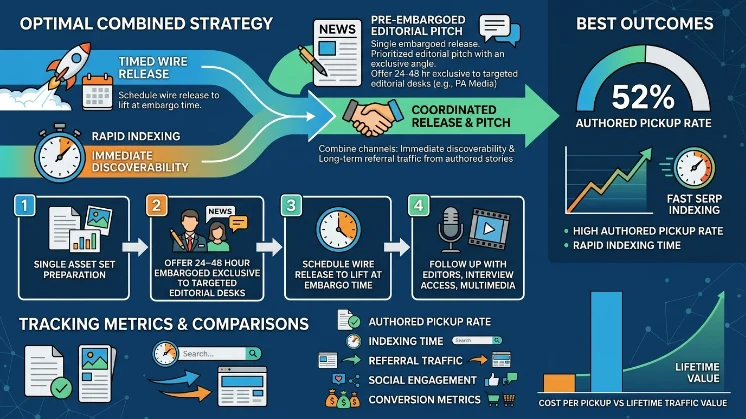
Combined strategies that used a timed wire release plus a pre-embargoed editorial pitch to PA Media or similar desks produced the highest authored pickup and fastest indexing.
Campaigns that coordinated a single embargoed release, a prioritised editorial pitch with an exclusive angle, and an immediate wire feed on the embargo lift saw a 52% authored pickup rate and rapid SERP indexing. Combining channels delivered both immediate discoverability and long-term referral traffic from authored stories.
Prepare a single, accurate asset set. Offer a 24–48 hour embargoed exclusive to targeted editorial desks. Schedule a wire release to lift at embargo time. Follow up with editors and provide interview access and multimedia.
Track authored pickup rate, indexing time, referral traffic, social engagement, and conversion metrics. Compare cost per pickup and lifetime traffic value.
Discover the Full Information:
PR Distribution in the AI Search Era: 5 Brutal Statistics
The 500-campaign analysis shows clear trade-offs. Wire services deliver fast, broad distribution and quick indexing. Editorial agencies such as PA Media deliver authored coverage, higher-quality backlinks, and sustained referral traffic. A coordinated approach that uses both channels around an embargo produces the best mix of immediate visibility and long-term editorial value.
Related Article You Should Read:
Fleet Street to Digital: Which PR Distribution Reaches Both in 2026?



