

Artificial intelligence referral traffic is changing how people discover information online. AI referral traffic comes from AI-powered assistants, chat interfaces, and generative search tools that direct users to websites. Organic search traffic comes from traditional search engine results pages. In the United Kingdom, AI referral traffic often demonstrates stronger purchase intent because users arrive with more specific goals, clearer needs, and advanced decision-making context.
What is AI referral traffic and how does it differ from organic UK search?
AI referral traffic comes from AI-powered platforms that recommend or cite websites during conversations. Organic search traffic comes from traditional search engine results. The key difference is user intent. AI users often ask detailed questions, while search users frequently begin with broader information gathering.
AI referral traffic originates when a user interacts with an AI assistant and clicks a recommended source. The referral occurs because the AI identifies a webpage as relevant to a specific question.
Organic search traffic originates when a user enters a query into a search engine and selects a result from the search engine results page.
The difference lies in the stage of the user journey.
How do user journeys differ?
Organic search users often begin with exploratory queries:
- What is audience analysis?
- Best ways to understand customers
- How digital advertising works
AI users frequently ask more detailed questions:
- Which audience metrics predict purchase intent in UK retail?
- What data signals indicate a customer is ready to buy?
- How can news audience insights improve campaign performance?
The second set of questions reflects a narrower objective and stronger commercial focus.
Why does query depth matter?
Query depth refers to the amount of context included in a user request.
Traditional searches often contain three to five words.
AI interactions commonly include complete sentences, constraints, objectives, and desired outcomes.
More context allows AI systems to provide highly targeted recommendations. As a result, referred visitors arrive with greater clarity about what they are seeking.
Why does AI referral traffic often indicate higher purchase intent?
AI referral traffic often reflects stronger purchase intent because users ask detailed, goal-oriented questions before visiting a website. By the time they click a source, they have already narrowed options, evaluated information, and defined the problem they want to solve.

Purchase intent measures how likely a visitor is to take a commercial action.
Examples include:
- Requesting information
- Comparing solutions
- Evaluating costs
- Preparing for a purchase decision
AI interactions naturally encourage these behaviours.
How does AI reduce early-stage browsing?
Traditional search users often visit multiple pages to gather information.
A typical process includes:
- Searching a topic
- Reviewing several results
- Comparing sources
- Refining queries
- Returning to search
AI systems consolidate much of this activity into a single interaction.
Users receive summarised information before clicking through to a source. This means the website visit often occurs later in the decision process.
Why are AI users more focused?
AI users frequently arrive with defined objectives.
Examples include:
- Budget planning
- Product evaluation
- Service comparison
- Vendor research
Focused objectives create stronger engagement signals and higher conversion potential.
How does context-rich questioning improve visitor quality?
Context-rich questioning improves visitor quality because AI users provide detailed information about their goals. This enables more accurate recommendations and filters out less relevant traffic. Websites receive visitors whose interests closely match the content they consume.
AI systems process multiple layers of context.
Examples include:
- Industry
- Location
- Budget
- Timeframe
- Business objective
This context improves relevance.
What happens before the click?
Before reaching a website, an AI user often completes several actions:
- Defines a problem
- Clarifies requirements
- Requests comparisons
- Reviews recommendations
- Narrows options
The website visit occurs after these steps.
This creates a more qualified audience.
How does relevance affect engagement?
Higher relevance often leads to:
- Longer session duration
- More page views
- Greater content consumption
- Stronger conversion behaviour
These outcomes result from alignment between user intent and page content.
What engagement signals are commonly associated with AI referral visitors?
AI referral visitors often display stronger engagement signals because they arrive with a clear purpose. Common indicators include higher dwell time, deeper content consumption, increased interaction rates, and more focused navigation paths across relevant website sections.
Engagement signals help organisations understand visitor behaviour.
Common metrics include:
- Dwell time
- Scroll depth
- Click patterns
- Session duration
- Return visits
The relationship between these metrics becomes important when evaluating audience quality.
How does dwell time reflect intent?
Dwell time measures the amount of time a visitor spends engaging with content.
Visitors with a defined objective often spend more time reviewing information relevant to their needs.
This provides stronger evidence of interest.
Why is scroll depth important?
Scroll depth measures how much of a page users consume.
Higher scroll depth often indicates:
- Content relevance
- Topic interest
- Information value
Organisations analysing visitor behaviour often combine scroll depth with dwell time and click analysis.
For a deeper understanding of behavioural metrics, see:
Understanding Dwell Time, Scroll Depth and Click Patterns on UK News Properties.
How do AI systems influence decision-stage discovery?
AI systems influence decision-stage discovery by helping users evaluate options before visiting external websites. Users often complete significant research within the AI interaction, resulting in website visits that occur closer to the final stages of the buying journey.
Decision-stage discovery occurs when users actively compare alternatives.
AI systems support this process by:
- Summarising information
- Organising facts
- Answering follow-up questions
- Refining recommendations
How does information consolidation affect behaviour?
Information consolidation reduces the need for repetitive searches.
Instead of reviewing ten separate pages, users receive structured information in one conversation.
This shortens the research cycle.
Why does this matter for purchase intent?
Users who complete more research before arriving often possess:
- Defined requirements
- Established priorities
- Clear evaluation criteria
These characteristics align with stronger commercial intent.
Which industries in the UK benefit most from high-intent AI referral traffic?
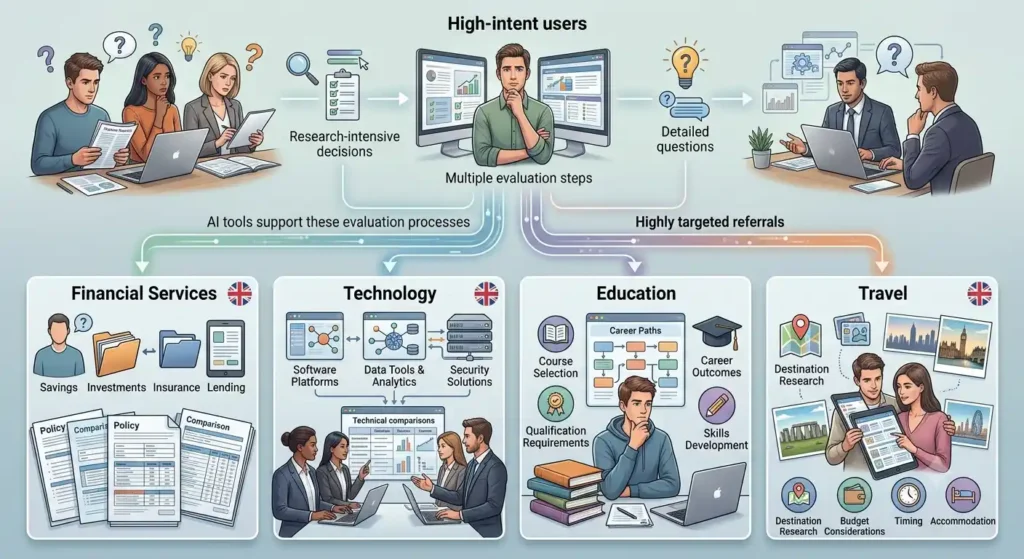
Industries involving research-intensive decisions benefit significantly from AI referral traffic. These sectors include financial services, technology, healthcare, education, travel, automotive markets, and business-to-business services where users require extensive information before making decisions.
Research-intensive purchases involve multiple evaluation steps.
AI tools support these evaluation processes.
Financial services
Consumers frequently compare:
- Savings products
- Investment options
- Insurance products
- Lending solutions
Detailed questions naturally fit AI interactions.
Technology
Technology buyers often evaluate:
- Software platforms
- Data tools
- Analytics systems
- Security solutions
Complex comparisons generate highly targeted referrals.
Education
Education decisions involve:
- Course selection
- Qualification requirements
- Career outcomes
- Skills development
These topics require extensive research before commitment.
Travel
Travel planning includes:
- Destination research
- Budget considerations
- Timing decisions
- Accommodation comparisons
AI platforms help users organise information efficiently.
How can organisations measure AI referral traffic quality?
Organisations measure AI referral traffic quality by comparing engagement, conversion, and behavioural metrics against other channels. Analysis focuses on user actions, session quality, and progression through defined customer journey stages.
Measurement begins with traffic source identification.
Key metrics include:
- Conversion rate
- Session duration
- Pages per session
- Bounce rate
- Lead generation rate
Which behavioural indicators matter most?
Important indicators include:
- Time spent on high-value pages
- Completion of forms
- Resource downloads
- Repeat visits
- Navigation depth
These actions reveal audience quality more effectively than traffic volume alone.
Why is conversion analysis essential?
Traffic quality depends on outcomes.
A smaller volume of highly engaged visitors often creates more value than a larger volume of low-intent traffic.
Conversion analysis provides evidence of this difference.
For readers interested in investment considerations and expected outcomes, see:
Audience Insights Service Pricing: What UK Brands Typically Invest and What They Get.
What does the future of AI referral traffic look like in the UK?

AI referral traffic is becoming a more significant part of digital discovery as users increasingly seek direct answers and personalised recommendations. The trend reflects a broader shift toward conversational information retrieval and intent-driven website visits.
Digital discovery continues to evolve.
Users increasingly prefer:
- Direct answers
- Faster research
- Personalised information
- Context-aware recommendations
AI systems support these preferences.
How are search behaviours changing?
Search behaviour is becoming more conversational.
Users increasingly submit:
- Full questions
- Multi-step requests
- Detailed objectives
- Context-rich prompts
These interactions provide stronger intent signals than short keyword searches.
What does this mean for audience quality?
Higher-quality traffic is characterised by:
- Strong relevance
- Clear objectives
- Focused engagement
- Defined decision criteria
AI referral traffic aligns closely with these characteristics.
Dive Deeper With Our Expert Guides:
91% of UK Consumers Discover Trends Through Media: What Brands Are Missing
The Death of the Average UK Reader: Why Broad Targeting Is Failing Brands
AI referral traffic often demonstrates higher purchase intent than organic UK search because users arrive after completing a larger portion of their research journey. AI interactions encourage detailed questioning, context-rich discovery, and focused evaluation. As a result, referred visitors frequently display stronger engagement, deeper content consumption, and clearer commercial objectives. Understanding these behavioural differences helps organisations evaluate audience quality and adapt to changing patterns of digital discovery.



