Marketing efficiency depends on reaching the right audience at the right moment. Audience intent data helps advertisers identify what consumers actively research, compare, and plan to purchase. In the UK market, intent-based targeting reduces irrelevant impressions, improves conversion rates, and helps marketing teams allocate budgets more effectively.
What is audience intent data and why does it reduce campaign waste?
Audience intent data identifies signals that indicate a person’s current interests, research activity, and purchase readiness. By targeting audiences based on demonstrated intent rather than broad demographics alone, advertisers reduce irrelevant ad exposure and improve budget efficiency across digital campaigns.
Audience intent data refers to behavioural information that reveals what consumers are actively researching or considering. These signals come from content consumption, search activity, article engagement, topic interests, and online interactions.
Traditional audience targeting often relies on demographics such as age, gender, and location. Intent data adds another layer by revealing what individuals are interested in right now.
For example:
- A 28-year-old researching mortgage rates shows home-buying intent.
- A professional reading cybersecurity reports shows technology interest.
- A traveller comparing destinations demonstrates travel planning intent.
These signals help marketers focus spending on audiences with higher engagement potential.
How does intent data differ from demographic targeting?
Demographic targeting answers who the audience is.
Intent targeting answers what the audience is actively trying to achieve.
Combining both approaches creates more accurate audience segmentation and reduces wasted impressions.
What types of intent signals exist?
Common intent signals include:
- Search behaviour
- Content consumption patterns
- Topic engagement
- Product research activity
- Comparison article readership
- Industry-specific interest clusters
These indicators help marketers understand audience priorities at different stages of the buying journey.
How can marketers collect audience intent data in the UK?
UK marketers collect audience intent data through publisher platforms, first-party analytics, content engagement tracking, search insights, and audience intelligence tools. These sources provide behavioural signals that reveal audience interests and decision-making patterns.
Several data sources contribute to intent-driven audience analysis.
What is first-party intent data?
First-party intent data comes directly from a company’s own digital properties.
Examples include:
- Website visits
- Resource downloads
- Newsletter engagement
- Webinar registrations
- Product page interactions
This data reflects direct engagement with owned assets.
What is publisher audience data?
Publisher audience data comes from media websites and content platforms.
News publishers often possess rich behavioural datasets because readers regularly engage with industry, finance, technology, healthcare, and lifestyle content.
Audience intelligence generated from publisher environments often reveals emerging interests before purchase activity occurs.
For deeper understanding of audience behaviour differences across generations, see:
How Gen Z in the UK Searches for Brands Completely Differently Than Millennials.
What is third-party intent data?
Third-party intent data aggregates behavioural signals from multiple sources.
These datasets provide broader visibility into audience interests across different websites and content ecosystems.
Many UK advertisers combine first-party and third-party signals to improve targeting precision.
How do you build an intent-based audience targeting strategy?
An effective intent-based strategy starts with campaign objectives, identifies relevant audience signals, maps intent stages, and aligns messaging with consumer readiness levels. This structured approach improves efficiency and reduces unnecessary spending.
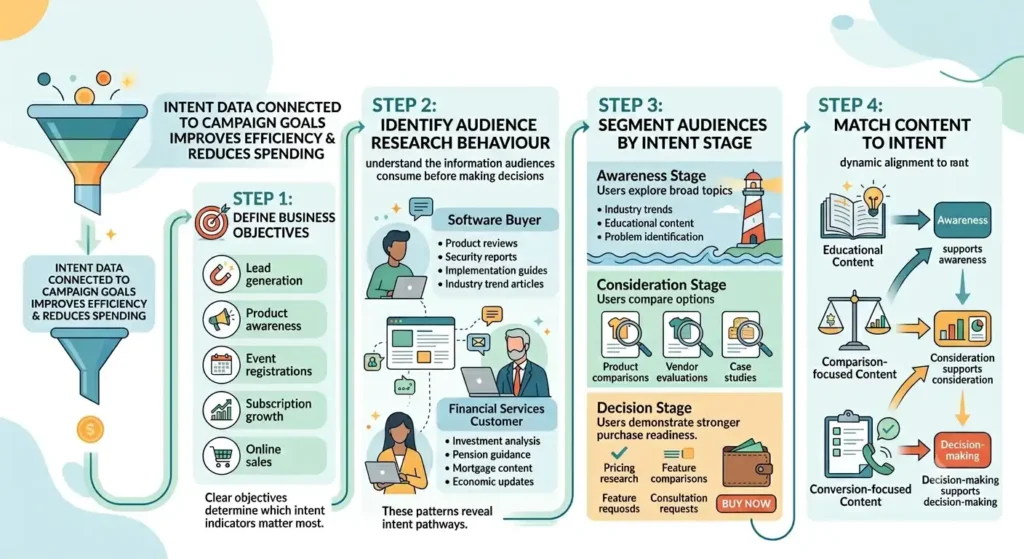
Intent data becomes valuable when connected to campaign goals.
Step 1: Define business objectives
Different objectives require different audience signals.
Examples include:
- Lead generation
- Product awareness
- Event registrations
- Subscription growth
- Online sales
Clear objectives determine which intent indicators matter most.
Step 2: Identify audience research behaviour
Marketers need to understand the information audiences consume before making decisions.
For example:
A software buyer often reads:
- Product reviews
- Security reports
- Implementation guides
- Industry trend articles
A financial services customer often reads:
- Investment analysis
- Pension guidance
- Mortgage content
- Economic updates
These patterns reveal intent pathways.
Step 3: Segment audiences by intent stage
Intent data works best when grouped into stages.
Awareness Stage
Users explore broad topics.
Examples:
- Industry trends
- Educational content
- Problem identification
Consideration Stage
Users compare options.
Examples:
- Product comparisons
- Vendor evaluations
- Case studies
Decision Stage
Users demonstrate stronger purchase readiness.
Examples:
- Pricing research
- Feature comparisons
- Consultation requests
Step 4: Match content to intent
Every intent stage requires different messaging.
Educational content supports awareness.
Comparison-focused content supports consideration.
Conversion-focused content supports decision-making.
Which audience intent metrics matter most?
The most valuable intent metrics measure engagement depth, topic relevance, frequency of interaction, content consumption patterns, and progression through the buyer journey. These indicators reveal audience quality more accurately than impressions alone.
Not all behavioural signals carry equal value.
Engagement depth
Engagement depth measures how thoroughly users consume content.
Examples include:
- Article completion rates
- Scroll depth
- Session duration
- Multi-page visits
Higher engagement often indicates stronger interest.
Topic concentration
Topic concentration measures repeated interaction with related subjects.
For example:
A user reading multiple cybersecurity articles demonstrates stronger intent than a user reading a single article.
Repeated behaviour creates more reliable audience signals.
Recency of activity
Recent engagement often reflects active interest.
Intent signals from the last seven days generally provide stronger targeting value than signals generated months earlier.
Frequency of interaction
Multiple engagements reveal sustained interest.
Examples include:
- Returning visitors
- Repeat content consumption
- Multiple research sessions
Frequency helps identify audiences progressing toward action.
How can audience intent data cut campaign waste by up to 40%?
Audience intent data reduces campaign waste by eliminating low-relevance impressions, improving audience qualification, increasing engagement rates, and focusing spend on users with demonstrated interest. These improvements significantly increase media efficiency.
Campaign waste occurs when ads reach audiences unlikely to engage.
Intent targeting addresses this problem directly.
Reducing irrelevant impressions
Broad demographic targeting often reaches users with little interest in the advertised solution.
Intent filtering removes many of these irrelevant exposures.
This improves media efficiency.
Improving audience quality
Intent signals identify users actively researching relevant topics.
These audiences typically generate:
- Higher click-through rates
- Better engagement
- More qualified leads
- Stronger conversion performance
Increasing budget allocation efficiency
Intent insights help marketers direct spending toward high-performing audience groups.
Instead of distributing budget equally across large segments, advertisers focus on audiences showing stronger behavioural relevance.
Supporting optimisation decisions
Campaign teams can continuously refine targeting based on audience response patterns.
This reduces ongoing waste throughout campaign execution.
Which industries benefit most from intent-based targeting in the UK?

Industries with longer research cycles and complex purchasing decisions benefit significantly from intent targeting. Financial services, technology, healthcare, education, automotive, and travel sectors often achieve stronger audience qualification through intent-driven strategies.
Several sectors rely heavily on audience research behaviour.
Financial services
Consumers frequently research:
- Mortgages
- Investments
- Insurance
- Pension products
Intent signals help identify users actively exploring financial solutions.
Technology
Technology buyers often consume extensive content before purchasing.
Examples include:
- Software reviews
- Security analyses
- Product comparisons
- Industry reports
Intent data improves targeting precision across these research stages.
Healthcare
Healthcare audiences engage with educational content before making decisions.
Intent-based audience segmentation improves relevance and engagement.
Travel
Travel planning generates strong behavioural signals.
Examples include:
- Destination research
- Accommodation comparisons
- Flight searches
- Travel guides
These activities reveal clear consumer intent.
For practical examples of audience composition and intent distribution across sectors, see:
What 10 UK News Site Audiences Look Like by Industry, Age and Intent Stage.
What mistakes reduce the effectiveness of audience intent data?
The most common mistakes include relying on a single data source, ignoring intent stages, using outdated signals, over-targeting narrow segments, and measuring success through impressions instead of business outcomes.
Intent data requires structured implementation.
Using intent data without context
Behavioural signals require interpretation.
A single content interaction rarely indicates strong purchase readiness.
Patterns provide more reliable insights.
Ignoring buyer journey stages
Different audiences require different messaging.
Awareness-stage users respond differently from decision-stage users.
Treating all audiences identically reduces effectiveness.
Overlooking signal freshness
Intent changes quickly.
Recent behaviours generally provide stronger predictive value than historical activity.
Measuring the wrong metrics
Campaign success depends on business outcomes.
Important metrics include:
- Cost per lead
- Conversion rate
- Qualified audience reach
- Return on advertising spend
- Customer acquisition cost
These metrics reveal actual efficiency improvements.
How should UK marketers integrate audience intent data into future campaigns?
UK marketers achieve stronger campaign performance by combining intent data with demographic insights, first-party analytics, publisher intelligence, and continuous optimisation. This integrated approach creates more accurate audience targeting and sustainable efficiency gains.
Audience intent data provides a clearer view of consumer behaviour than demographics alone.
Dive Deeper With Our Expert Guides:
Building an Audience Persona From News Site Data: A Step-by-Step UK Framework
Psychographic vs Behavioural Segmentation: Which Wins for UK Media Buys?
Modern targeting strategies increasingly focus on behavioural relevance, research activity, and decision-stage indicators.
Combining intent insights with audience segmentation enables advertisers to reduce waste, improve engagement quality, and allocate budgets more effectively.
As privacy regulations continue to reshape digital advertising, intent-driven audience intelligence offers a practical framework for identifying relevant consumers while improving campaign efficiency across the UK market.