

Sponsored content pricing is the published fee a media owner charges to create, place, and promote branded editorial-style material across its channels. Prices reflect reach, format, production, and measurement.
Sponsored content pricing is a structured commercial offer from publishers, broadcasters, and platforms. It bundles editorial placement, creative production, distribution, and metrics into a single fee. In the UK this pricing follows standard components: audience size (unique monthly visitors or broadcast reach), content format (long-form article, native advert, video, newsletter slot), production scope (script, interview, shoot, editorial time), distribution scope (homepage, social amplification, newsletter inclusion), and reporting (impressions, clicks, engagement, view-through rates).
Prices vary by publisher tier: national newspapers, national broadcasters, national digital publishers, regional outlets, and specialist vertical sites. Each tier sets baseline rates and adds premium multipliers for exclusive positioning or guaranteed viewability.
How do £5,000, £15,000 and £30,000 packages differ?
£5,000 buys local or niche placement with limited production; £15,000 buys national reach with professional production and cross-channel promotion; £30,000 buys premium placement, high-end production, and extensive amplification.
A £5,000 package targets regional audiences or niche verticals. Typical deliverables include a single long-form native article, one round of editorial revisions, and basic social sharing. Creative elements are lightweight: existing brand assets repurposed, a single photo, or a short edit of supplied video. Measurement focuses on pageviews and basic engagement metrics.
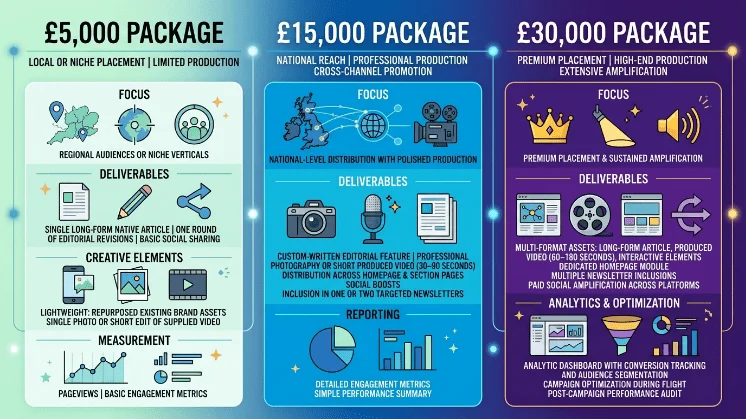
A £15,000 package combines national-level distribution with polished production. Deliverables include a custom-written editorial feature, professional photography or a short produced video (30–90 seconds), distribution across the homepage and section pages, social boosts, and inclusion in one or two targeted newsletters. Reporting includes detailed engagement metrics and a simple performance summary.
A £30,000 package secures premium placement and sustained amplification. Deliverables include multi-format assets (long-form article, produced video 60–180 seconds, interactive elements), a dedicated homepage module, multiple newsletter inclusions, paid social amplification across platforms, and an analytic dashboard with conversion tracking and audience segmentation. Clients receive campaign optimisation during flight and a post-campaign performance audit.
What production components are included at each price point?
Production components scale from basic editorial drafting at £5,000 to full multi-format production and analytics at £30,000.
At £5,000 the publisher typically provides editorial drafting (1–2 writers, 4–8 hours), copyediting, and light layout. Photography or b-roll is usually provided by the advertiser or licensed stock. Video is rarely included. At £15,000 the package includes assigned journalist time (6–12 hours), commissioned photography, short-form video production (one-day shoot or studio edit), graphic design for in-article assets, and native ad coding. At £30,000 production expands to multi-day shoots, dedicated producer, custom animation or interactive modules, and QA across devices. The highest tier often includes A/B creative testing and minor landing-page development to improve conversion tracking.
How does distribution and amplification change with budget?
Distribution increases from single-channel exposure at £5,000 to multi-channel, paid amplification and newsletter saturation at £30,000.
A £5,000 buy places content in one primary channel: the website or a single newsletter slot. Social sharing is organic and limited. At £15,000 distribution includes homepage exposure, placement in relevant sections, one or two newsletter inclusions, and paid social boosts targeted by interest or geography. At £30,000 distribution includes guaranteed homepage module timing (day and position specified), multiple newsletter placements across different audience segments, programmatic or direct paid social campaigns with defined CPMs, and cross-promotion on owned audio or video channels where available.
What metrics and reporting are standard for these price tiers?
Standard metrics progress from pageviews and time on page at £5,000 to multi-metric dashboards with attribution and conversion insights at £30,000.
For £5,000, reports show impressions, unique pageviews, average time on page, and basic engagement (scroll depth or social shares). For £15,000, reports include refined engagement: click-through rates from social, newsletter open and click metrics, view-through rates for video, and demographic skews. For £30,000, publishers provide a campaign dashboard showing impressions, unique users, engagement rate, view-through and completion rates for video, assisted conversions, UTM-tagged interaction data, and audience segment performance. Higher tiers include consultative analysis and recommendations tied to conversion goals.
What audience outcomes are realistic at each budget?
£5,000 yields targeted reach of 10,000–50,000 engaged users; £15,000 yields 75,000–300,000 national users; £30,000 yields 250,000–1,000,000+ multi-channel exposures with conversion tracking.
Outcomes depend on publisher scale and targeting precision. A local newspaper or specialist vertical with a £5,000 package typically delivers 10,000–50,000 article views and niche engagement that drives brand awareness within a defined community. A mid-tier national publisher at £15,000 generally delivers 75,000–300,000 article views plus newsletter and social interactions that increase topical authority. A top-tier national publisher or cross-publisher campaign at £30,000 delivers 250,000–1,000,000+ exposures across web, newsletters, and paid social. Conversion performance links to landing pages and product fit; publishers supply baseline benchmarks for click-to-conversion but advertisers must track destination metrics.
What legal and editorial controls apply to sponsored content?
Sponsored content follows publisher rules on clear labelling, editorial independence boundaries, and advertising standards; legal review and brand approvals feature at higher budgets.
In the UK, publishers label paid content clearly under Advertising Standards Authority (ASA) guidance and Competition and Markets Authority (CMA) rules on transparency. Publishers require factual accuracy and vet claims for legal compliance. At lower budgets, brands supply final copy or accept publisher edits. At mid and high budgets, brands receive structured review cycles: script approval for video, fact-checking for technical claims, and legal sign-off for regulated categories (finance, healthcare). High-budget campaigns include bespoke compliance checks, archived approvals for ASA queries, and joint statements if required.
What use cases match each price level?
£5,000 fits local launches and niche awareness; £15,000 fits regional product launches and thought-leadership; £30,000 fits national product launches, reputation campaigns, and conversion-focused drives.
Use cases align to scale and objectives. Small businesses or local events use £5,000 placements to reach local audiences and drive footfall or local sign-ups. Mid-size brands use £15,000 to launch products across regions, secure topical authority through a produced feature, or run a targeted lead-generation push tied to a newsletter audience. Large brands allocate £30,000 for national product launches, sustained reputation management, seasonal campaigns, or conversion-driven campaigns that require precision targeting and measurement.
How do VAT, agency fees, and extras affect final cost?
Add 20% UK VAT and agency fees of 10–20%; extras such as licensing, talent, and paid amplification add discrete line items.
Published fees often exclude VAT. Media agencies add booking fees ranging 10–20% on top of net media cost. Extras such as celebrity talent, exclusive photography licensing, bespoke research, or third-party analytics add fixed costs. Paid media (programmatic or social) is billed either net of agency margin or with agreed CPMs. Contracts specify payment schedules, cancellation terms, and revision limits to avoid scope creep.
Explore More Expert Insights:
Sponsored Content ROI Tracker: A 6-Month UK News Campaign Dissected
Multi-Site Sponsored Content: How 10 UK News Properties Multiply Reach
How should buyers evaluate value across these price points?
Evaluate reach, relevance, production quality, measurability, and contractual guarantees against campaign goals and unit economics.
Buyers should request audience demos, sample placements, case studies with concrete KPIs, and post-campaign measurement methods. Match the publisher’s audience profile to the client’s target customer profile. Assess production samples and ask for a content calendar showing placement timing. Insist on UTM tagging and access to raw metrics or a dashboard. Compare metrics per £1,000 spent: cost per thousand impressions (CPM), cost per engaged user, and cost per tracked conversion where applicable.
What are recommended next steps for decision-makers?
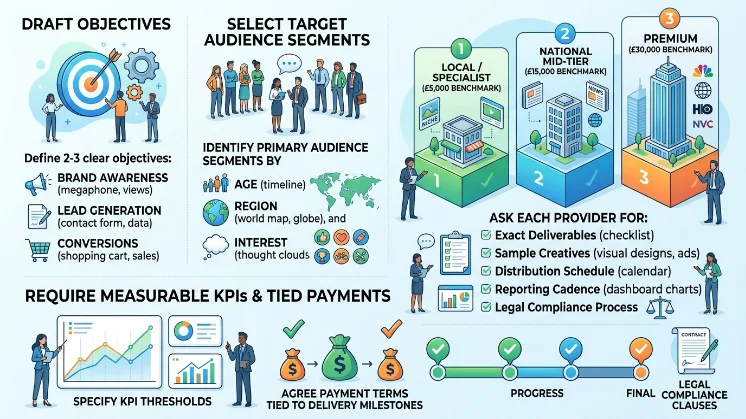
Draft objectives, select target audience segments, request three publisher proposals with line-item costing, and require measurable KPIs and legal compliance clauses.
Dive Deeper Into This Topic:
Why AI-Generated Sponsored Content Is Failing UK Audiences in 2026
Define 2–3 clear objectives brand awareness, lead generation, or conversions. Identify primary audience segments by age, region, and interest. Request proposals from at least three publishers or publisher tiers: local/specialist for a £5,000 benchmark, national mid-tier for a £15,000 benchmark, and premium for a £30,000 benchmark. Ask each provider for exact deliverables, sample creatives, distribution schedule, reporting cadence, and legal compliance process. Specify KPI thresholds and agree payment terms tied to delivery milestones.
Click Here to Explore More:
Sponsored Content Across 10 Verticals: UK Engagement Benchmarks 2026



