

Multi-site sponsored content is paid editorial material distributed across multiple news properties to reach larger, segmented audiences. It places the same sponsored article or campaign on at least ten publisher sites to increase impressions, engagement, and behavioral data capture.
Multi-site sponsored content uses centralised creative and targeting to run a single campaign across many publisher domains. Publishers accept the paid content under editorial-like formats: native article, branded feature, or custom hub. Campaign managers select ten or more UK news properties that collectively cover desired demographics, regions, and interest verticals. Distribution often follows an agreed run length, typically 7–30 days, with unified tracking pixels and UTM parameters for performance measurement. Ad tech layers content recommendation widgets, programmatic guaranteed deals, or direct publisher bundles deliver the content to each site’s audiences while preserving the editorial look and trust signals of the host.
Why do marketers use ten news properties instead of one?
Marketers use ten news properties to multiply reach, diversify audience segments, reduce single-site performance risk, and collect richer cross-publisher data for attribution.
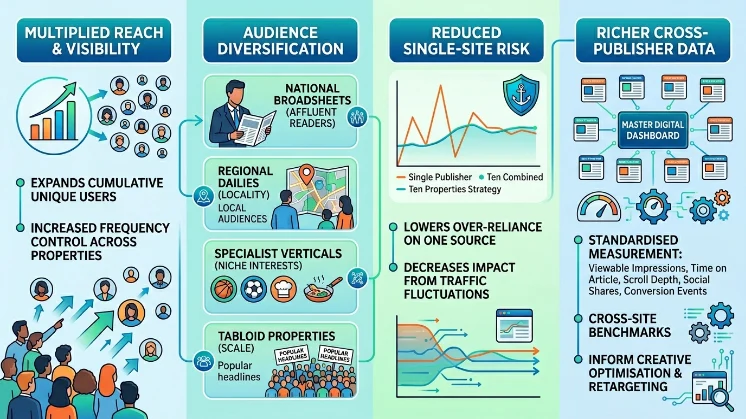
A single publisher limits reach to one audience profile and geographic footprint. Running the same sponsored creative across ten properties expands cumulative unique users, increases frequency control, and reduces variance in engagement caused by a single publisher’s traffic fluctuations. Ten-site strategies enable precise combinations: national broadsheets for affluent readers, regional dailies for locality, specialist verticals for niche interests, and tabloid properties for scale. Campaign planners set KPIs per site and aggregate results to evaluate both reach metrics and downstream conversions. Standardised measurement viewable impressions, time on article, scroll depth, social shares, and conversion events produces cross-site benchmarks that inform creative optimisation and retargeting segments.
How much more engagement does multi-site sponsored content deliver versus standard display ads?
Data from UK publisher networks show sponsored content drives up to 22× higher engagement than standard display ads on average, measured by time on page and social interactions.
Sponsored content sits within editorial contexts. Readers spend longer reading branded articles than viewing rotating banner ads. Sponsored content achieves measurable actions: article clicks, scroll depth beyond 50%, and social shares. Performance studies in the UK market report average dwell-times of 90–180 seconds for sponsored articles compared with 4–8 seconds for typical display impressions. Click-through rates for sponsored headlines reach 0.5%–2.5% versus 0.05%–0.2% for standard display. When the same creative runs across ten properties, cumulative engagement multiplies because each site contributes unique engaged users, increasing total article reads and shares while reducing cost-per-engaged-user.
Dive Deeper Into This Topic:
Sponsored Content Gets 22× More Engagement Than Display Ads: UK Data
Which metrics prove effectiveness across multiple publishers?
Key metrics are unique reach, viewable impressions, average time on article, scroll-to-depth percentage, social shares, and conversion events tied to unified tracking.
Unique reach measures distinct users exposed across the ten properties, avoiding double-counting via device and cookie stitching. Viewable impressions follow industry viewability thresholds: 50% in view for at least one second for display; longer for content measured by time spent. Average time on article indicates content relevance; campaigns target at least 60 seconds as a baseline. Scroll-to-depth percentage shows how many readers reach key calls-to-action or embedded assets. Social shares quantify organic amplification. Conversion events—newsletter signups, form fills, transactions—require a unified tag or post-click landing page to attribute outcomes across publishers. Combining these metrics enables calculation of cost-per-engaged-user and return on ad spend for the multi-site campaign.
How are publishers selected for a ten-site distribution?
Publishers are selected using audience overlap analysis, topical relevance, geographic coverage, and historical sponsored-content performance to meet reach and engagement KPIs.
Campaign planners start with audience data: first-party publisher demographics, Comscore or similar panels, and site-level engagement rates. Planners eliminate sites with high audience overlap to maximize net reach. Topical relevance ensures the content aligns with each publisher’s editorial vertical, improving dwell time. Geographic coverage balances national and regional tastes across the UK, including London-centric outlets, Midlands and Northern hubs, and devolved-region publications. Past sponsored-content case studies provide benchmark CTR and time-on-article, which guide slate selection. Contract terms define run dates, editorial placement (homepage, section page, or in-article), and measurement access.
What creative formats work best for multi-site sponsored campaigns?
Native long-form articles with strong headlines, high-quality images, embedded video, and clear branded disclosure deliver the highest engagement across multiple UK news properties.
Long-form native articles provide context and utility, which increase time on article. Matching publisher templates preserves editorial look and improves trust. Strong headlines and subheads optimised for each publisher’s audience promote higher click-through. High-resolution images and short videos increase scroll depth and social shares. Include clear disclosure wording such as “Sponsored” or “Paid content” placed near the headline to meet regulatory standards and maintain transparency. Interactive elements—data visualisations or calculators—boost engagement when supported by the host site. Ensure all assets meet each publisher’s technical specifications for image dimensions and video codecs to avoid rendering issues that harm performance.
How is measurement standardised across different publisher analytics?
Standardisation uses a single campaign tag, uniform UTM parameters, and a shared analytics endpoint or data clean room to aggregate cross-publisher data for direct comparison.
Campaign managers deploy a universal tracking pixel and consistent UTM schema across all placements to capture traffic, session metrics, and events in a central analytics platform. Publishers provide viewability and impression counts; campaign tags capture on-site behaviors like time on article and scroll. For privacy-safe attribution, some programs use a data clean room where aggregated event data from multiple publishers is matched without exposing raw user identifiers. Regular reporting intervals daily for reach and impressions, weekly for engagement trends, and post-campaign for conversions ensure timely optimisation and final attribution analysis.
What are legal and disclosure requirements in the UK for sponsored content?
UK rules require clear labelling of sponsored content, truthful claims in editorial, and adherence to the Advertising Standards Authority (ASA) and CAP Code for transparency.
Publishers must present sponsored content with clear sponsorship markers visible to users at first glance. All claims in sponsored editorial must be substantiated by evidence and not mislead readers. Any price, health, or performance claims must include supporting data or appropriate qualifiers per ASA guidance. Financial promotions and regulated claims require additional compliance checks before publication. Contract clauses commonly assign responsibility for factual accuracy to the advertiser while publishers retain right of editorial amendment to meet standards.
What benefits do brands gain from multi-site sponsored content in the UK market?
Brands gain increased reach, improved engagement quality, stronger contextual alignment with audience segments, and more robust first-party signals for future targeting.
Multi-site campaigns reach an aggregate audience that single-site buys cannot match. Higher dwell times indicate message attention, improving message retention and downstream conversions. Contextual alignment with relevant publisher verticals builds perceived relevance and trust metrics measured in post-campaign surveys. Publishers’ first-party data topic-level interest and engagement cohorts create segments for retargeting and lookalike modeling without relying on third-party cookies. The combined effect produces measurable improvements in cost-per-engaged-user and in many cases higher conversion rates on campaign landing pages.
Explore More Expert Insights:
B2B Sponsored Content Packages for UK Platforms
Buy Sponsored Content Placements in Leading London News Outlets
When should advertisers choose multi-site sponsored content over programmatic display?
Advertisers choose multi-site sponsored content when the goal is sustained attention, contextual relevance, brand storytelling, and measurable content engagement rather than short-exposure impressions.
Programmatic display excels at scale and frequency across the open web. Multi-site sponsored content excels at capturing attention, delivering detailed narratives, and generating social shares. Use multi-site sponsored content when campaigns require longer-form messaging, thought leadership, product education, or audience trust building. Choose programmatic display for broad awareness with limited headline creatives. Combining both approaches in the same campaign can optimise reach and follow-through: sponsored content for initial engagement and programmatic display for frequency and retargeting.
How do agencies and brands measure ROI and decide success?
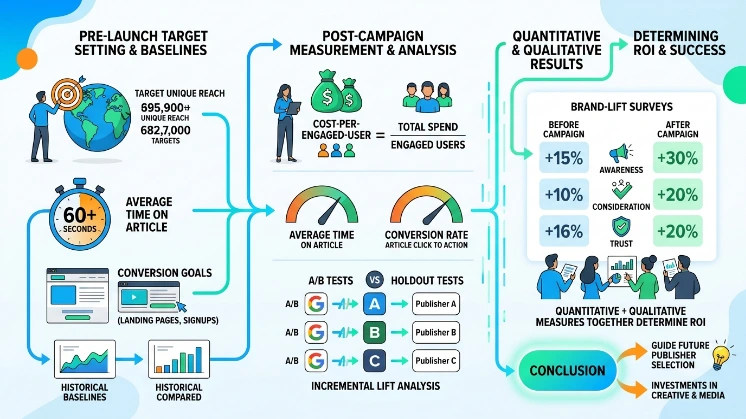
Success is measured by comparing campaign KPIs cost-per-engaged-user, average time on article, conversion rate, and incremental lift in brand metrics against predefined targets and historical baselines.
Agencies set targets before launch: target unique reach, engagement thresholds (e.g., 60+ seconds average), and conversion goals tied to landing pages or signups. Post-campaign, they calculate cost-per-engaged-user by dividing total campaign spend by engaged users (users meeting time or scroll criteria). They measure conversion rate from article click to desired action. When possible, they run A/B or holdout tests across publishers to estimate incremental lift. Brand-lift surveys before and after campaigns quantify shifts in awareness, consideration, and trust. These quantitative and qualitative measures together determine ROI and guide future publisher selection and creative investments.
Find Out More:
Native vs Branded: Which Sponsored Format Builds More UK Brand Trust?



