
Targeted distribution is the practice of sending press materials directly to a carefully selected list of journalists, outlets, and influencers based on relevance, topic, and audience. It differs from mass distribution by focusing on relevance over volume, which increases pickup rates.
Targeted distribution identifies reporters, beat editors, trade outlets, and niche publications that cover a specific sector or topic. It uses audience demographics, outlet reach, and content format to match the story to the right contact. Mass distribution sends the same release to a broad media list without tailoring; targeted distribution segments lists and customises messaging for each segment. Targeted distribution reduces noise, raises open rates, and produces higher editorial interest. In the UK market, targeted lists include national newspapers, regional titles, trade magazines, trade websites, and specialist online publishers.
Targeted distribution: a selective outreach method sending tailored press materials to a curated media list. Media list a dataset of contacts with role, outlet, topic focus, and contact details. Pickup: a published story or feature that derives from the distributed material. Relevance score: a quantified match between story topic and outlet focus.
How does targeted distribution increase pickup rates for UK brands?
Targeted distribution increases pickup rates by matching story angle to outlet priorities, improving journalist response and editorial use, which leads to higher placement frequency and share.
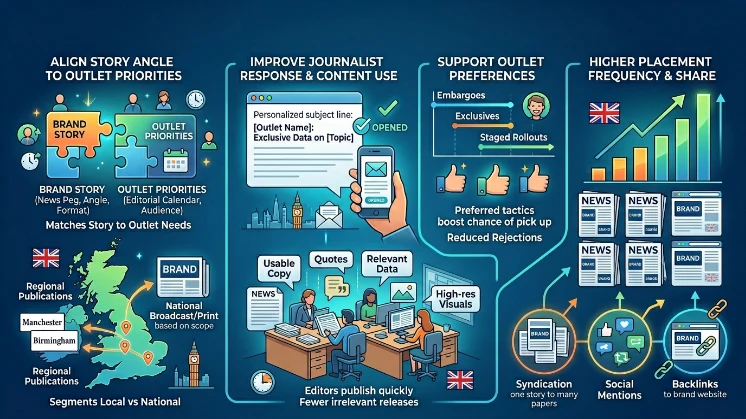
Journalists receive fewer irrelevant releases when distribution targets their beats. Reporting teams prioritise stories that fit their editorial calendar and audience. By aligning the news peg, angle, and format with outlet needs, brands provide usable copy, quotes, and data that editors can publish quickly. Targeted outreach also enables personalised subject lines and lead paragraphs, which increase opens and reads. UK brands that segment local versus national outlets secure local pickup for regional campaigns and national pickup for broader stories. Targeted distribution also supports embargoes, exclusives, and staged rollouts, which editors prefer. These tactics reduce rejection and boost the chance of syndication, social mentions, and backlinks.
What process do UK PR teams follow to implement targeted distribution?
The process includes audience mapping, contact curation, message tailoring, timed outreach, and follow-up, executed with tracking and iteration to optimise pickup results.
First, teams map target audiences by region, sector, and buyer persona. Next, they curate contacts using role, recent coverage, and outlet format. Then, teams craft angles and subject lines tailored to each segment. Outreach schedules use time-zone and editorial calendar intelligence; UK newsroom mornings and mid-week sends are typical for national press. Follow-up follows a strict cadence: one polite reminder and a single targeted pitch to the most relevant reporter. Measurement uses open, click, and pickup metrics to refine lists. Continuous review removes inactive contacts and updates beats based on recent coverage.
Contact records, outlet descriptions, and beat tags. Editorial calendars: schedules that indicate story windows. Distribution platform: software that supports segmentation, personalisation, and tracking. Tracking: metrics that show opens, clicks, and pickups.
Which components make targeted distribution effective?
Effective targeted distribution depends on accurate media lists, tailored messaging, relevant data or visuals, timing aligned with editorial cycles, and measurement systems.
Accurate media lists prevent wasted sends to irrelevant journalists. Tailored messaging uses concise leads, suggested headlines, and clear assets so editors reuse content. Relevant data or images increase editorial value. Timing aligns sends with outlet deadlines; for example, morning sends increase chances for same-day coverage in UK newspapers. Measurement systems record pickup, syndication, and referral traffic for ROI analysis. Combining these components creates a repeatable workflow that raises editorial trust and pickup frequency.
A high-quality media list includes contact name, role, outlet, beat description, recent relevant articles, preferred contact method, and consent/status for outreach.
What benefits do UK brands see from using targeted distribution?
Brands see higher pickup rates, increased editorial relevancy, improved backlink quality, and more efficient PR spend compared with broad, untargeted outreach.
Higher pickup rates translate into more published stories per campaign. Increased editorial relevancy improves reader engagement and trust for the brand. Backlinks from relevant outlets carry stronger referral traffic and SEO value. Efficient PR spend reduces wasted impressions and lowers cost per published story. For UK campaigns, regional pick-ups drive local footfall and awareness, while national placements increase brand credibility and search visibility. Targeted distribution also supports measurable attribution: brands can link pickup events to spikes in organic traffic, social engagement, and direct enquiries.
Ratio of published stories per release. Cost-per-pickup: total spend divided by pickups. Referral uplift: percentage increase in site traffic after pickup events.
When should UK brands choose targeted distribution versus mass distribution?
Choose targeted distribution when the story requires editorial depth, niche audience engagement, or high editorial quality; choose mass distribution only for broad, low-specificity announcements that rely on volume.
Targeted distribution fits product launches, research reports, expert commentary, local campaigns, and industry updates needing editorial context. Mass distribution fits generic announcements with a need for broad awareness, such as basic operational notices where editorial fit is not required. For campaigns aiming to improve pickup rates and downstream SEO value, targeted distribution provides better outcomes. For announcements requiring regulatory disclosure to many stakeholders, mass distribution can complement a targeted approach.
Audience specificity, editorial complexity, desired pickup quality, and budget per pickup determine the choice between targeted and mass distribution.
How do UK brands measure ROI from targeted distribution?
ROI measurement uses pickups, referral traffic, earned media value, conversion events, and cost-per-pickup to determine campaign effectiveness.
Measure pickups as count of unique published items. Track referral traffic from each pickup to landing pages and record on-site engagement metrics: session duration, pages per session, and goal completions. Assign earned media value (EMV) by estimating advertising-equivalent rates for placements. Record conversions directly attributable to editorial referrals, such as signups or sales. Divide total campaign spend by pickups to calculate cost-per-pickup. Use A/B tests comparing targeted lists versus control lists to quantify incremental pickup rates. These metrics provide a clear basis for budget allocation and list refinement.
Use UTM parameters for links in press assets, capture landing page events, and record referral sources in analytics to link pickups to conversions.
Where do UK brands see practical use cases for targeted distribution?
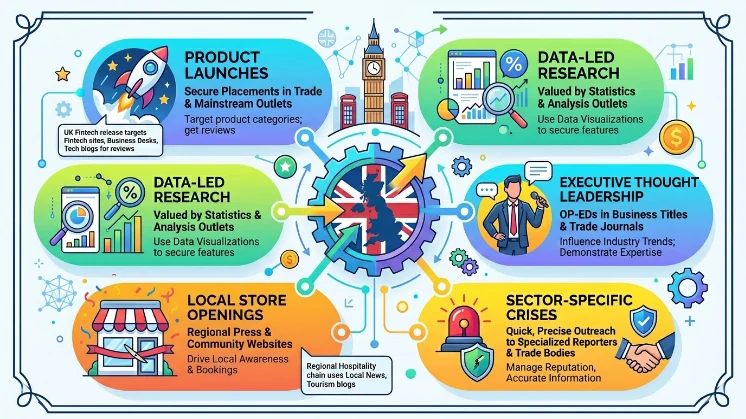
Brands see use cases in product launches, data-led research, executive thought leadership, local store openings, and sector-specific crises, each benefiting from higher editorial fit and pickup rates.
Product launches require placements in trade and mainstream outlets that cover the product category. Data-led research needs outlets that value statistics and analysis; data visualisations help secure features. Executive thought leadership needs op-eds in business titles and trade journals. Local store openings benefit from regional press and community websites. Sector-specific crises require quick, precise outreach to specialised reporters and trade bodies. Each use case benefits from tailored angles, relevant assets, and curated contact lists to maximise editorial pickup and audience impact.
A UK fintech release targets fintech trade sites, national business desks, and tech blogs to secure product reviews. A regional hospitality chain uses local news outlets and tourism blogs to drive local awareness and bookings.
Explore More Expert Insights:
Selecting a Media Agency for Strategic Industry Report Distribution
How to Interpret UK News Media Audience Research for B2B Growth
How do brands scale targeted distribution while maintaining quality?
Brands scale by segmenting audiences, automating personalisation, maintaining active list hygiene, and using performance data to prioritise high-yield contacts.
Segment audiences by beat, region, and outlet type. Use templates with dynamic fields to personalise subject lines and leads automatically. Maintain list hygiene with quarterly audits and remove inactive or irrelevant contacts. Prioritise segments by historical pickup performance and outlet authority. Use analytics to identify high-yield contacts and replicate tactics that worked. This approach increases throughput without degrading editorial fit.
Regularly update beat information, keep one-to-one outreach for top-tier contacts, and monitor response rates to detect list decay.
Find Out More:
Why 73% of UK Press Releases Never Get Picked Up
How should UK brands begin testing targeted distribution for higher pickup rates?
Define objectives, create segmented lists, craft tailored angles, send during optimal windows, and measure pickups versus a control group.
Set a clear KPI such as pickup rate or cost-per-pickup. Build two lists, one targeted and one control with broader reach. Send releases with identical assets but tailored subject lines for the targeted list. Track pickups, referral traffic, and conversions for both lists over a four-week window. Use results to refine audience mapping, timing, and message elements. Scale the approach where targeted lists show a statistically significant pickup improvement.
Dive Deeper Into This Topic:
PR Distribution Services UK: ROI Comparison Across 6 Providers