
Display ads are visual online ads banners, rich media, and video served on websites and apps to build awareness and prompt user consideration for event tickets. They target audiences by demographics, behaviour, and context and use impressions and clicks to measure reach.
Display ads appear as images, animated creatives, or short videos on publisher sites and within mobile apps. Ad servers deliver creatives based on targeting rules: geographic location (United Kingdom regions), audience segments (age 18–45, interests like live music), contextual signals (pages about venues), and retargeting lists (users who visited the event page). Pricing structures include CPM (cost per 1,000 impressions), CPC (cost per click), and CPA (cost per action). Key metrics include viewable impressions, click-through rate (CTR), view-through rate (VTR), and post-impression engagement with ticketing pages.
Impressions are counted views of an ad; CTR is clicks divided by impressions; viewability is the percentage of impressions that meet a visibility threshold; retargeting is serving ads to users who previously visited a site.
How do display ads move people from awareness to ticket consideration?
Display ads use progressive targeting and creative sequencing to increase familiarity, relevance, and intent, moving users from broad awareness to active consideration within weeks.
Campaigns begin with broad audience reach across UK websites to build exposure. Subsequent stages use audience segmentation to narrow to users who engaged with the initial ads or visited event pages. Creative sequencing shows different messages over time: first creatives highlight event identity (name, date, venue), second creatives show lineup or special features, third creatives present social proof (reviews or attendance counts). Frequency capping ensures users see each phase five to eight times over 14 to 30 days, which aligns exposure with increased consideration.
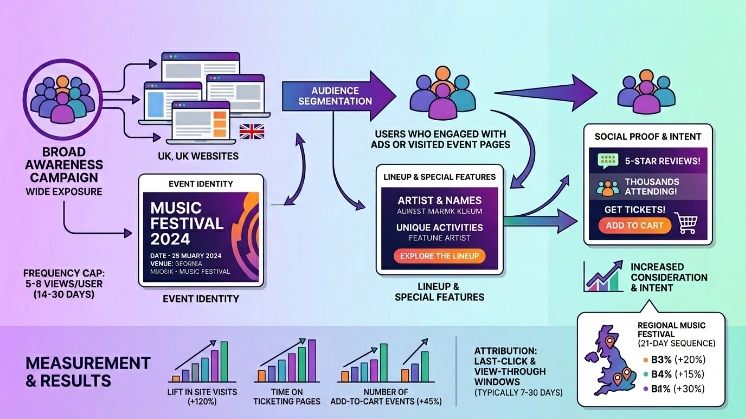
Measurement tracks lift in site visits, time on ticketing pages, and the number of users who add tickets to cart. Attribution uses last-click and view-through windows (typically 7 to 30 days) to quantify influence. Example: a regional music festival runs a 21-day sequence; site visits from display ad viewers increase by 120% and add-to-cart events rise by 45% compared with non-exposed cohorts.
What components make an effective event display ad?
An effective event display ad contains a clear visual, event name, date and location, a value-led message, and a measurable call to action that directs users to the ticket page.
Visuals must show the venue, headline performer, or key attraction. Text must include the event name, date, city, and one concrete benefit, “Early-bird tickets from £25” or “Line-up: 4 artists.” Creative sizes should include 300×250, 728×90, 300×600, and mobile 320×50 to cover common placements across desktop and mobile inventory. File formats are PNG, JPG, or HTML5 for animated creatives; video ads should be 15–30 seconds and web-optimised.
Ad copy must use direct verbs and precise numbers. Headlines present the event identity. Subtext lists a key detail such as price, time, or headline act. Landing pages must mirror creative messaging and deliver ticket options within two clicks. Tracking requires a pixel or tag to capture impressions and add-to-cart events for audience building.
How should event organisers structure targeting and audiences?
Organisers should use a layered audience approach: geotargeting, interest segments, lookalike models, and retargeting lists to raise consideration among qualified users.
Layer one restricts delivery to UK regions relevant to the event: city level (e.g., London boroughs, Manchester metropolitan area) within a specified radius, using postcode targeting when needed. Layer two targets interest segments derived from browsing behaviour: live music, theatre, sport, festivals. Layer three uses lookalike modeling built from ticket purchasers or high-engagement visitors; a 1%–3% lookalike typically yields higher intent. Layer four retargets users who viewed ticket pages, watched event videos for more than 10 seconds, or added tickets to cart without purchase.
Frequency and scheduling align with ticket lifecycle, heavier exposure during early-bird sales and ticket-release days. Dayparting can prioritize evenings and weekends when users research leisure activities. Exclusion lists remove users who already purchased a ticket to avoid wasted impressions.
What creative and messaging strategies increase ticket consideration?
Use sequential messaging that progresses from identity to social proof to urgency, each creative containing one measurable fact or number to increase clarity and tracking.
Identity creatives show event name, date, and location. Second wave, benefit creatives list line-up or unique features and include attendance numbers (for example: “10,000 attendees in 2025”). Third wave: social proof creatives show reviews, ratings, or endorsements with a quantifiable element (for example: “4.7/5 from 2,000 attendees”). Final wave: urgency creatives state exact ticket counts available or days left (for example: “500 early-bird tickets left”).
Each creative must link to a landing page that repeats the same factual details. Use UTM parameters for each sequence step to isolate performance by creative version. A/B test two variants per stage: visual-first versus copy-first, and record add-to-cart rates for both.
How do measurement and attribution prove display ads increase consideration?
Measurement combines view-through attribution, on-site engagement metrics, and matched conversion lift tests to quantify the influence of display ads on ticket consideration.
Track view-through conversions within a 7–30 day window to capture users who saw an ad and later visited the ticket site without clicking the ad. Monitor engagement metrics: pages per session, session duration, and add-to-cart events. Use matched conversion lift tests where exposed and control cohorts of at least 50,000 users each validate incremental lift statistically. Report results in absolute numbers and percentages: incremental visits, incremental add-to-cart events, and incremental purchases originating from the ad exposure.
What are the benefits of using display ads for ticket consideration?
Display ads increase reach, control message sequencing, enable precise audience re-engagement, and lower cost per engaged user compared with search-only tactics.
Display inventory covers premium and long-tail publisher sites that search does not capture. Sequencing: advertisers show staged messages that align with the buyer journey. Retargeting: display retargeting recaptures users who left the ticket path. Cost efficiency: CPM-based buys reduce cost for awareness phases and produce lower cost per engaged user for mid-funnel metrics like add-to-cart.
When a regional theatre used display campaigns during a six-week window, add-to-cart events rose 62% and conversion rate from add-to-cart to purchase rose 18% after tailored retargeting creatives.
Explore More Expert Insights:
How Gaming Companies Build Player Interest Using Banner Campaigns
How Film Studios Nurture Audience Hype Using Trailer Ads
What use cases fit display ad strategies for events?
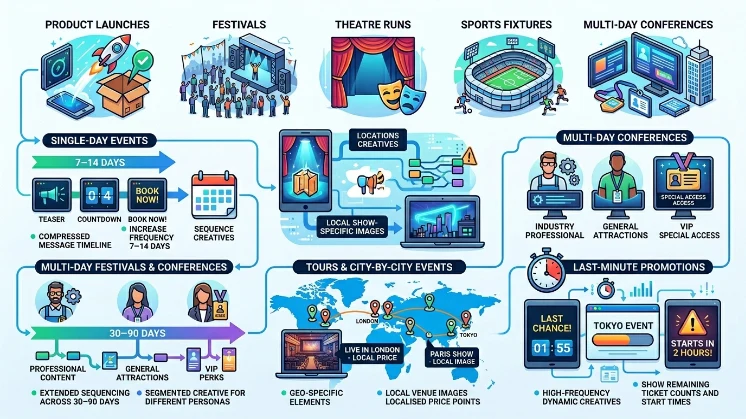
Display ads fit product launches, festivals, theatre runs, sports fixtures, and multi-day conferences where visual context and repeated exposure increase user consideration.
For single-day events, sequence creatives to compress the message timeline and increase frequency across 7–14 days. For multi-day festivals and conferences, extend sequencing across 30–90 days with segmented creatives for different attendee personas (industry professionals, general public, VIP). For tours or city-by-city events, use geo-specific creatives with local venue images and localised price points. For last-minute promotions, use high-frequency dynamic creatives that show remaining ticket counts and start times.
How do display ads integrate with other channels during the consideration phase?
Integrate display ads with email, social media retargeting, and paid search by using shared audience signals and consistent messaging to move users down the funnel.
Export retargeting lists to social platforms and build parallel search campaigns targeting branded queries and ticketing pages. Sync creative messaging across channels: same event name, date, and headline act. Use email to convert users who added tickets to cart; display campaigns continue to nudge users earlier in the funnel. Maintain a single source of truth for audience segments and update exclusion lists to avoid overexposure.
Implement a sequenced display campaign that targets UK geographies, uses layered audiences, and measures incremental lift through view-through attribution and conversion lift testing.
Check Out the Full Article:
How Event Organizers Increase Attendance Using Banner Ads
Set up creatives for identity, benefits, social proof, and urgency. Configure targeting layers: city/postcode, interests, lookalikes, and retargeting. Deploy frequency capping and dayparting aligned with ticket lifecycle. Track viewable impressions, CTR, add-to-cart events, and incremental purchases. Run a matched lift test to validate incremental impact and report costs per incremental outcome.
Explore the Complete Guide:
Event Display Ads That Convert Ticket Consideration Into Purchases