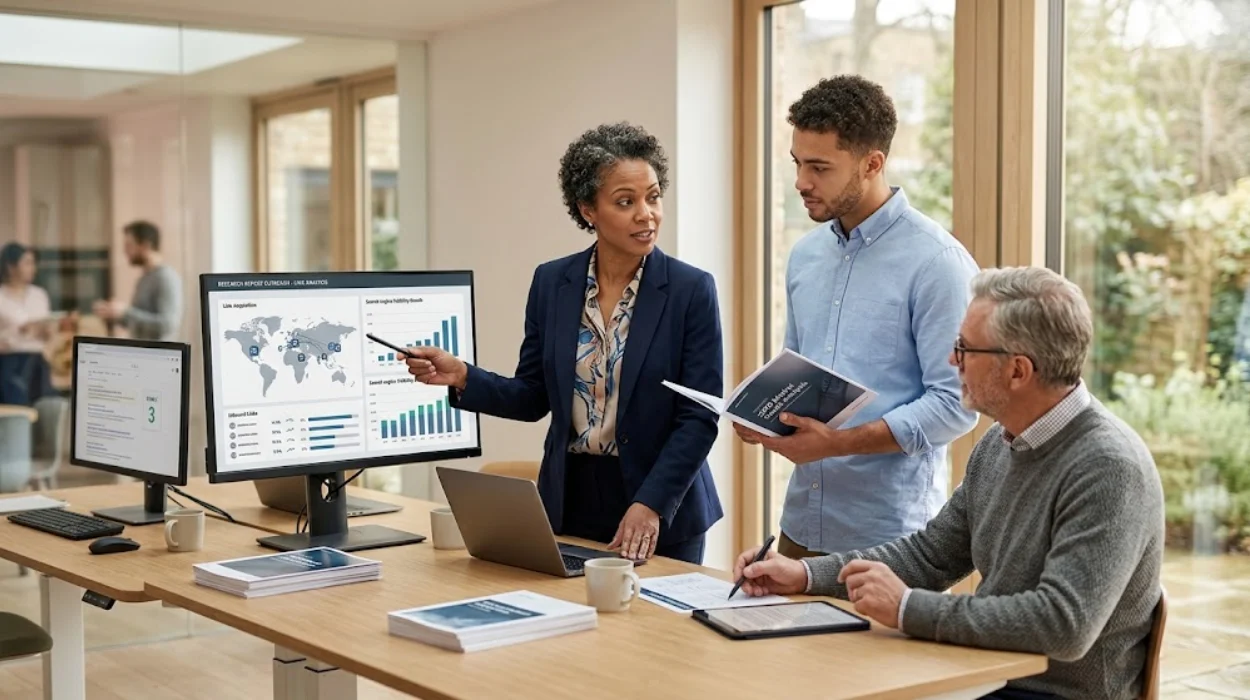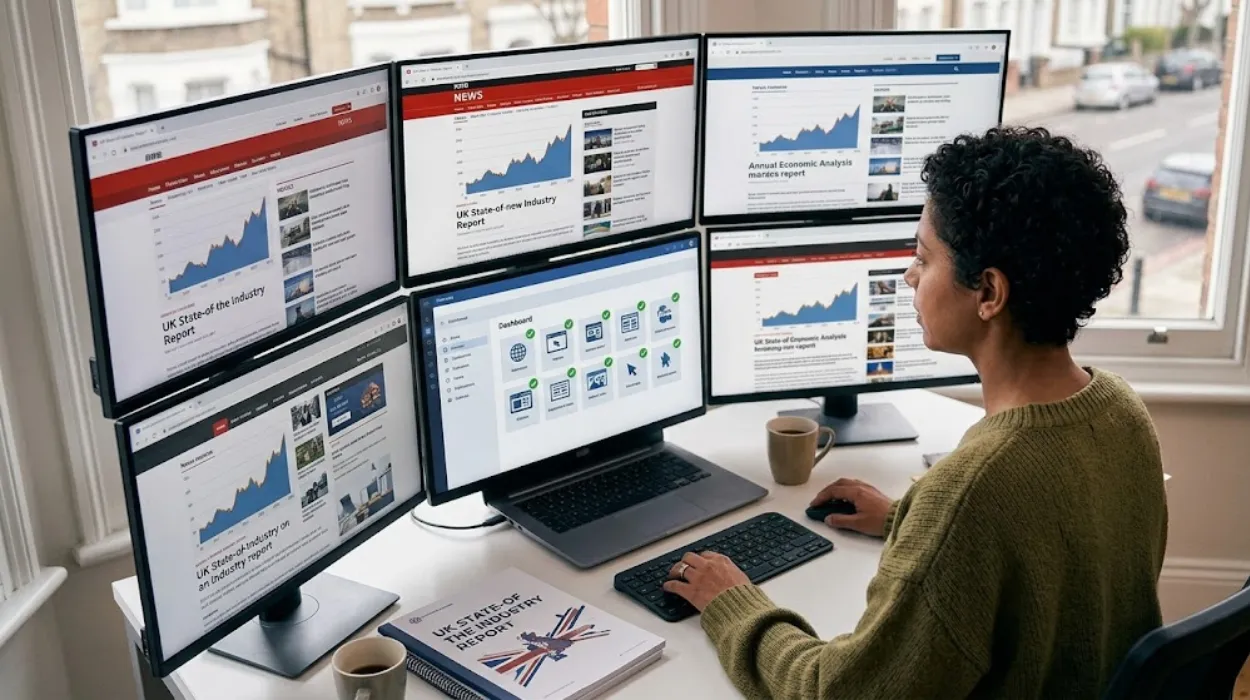
Local banner advertising places visual ads on websites, apps, and digital displays targeted to users in a defined geographic area near a cafe. These ads use location signals and contextual targeting to prompt potential customers to visit the cafe.
Local banner advertising includes display ads on news sites, lifestyle blogs, local directories, and mobile apps. Cafes set a geographic radius, often between 0.5 km and 10 km, around the cafe location. Ads deliver images, headlines, and short text that highlight key attributes: opening hours, menu items, promotions, and unique features. Platforms supply metrics such as impressions, click-through rate (CTR), viewability, and estimated footfall lift. Advertisers combine these metrics with location analytics to measure actual visits.
How do cafes use targeting to reach nearby customers?
Cafes use geographic targeting, device targeting, and time targeting to deliver banners to people who are physically near the venue and likely to be in a buying mindset.
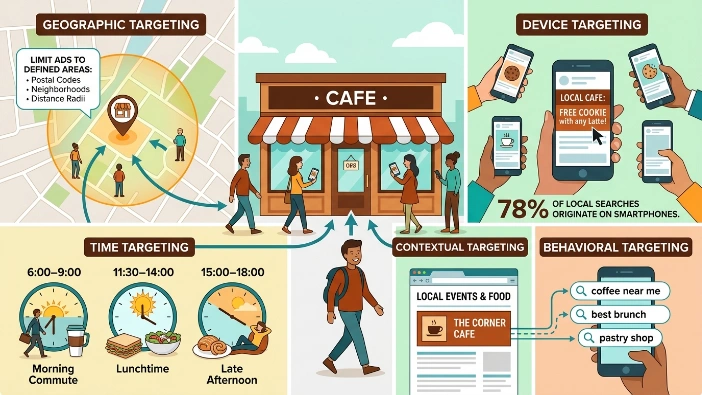
Geographic targeting limits ad delivery to defined areas: postal codes, neighborhoods, or distance radii. Device targeting focuses on mobile devices because 78% of local searches originate on smartphones. Time targeting schedules ads around peak decision times: morning commute (06:00–09:00), lunch (11:30–14:00), and late afternoon (15:00–18:00). Contextual targeting places ads on local food and events pages. Behavioral targeting uses interest signals like frequent searches for “coffee near me” or “best brunch” to refine delivery. Combining these signals increases relevance and raises the probability of turning an impression into a visit.
What creative elements increase visit intent in banner ads?
High-contrast images, clear value statements, concise offers, and visible location cues raise the chance that viewers will act and visit the cafe.
Use a single headline with a clear value proposition and one supporting line of text. Display the cafe address or distance (for example, “200 m away”) and operating hours. Use food photography with one focal item, such as a latte or pastry, sized large enough to read on a 320×50 mobile banner. Highlight a concrete offer when available: “Free pastry with any large coffee — weekdays 08:00–10:00.” Include a visual map pin or simplified address to reduce friction. Keep file sizes under 150 KB to preserve load speed and viewability on mobile networks. Test static versus animated creatives and choose formats that maintain clarity at small sizes.
How do measurement and attribution link banners to actual visits?
Attribution combines impression logs, geofence data, and store visit conversions to estimate how banner exposure influenced foot traffic.
Impression logs show who saw the ad and when. Geofence technology or Wi‑Fi beacon data records device proximity to the cafe after ad exposure. Store visit conversions count devices that entered a predefined geofence within a time window, commonly 24 hours after exposure. Incrementality tests compare exposed and control groups to separate organic visits from ad-driven visits. Common metrics: impressions, CTR, viewable rate, cost per store visit, and visit lift percentage. Use device-level anonymised identifiers to measure visits while preserving privacy and comply with local data regulations, including UK GDPR.
What budget and bidding approaches work for local banner campaigns?
Set a fixed daily budget per location, use CPM or CPC with floor bids, and allocate 60% to high-intent dayparts to maximise exposure when people search locally.
Estimate audience size based on radius and local population density. Start with a 14-day campaign to collect baseline data. Use CPM for awareness and CPC for click-driven performance. Implement bid adjustments for weekday mornings and weekends when local foot traffic rises. Monitor cost per store visit and adjust bids to optimise for lower cost per visit. Reallocate 20% of budget to retargeting nearby users who viewed the banner but did not click. Use frequency caps to limit exposures to fewer than 6 impressions per week per user to avoid ad fatigue.
How do cafes integrate banner ads with search and maps presence?
Coordinate banners with local search profiles and map listings so ad messaging matches business hours, offers, and accurate location details to reduce friction between search and physical visit.
Ensure the cafe’s map listing shows the same address and opening hours used in banner creatives. When a user clicks a banner, send them to a landing page that displays distance calculations and a “get directions” link. Sync special offers used in banners with the listing to avoid mismatched expectations. Use UTM parameters on banner links to attribute web sessions and trace which creatives drive direction clicks. Cross-reference web analytics with store visit data to validate which ad variations generate the largest visit lift.
What audience segments produce the highest visit intent?
Nearby repeat visitors, commuters along key routes, and event attendees within a 1–5 km radius produce the highest likelihood of converting from banner exposure to walk-in visits.
Segment audiences by past visitation signals, local mobility patterns, and event attendance. Repeat visitors include users who visited the cafe’s geofence in the past 90 days. Commuters include devices that travel along transport corridors and stop near the cafe between 06:00 and 09:00 or 16:00 and 18:00. Event attendees include users who attended nearby markets or community events in the last 7 days. Prioritise repeat visitors with tailored creatives that mention loyalty perks. Use commuter-focused creatives to emphasise quick service and takeaway options. For event attendees, promote group items and extended hours.
What creative testing strategies improve campaign performance?
Run A/B tests that vary one element at a time, headline, offer, image, or distance display; measure CTR and store visit conversion for each variant.
Test a headline that emphasises speed against one that emphasises quality. Compare a “Free pastry” offer with a “20% off” offer. Measure which image type performs better: product close-up versus in-store atmosphere. Run each test for at least 7 days and collect a minimum of 10,000 impressions to reach statistical clarity in dense urban areas; reduce to 2,000 impressions in smaller towns with careful interpretation. Use results to create a creative template library for future campaigns.
What benefits do cafes gain from local banner advertising?
Local banner ads increase brand visibility in the immediate area, raise foot traffic, and provide measurable data on which creatives and schedules drive visits.
Ads reach users who are actively in the area or planning local activity. Measurement tools provide cost per store visit metrics. Campaign data helps schedule staff for peak times and tailor menu promotions to demand patterns. Local banners deliver scalable control over spend and targeting across multiple locations. For multi-site operations, the ads allow per-location optimisation and comparison using standardised KPIs.
Explore More Expert Insights:
How Restaurants Increase Food Consideration Using Display Campaigns
How Food Delivery Apps Nurture Users Using Offer-Based Banner Ads
What practical use cases show success for cafes?
Use case examples: morning commuter boost, weekend brunch promotion, and event-driven surge planning demonstrate measurable visit increases when banners align with local demand.
A cafe targeting commuters with a 06:00–09:00 campaign showing “Grab & Go 20% Off Hot Drinks” records a measurable morning visit lift within a 1 km radius. A weekend campaign promoting a brunch special during 09:00–13:00 increases weekend footfall and average spend per visit when combined with map listing updates. An event-driven campaign that runs banners during a local festival week captures attendees who search for food and increases visits between 12:00 and 16:00. Compare campaign periods to baseline weeks to calculate visit lift and cost efficiency.
Get the Full Insights Here:
How Cafes Increase Foot Traffic Using Display Ads
How should cafes scale and optimise campaigns across multiple locations?
Standardise targeting templates, centralise measurement, and apply per-location adjustments for radius, dayparts, and creatives to optimise performance at scale.
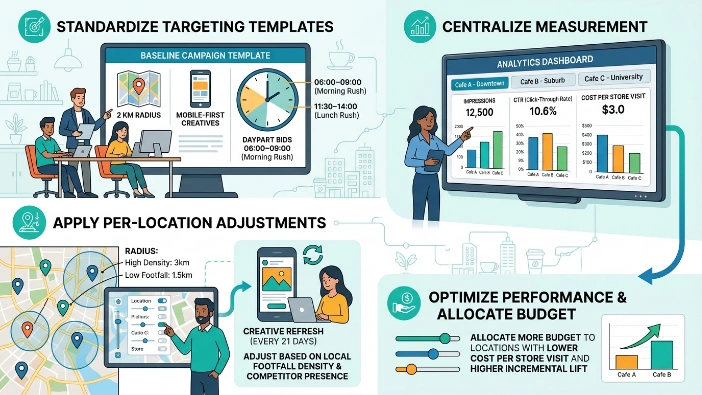
Create a baseline campaign template, 2 km radius, mobile-first creatives, and daypart bids for 06:00–09:00 and 11:30–14:00. Use a single analytics dashboard to compare impressions, CTR, and cost per store visit across locations. Adjust radius and creative based on local footfall density and competitor presence. Allocate more budget to locations with lower cost per store visit and higher incremental lift. Maintain a rolling cadence of creative refresh every 21 days to prevent fatigue.
Read More to Understand Better:
Local Cafe Ads That Turn Nearby Searches Into Walk-In Customers