
Mid-funnel advertising targets users who show planning intent and guides them from interest to consideration through relevant content and personalised messaging. Mid-funnel sits between awareness and conversion. Users have seen general travel messaging or searched for destinations. Advertisers use mid-funnel tactics to deepen consideration without hard selling. Entities: audiences (lookalike, remarketing lists), inventory (display, video, native), signals (site visits, search queries, content engagement), and creative formats (tiles, short-form video, interactive rich media). Example audiences include users who viewed destination pages or saved itineraries; example inventory includes programmatic display and in-feed video.
How do travel companies structure a mid-funnel campaign?
Travel companies structure mid-funnel campaigns around audience segments, relevant creatives, and sequential messaging to drive planning actions. Campaigns begin with defining segments from first-party and third-party signals. Segments include recent site visitors, search engagers, and content consumers. Next, advertisers select inventory with high viewability and contextual relevance, such as travel editorial sites and streaming video.
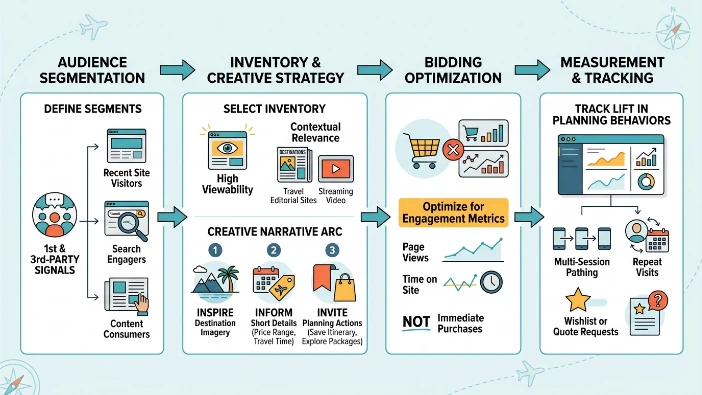
Creative follows a narrative arc, inspire with destination imagery, inform with short details (price range, travel time), and invite planning actions like saving an itinerary or exploring packages. Bidding optimises for engagement metrics (page views, time on site) rather than immediate purchases. Measurement tracks lift in planning behaviors, multi-session pathing, repeat visits, and wishlist or quote requests.
What audience signals indicate planning intent?
Audience signals for planning include repeated site visits, destination-specific searches, itinerary downloads, and engagement with accommodation or activities pages. Signals are explicit and implicit. Explicit signals: form submissions, saved trips, downloaded guides. Implicit signals: three or more page views of a destination within 14 days, session durations over two minutes on planning pages, or search queries that include dates and travel-related verbs. Travel companies combine signals into scoring rules. Example scoring: score 10 for itinerary download, score 5 for destination page view, score 3 for subscribing to alerts. Segments form when cumulative score exceeds a threshold, for example 12 points.
What creative components work best for mid-funnel travel ads?
Effective creative combines clear destination visuals, concise factual copy, contextual details (season, price band), and a planning-oriented call-to-action. Visuals use high-resolution images or 10–30 second video showing key experiences. Copy uses short declarative lines: destination name, travel time from the UK (hours), typical price range (£300–£1,200), and available seasons (June–September). Creative variants test different hooks: experience-focused, price-focused, and logistics-focused. Ad templates often include an interactive element for saving or comparing dates. Design standards prioritize legibility on mobile and accessible contrast ratios.
How do travel companies choose channels and inventory for mid-funnel ads?
Travel companies select channels with contextual relevance, audience reach, and measurable engagement, such as programmatic display, social in-feed video, and streaming platforms. Programmatic display offers scale and precise targeting through exchanges and private marketplaces. Social platforms provide behavior signals and easy creative iteration. Connected TV and streaming capture long-form engagement. Publishers with travel editorial content deliver contextual relevance and higher conversion rates for planning behaviors. Inventory choice aligns with campaign KPIs: viewability and time on site for inspiration, click-through and session depth for planning.
How do measurement and attribution work in the mid-funnel?
Measurement focuses on intent and planning metrics: repeat visits, time on planning pages, wishlist additions, and assisted conversions across a 14–90 day window. Attribution uses multi-touch models to credit mid-funnel interactions that materially increase planning signals. Typical windows: 14 days for short trips and 90 days for long-haul planning. KPIs include uplift in repeat sessions (target +20% versus control), increase in engaged sessions (target +15%), and growth in wishlist or quote requests (target +10%). Controlled experiments run holdout groups to measure incremental lift. Reporting integrates analytics platforms and ad platforms to show correlation between mid-funnel exposures and later purchase events.
What bidding and optimisation strategies suit mid-funnel campaigns?
Bidding and optimisation prioritise engagement outcomes: optimise for engaged sessions, view-through conversions, and conversions with planning signals rather than immediate bookings. Use outcome-based bidding where available: cost-per-engaged-session or viewable CPM with a frequency cap. Frequency caps often range from 3–7 impressions per user per week to maintain relevance without ad fatigue. Optimisation cycles run every 3–7 days to allow statistical significance. Creative rotation favors higher-engagement variants and retires low-performing formats. Automated bidding tools calibrate bids toward audiences that show higher planning scores.
What data sources feed mid-funnel targeting?
Data sources include first-party site and CRM data, publisher contextual signals, and privacy-compliant third-party intent segments. First-party data provides the strongest signals: site events, booking data, newsletter engagement, and CRM lifecycle stages. Publisher contextual data identifies content relevant to travel planning. Third-party segments supply supplemental intent where first-party coverage is low, for example, users who read multiple travel guides across publishers. Data hygiene includes regular list refreshes and 30–90 day expiry policies for planning segments.
What privacy and compliance practices apply to mid-funnel travel advertising?
Practices include explicit consent management, hashed or anonymised identifiers, and limited retention of behavioral segments to comply with UK and EU privacy laws. Consent frameworks must record user choices and pass signals only when consent exists. Use hashed emails and privacy-safe identifiers for CRM matches. Set retention limits: 30 days for short-trip planning, 90 days for long-haul planning. Maintain an opt-out mechanism and document data provenance for audits. Avoid deterministic cross-device stitching without user consent.
Discover the Full Information:
How Travel Companies Promote Deals Using Display Advertising
What benefits do mid-funnel ads deliver for travel marketers?
Mid-funnel ads increase planning engagement, reduce time-to-decision, and improve efficiency of later conversion campaigns by warming high-intent audiences. Specific benefits include higher return on ad spend for retargeting, improved conversion rates when audiences move to lower-funnel tactics, and reduced cost per engaged session. Measurable outcomes show a typical 12–25% increase in assisted bookings when mid-funnel strategies sit ahead of conversion campaigns. Travel companies use mid-funnel activity to prioritise paid search and email spend toward users with high planning scores.
Explore More Expert Insights:
How Resorts Nurture Guests Using Visual Experience Banner Ads
How Booking Platforms Improve Travel Intent Using Retargeting Ads
What use cases show mid-funnel advertising success?
Use cases include seasonal travel pushes, new-destination launches, and abandonment recovery for saved itineraries. Seasonal campaigns target users who engaged with seasonal content in the previous 120 days. New-destination launches use lookalike audiences based on similar destination interest. Abandonment recovery targets users who started booking but did not complete, offering itinerary comparisons or flexible date options. UK seasonal campaign that targeted past visitors with planning creatives achieved a 18% lift in quote requests and reduced CPA on subsequent booking campaigns by 23%.
How do travel companies move planning audiences into booking pipelines?
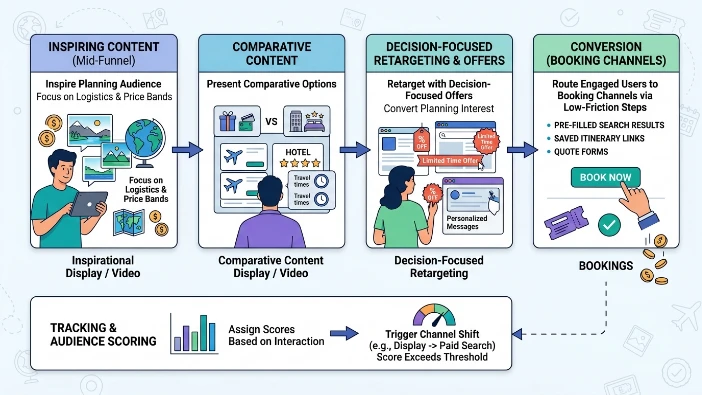
Companies map sequential touches inspire with mid-funnel content, present comparative options, then retarget with decision-focused offers to convert planning interest into bookings. The sequence starts with inspirational display or video focused on logistics and price bands. Next touch delivers comparative content: package types, hotel classes, and travel times. Final touch routes engaged users to booking channels via low-friction steps pre-filled search results, saved itinerary links, or quote forms. Tracking assigns audience scores to trigger channel shifts, for example, moving audiences from display to paid search when score exceeds a predefined threshold.
Explore More Expert Insights:
Mid-Funnel Travel Ads That Turn Planning Interest Into Confirmed Trips