
Informational banner advertising in healthcare trust building refers to structured digital display messages that present verified health education content across websites and apps. These banners focus on clarity, safety information, and awareness messaging designed to increase patient confidence in healthcare systems within regulated digital communication environments in the United Kingdom.
Informational banner advertising in healthcare operates as a structured communication method where visual ad units deliver educational health content. These units appear on digital platforms such as news websites, health information portals, and mobile applications. The primary function is not promotion but structured information delivery.
In the United Kingdom, healthcare communication frameworks emphasize accuracy, transparency, and regulated messaging. Informational banners align with these requirements by presenting simplified healthcare facts, service awareness categories, and preventive care information in short structured formats.
These banners use standardized digital formats including static images and responsive layouts. Each banner contains controlled messaging that avoids complex medical terminology. The goal is to improve understanding of healthcare topics among general audiences.
The system relies on digital distribution networks that place banners across multiple online environments. Users encounter consistent informational messaging across repeated digital touchpoints, which builds familiarity with healthcare concepts over time.
How does informational banner advertising build patient trust?
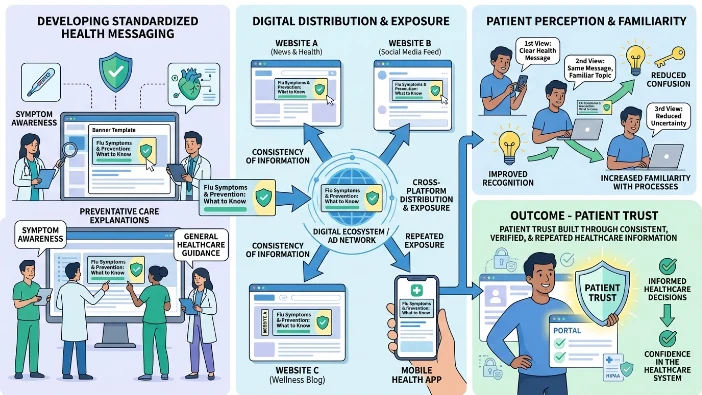
It builds trust by delivering consistent, verified, and repeated healthcare information across digital platforms. Exposure to clear health education messages improves recognition, reduces uncertainty, and increases familiarity with healthcare processes among users interacting with regulated online content systems in structured digital ecosystems.
Trust building in healthcare banner advertising operates through repetition and consistency of information. When users see the same structured healthcare messages across multiple platforms, familiarity increases. Familiarity reduces uncertainty in healthcare decision-making contexts.
Informational banners present standardized health content such as symptom awareness, preventive care explanations, and general healthcare system guidance. This structured communication reduces confusion around healthcare topics.
Digital advertising systems distribute these banners across multiple websites and applications. Users are exposed to the same message in different digital environments. This repeated exposure strengthens message retention.
Trust increases when users encounter consistent messaging from healthcare-related sources. Consistency indicates reliability in communication systems and reinforces structured understanding of healthcare topics.
The system operates without requiring user interaction. Passive exposure ensures that users receive information even without actively searching for healthcare content.
Why is transparency important in healthcare banner messaging?
Transparency in healthcare banner messaging ensures that information is clear, accurate, and easy to understand. It reduces misinformation, improves health literacy, and supports consistent communication standards across digital healthcare environments in the United Kingdom regulated information systems.
Transparency in healthcare banner messaging is defined by clarity of content and absence of ambiguous language. Messages are structured to communicate factual healthcare information without interpretation barriers.
Healthcare audiences require accurate and accessible information due to the sensitivity of medical topics. Transparent messaging ensures that users understand healthcare concepts without confusion.
Digital banners use simplified language structures that focus on direct communication. Each message is limited to essential healthcare information categories such as prevention, awareness, and general system guidance.
Transparency also supports regulatory compliance in healthcare communication. Structured messaging ensures alignment with digital advertising standards used in healthcare-related campaigns in the United Kingdom.
Clear communication reduces misinformation risk. When users receive structured and verified health content repeatedly, informational consistency improves across digital environments.
What types of informational banner ads are used in healthcare communication?
Healthcare informational banner ads include static educational banners, animated awareness banners, and responsive informational layouts. Each format delivers structured healthcare messaging across digital platforms, ensuring accessibility, readability, and consistency in health communication systems within regulated online environments.
Healthcare informational banners are designed in multiple formats to support clarity and accessibility. Static banners display fixed health messages using simple visuals and short text. These are used for basic awareness communication.
Animated banners include sequential information delivery. These banners present step-based health education messages in a structured visual sequence. This format improves information layering within limited digital space.
Responsive banners adapt to different screen sizes. These banners ensure consistent visibility across desktop, tablet, and mobile devices. This supports uniform communication across digital ecosystems.
Each format serves a structured communication purpose. Static banners support clarity. Animated banners support structured sequencing. Responsive banners ensure accessibility across devices.
Healthcare communication systems distribute these banners across digital environments such as news platforms and informational websites. Each format ensures consistent health messaging across user touchpoints.
How do healthcare providers structure trust-focused banner campaigns?
Healthcare providers structure trust-focused banner campaigns by defining audience segments, selecting informational messaging categories, and distributing content across regulated digital platforms. Campaigns focus on clarity, repetition, and health education consistency across multiple online environments and user interaction systems.
Trust-focused banner campaigns begin with audience segmentation. Segmentation divides users into groups based on demographic and behavioral signals such as age range, location, and content engagement patterns.
Healthcare messaging categories are then defined. These categories include preventive care awareness, general health system guidance, and symptom education. Each category is structured for clarity and accessibility.
Campaign distribution occurs through digital advertising networks. These networks place banners across websites, applications, and informational portals where target audiences are active.
Repeated exposure is a key structural component. Users see consistent healthcare messages across different platforms, which increases message recognition and reduces uncertainty.
Campaign structures are designed for informational stability. Each banner maintains consistent messaging formats across all placements to support trust-building objectives.
What role does user engagement data play in healthcare banner trust systems?
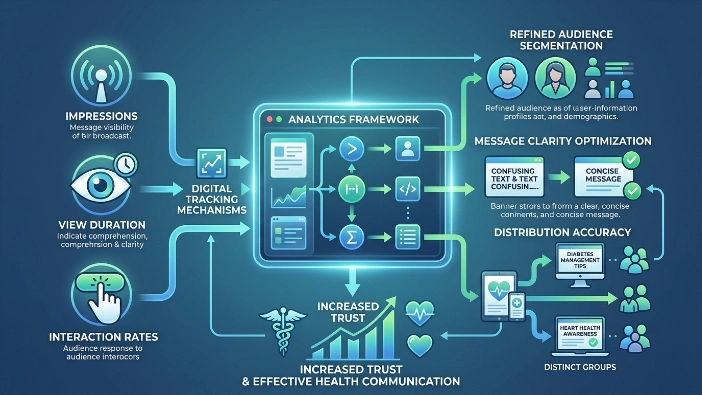
User engagement data measures how audiences interact with informational banners through impressions, view duration, and interaction rates. This data supports optimization of message clarity, audience targeting accuracy, and repeated exposure patterns within digital healthcare communication systems and structured analytics frameworks.
Engagement data in healthcare banner systems is collected through digital tracking mechanisms that monitor user interactions with advertisements. These interactions include impressions, clicks, and content view duration.
Impressions measure how often healthcare banners appear across digital platforms. High impression volume indicates strong message visibility across the system.
View duration measures how long users observe banner content. Longer viewing time indicates improved message comprehension and clarity.
Interaction rates measure user responses to banner content. These responses reflect engagement with informational healthcare messages across digital environments.
Engagement data is analyzed to refine audience segmentation and improve message distribution accuracy. This ensures that informational healthcare banners reach relevant user groups effectively.
Explore More Expert Insights:
How EdTech Companies Nurture Leads Using Curriculum-Focused Display Ads
How Education Providers Build Trust Using Success Story Banner Ads
How does informational banner advertising differ from promotional healthcare advertising?
Informational banner advertising focuses on health education and awareness messaging, while promotional healthcare advertising focuses on service offerings and conversion-driven messaging. Informational banners prioritize clarity and public understanding within regulated communication frameworks, while promotional banners emphasize action-oriented outcomes.
Informational banner advertising is structured around health education content. It communicates facts, preventive care information, and general healthcare system awareness.
Promotional healthcare advertising focuses on service visibility and user action. It emphasizes healthcare service availability and engagement pathways.
Informational banners do not contain persuasive language. They are designed to improve understanding of healthcare topics rather than influence immediate decisions.
Promotional banners are structured to guide user behavior toward specific actions. Informational banners remain focused on clarity and awareness.
In healthcare communication systems, both formats operate within digital advertising ecosystems but serve different stages of user understanding.
Read:
How Healthcare Providers Gain Patients Using Banner Advertising
What use cases define informational banner advertising in healthcare?
Informational banner advertising is used for public health awareness, preventive care education, healthcare system navigation guidance, and general medical literacy improvement. These use cases operate across digital platforms to increase structured understanding of healthcare information among online audiences in regulated communication environments.
Public health awareness campaigns use informational banners to distribute structured health messages across digital environments. These include seasonal health alerts and general wellness information.
Preventive care education focuses on informing users about early-stage health awareness concepts. This includes structured messaging around routine health checks and general wellness practices.
Healthcare system navigation guidance explains how healthcare systems operate. This supports user understanding of service access structures within regulated healthcare frameworks.
Medical literacy improvement focuses on increasing general understanding of healthcare terminology and processes. Informational banners simplify complex concepts into structured digital messages.
These use cases operate across multiple digital platforms where users interact with healthcare-related content passively.
Informational banner advertising in healthcare operates as a structured communication system focused on clarity, repetition, and accessibility. It builds trust through consistent exposure to verified health information across regulated digital environments in the United Kingdom.
Content defines the system structure. Content transitions into decision-focused healthcare interaction and structured appointment conversion frameworks.
Explore:
How Healthcare Providers Convert Patient Interest Into Appointment Bookings Using Banner Ads