

Converting demo visitors into sales calls means transforming users who have already interacted with a software demonstration into scheduled conversations with sales teams. This process uses banner campaigns, retargeting systems, and behavioral signals to move prospects from product evaluation into structured decision-stage discussions.
Demo visitors represent high-intent users. They have already viewed product functionality through live demos, recorded walkthroughs, or interactive sessions. At this stage, interest is established, but purchase readiness requires structured engagement.
Software companies use banner campaigns to reconnect with these users after the demo experience. These campaigns display follow-up messaging across digital platforms, reinforcing product value and encouraging direct sales interaction.
A sales call in software marketing refers to a scheduled conversation between a potential customer and a sales representative. The purpose is to discuss pricing, implementation, integrations, and operational requirements.
Banner campaigns at this stage focus on clarity. They do not introduce new product awareness. They reinforce evaluated features such as dashboards, automation workflows, and system integrations.
Users transitioning from MOFU context can explore deeper engagement pathways here:
How Software Companies Increase Demo Engagement Using Banner Campaigns
Users moving toward decision-stage actions can continue here:
How Software Companies Convert Demo Visitors Into Active Sales Calls Using Banner Campaigns
How do banner campaigns convert demo viewers into sales-ready leads?
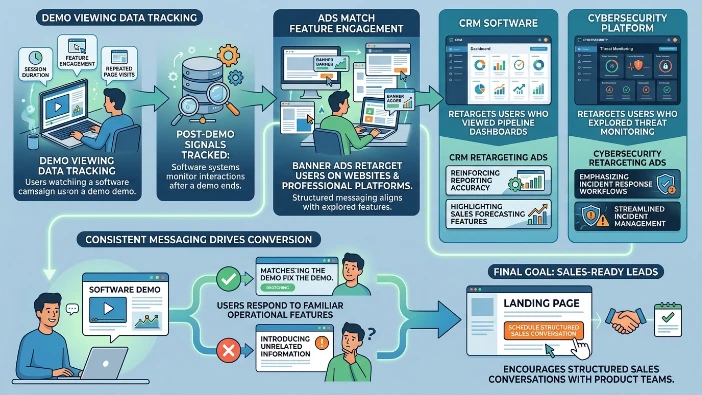
Banner campaigns convert demo viewers into sales-ready leads by using retargeting systems, behavior tracking, and decision-stage messaging that reconnects users with software value after initial demo exposure and encourages them to schedule structured sales conversations with product teams.
The conversion process begins after a demo session ends. Software systems track user interaction signals such as session duration, feature engagement, and repeated page visits.
Banner advertisements then target these users across websites and professional platforms. These ads contain structured messaging aligned with the features users explored during the demo.
A CRM software platform, for example, retargets users who viewed pipeline dashboards with banners reinforcing reporting accuracy and sales forecasting features. A cybersecurity platform retargets users who explored threat monitoring with banners emphasizing incident response workflows.
Conversion improves when messaging remains consistent with demo content. Users respond to familiar operational features rather than new or unrelated information.
Landing pages connected to these banners provide direct scheduling options for sales conversations. These pages maintain focus on specific product benefits already demonstrated.
The final conversion step occurs when users book a structured sales call for pricing evaluation, integration discussion, or implementation planning.
Why are demo visitors considered high-intent users?
Demo visitors are considered high-intent users because they have already engaged with software functionality through structured demonstrations. This behavior indicates active evaluation, comparison activity, and readiness to assess pricing, integrations, and operational suitability for business adoption decisions.
High-intent users follow a defined software evaluation journey. They move from awareness to exploration and then to demonstration engagement.
Demo participation signals strong purchase consideration. Users allocate time to understand software workflows, interface design, and functional outcomes.
Software companies classify these users as decision-stage prospects. Unlike general website visitors, demo viewers already understand product capabilities.
Behavioral indicators confirm intent. These include full demo completion, repeated feature viewing, and return visits to product pages after the demo.
A marketing automation platform, for example, identifies users who watched complete workflow automation demos as high-priority leads for sales outreach.
Banner campaigns reinforce this intent by maintaining visibility after the demo session ends.
What role do retargeting banners play after software demos?
Retargeting banners play a central role in post-demo engagement by reconnecting users with evaluated software features, reinforcing product value, and guiding them toward structured sales conversations through repeated exposure across digital platforms and professional content environments.
Retargeting is a system that tracks users who interacted with software content and displays follow-up advertisements across multiple websites.
After a demo session, users often continue researching alternatives or reviewing internal business requirements. Retargeting banners maintain product visibility during this period.
These banners focus on specific features already seen in the demo. A project management tool retargets users with banners highlighting task automation and reporting tools after a demo session covering those features.
Frequency control improves engagement quality. Users see repeated but structured messaging across different platforms without message overload.
Retargeting also shortens decision timelines. Users return to sales conversations faster because they repeatedly encounter familiar software capabilities.
Banner placement includes business publications, industry blogs, and professional networks where decision-makers continue research activity.
How do software companies structure BOFU banner messaging?
Software companies structure BOFU banner messaging using feature reinforcement, decision-stage clarity, and evaluation-focused content. These banners highlight specific operational outcomes, integration readiness, and business suitability to encourage users to transition from demo viewing into scheduled sales discussions.
BOFU messaging focuses on evaluation completion. Users at this stage already understand the product and require clarity for decision-making.
Banner content avoids general descriptions. It focuses on measurable software outcomes such as automation efficiency, reporting accuracy, or system integration capabilities.
A finance software platform, for example, displays banners reinforcing invoice automation speed and compliance reporting after demo engagement. A logistics platform highlights real-time tracking accuracy and supply chain visibility.
Messaging structure remains concise. Each banner communicates one operational benefit aligned with demo interaction history.
Decision-stage banners often include comparison reinforcement. Users who viewed multiple tools receive banners emphasizing specific differentiators.
Landing pages connected to BOFU banners focus on scheduling structured sales calls for pricing, integration planning, and deployment discussion.
These pages remove unnecessary navigation to maintain focus on conversion objectives.
Why do banner campaigns improve sales call conversion rates?
Banner campaigns improve sales call conversion rates by maintaining continuous visibility after demo engagement, reinforcing evaluated features, and reducing decision delays through structured retargeting systems that guide users toward scheduled sales conversations based on prior software interaction behavior.
Conversion improvement occurs through repetition. Users encounter software messaging multiple times after demo completion, increasing familiarity.
Consistency between demo content and banner messaging strengthens recall. Users recognize previously evaluated features during follow-up interactions.
Behavioral alignment also increases conversion. Banner campaigns target users based on actual demo engagement patterns rather than general interest categories.
A human resources software platform, for example, retargets users who explored onboarding workflows with banners emphasizing employee lifecycle management systems.
Timing also influences conversion rates. Banner campaigns activate immediately after demo completion when user interest remains high.
Sales call conversion improves when users experience minimal friction between demo viewing and scheduling interactions.
This structured approach reduces drop-off between product evaluation and direct sales engagement.
What data is used to target demo visitors with banner campaigns?
Software companies use behavioral, demographic, and engagement data to target demo visitors with banner campaigns. This includes demo completion rates, feature interaction tracking, industry classification, and user activity signals collected across digital platforms during software evaluation processes.
Behavioral data tracks how users interact with software demos. Metrics include time spent, feature clicks, and workflow exploration patterns.
Engagement data identifies which parts of the software received the most attention. A user focusing on analytics dashboards receives different follow-up messaging than a user exploring automation features.
Demographic data includes company size, industry type, and job role. This helps align messaging with operational responsibilities.
A cybersecurity platform targets IT managers differently from procurement officers based on role-specific decision needs.
Cross-platform tracking connects user activity across websites, emails, and demo systems. This allows consistent banner exposure after demo engagement.
Data accuracy improves conversion efficiency by ensuring that only relevant users receive BOFU banner campaigns.
How do landing pages complete the demo-to-sales conversion process?
Landing pages complete the demo-to-sales conversion process by providing structured scheduling systems, focused product summaries, and decision-stage information that enables demo visitors to transition directly into sales calls without additional navigation or information overload during evaluation.
Landing pages serve as conversion endpoints for banner campaigns. They remove unnecessary browsing paths and focus on one objective.
After clicking a retargeting banner, users reach a page aligned with their demo experience. The content reinforces previously viewed software features.
Scheduling systems allow users to book sales calls directly. These calls cover pricing models, integration requirements, and implementation timelines.
A cloud storage platform, for example, uses landing pages that highlight security features demonstrated in the demo and provide direct consultation scheduling.
Information structure remains minimal. Pages avoid introducing unrelated product features to maintain decision focus.
User journey continuity ensures that demo engagement flows directly into structured sales conversations without interruption.
Explore More Expert Insights:
How SaaS Platforms Drive Free Trial Signups From Ready-To-Buy Users Using Banner Ads
How Tech Firms Turn Feature Interest Into Demo Bookings Using High-Intent Display Ads
What industries rely most on demo-to-sales banner conversion systems?
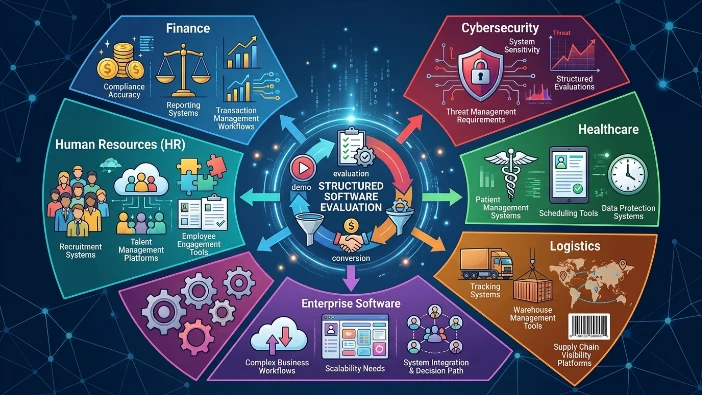
Industries that rely heavily on demo-to-sales banner conversion systems include finance, cybersecurity, healthcare, logistics, enterprise software, and human resources. These sectors require structured software evaluation before purchasing decisions due to operational complexity and regulatory requirements.
Finance organizations evaluate software for compliance accuracy, reporting systems, and transaction management workflows.
Cybersecurity companies depend on structured evaluations due to system sensitivity and threat management requirements.
Healthcare organizations use demo-to-sales pathways to assess patient management systems, scheduling tools, and data protection systems.
Logistics companies evaluate tracking systems, warehouse management tools, and supply chain visibility platforms.
Enterprise software buyers require multi-stage evaluation processes involving demonstrations, internal reviews, and decision meetings.
Human resources systems are evaluated for onboarding workflows, employee management features, and performance tracking tools.
In all these industries, banner campaigns support structured transitions from demo engagement to sales discussions.
How does banner strategy fit into the software sales funnel?
BOFU banner strategy fits into the software sales funnel by targeting users who have already completed awareness and evaluation stages. It focuses on decision-stage engagement, guiding demo visitors toward structured sales calls through retargeting, reinforcement messaging, and conversion-focused landing experiences.
The sales funnel begins with awareness, continues through evaluation, and ends with decision-making.
BOFU banner campaigns operate at the final stage. Users have already interacted with software demos and understand core functionality.
At this stage, messaging focuses on clarity and decision support. Users receive reinforcement of evaluated features rather than new product introductions.
A workflow automation platform uses BOFU banners to reconnect users who completed demos by highlighting implementation readiness and operational efficiency.
Campaign success depends on aligning banner messaging with prior user behavior and demo interaction history.
The result is a structured transition from demo participation to active sales conversation scheduling within software evaluation cycles.



