
Flash sale banner ads are digital visual advertisements that promote limited-time discounts, short-duration campaigns, and urgent shopping events. E-commerce businesses use these banners across websites, mobile apps, search platforms, and social channels to increase visibility, attract visitors, and generate immediate shopping traffic during sales periods.
Flash sale banner advertising is a performance-focused marketing method used in online retail. A flash sale usually lasts between 2 hours and 72 hours. The main goal is to create urgency and increase short-term customer activity.
Banner ads contain visual and textual elements that communicate the sale clearly. Common elements include discount percentages, countdown messages, sale deadlines, product categories, and call-focused phrases such as “Ends Tonight” or “24-Hour Offer.”
E-commerce businesses use flash sale banners during seasonal campaigns, inventory clearances, holiday events, and product launches. Common examples include Black Friday campaigns, end-of-season sales, weekend electronics discounts, and limited-time fashion promotions.
Flash sale banners appear in several placements. Website homepage banners target existing visitors. Display network banners target browsing users across websites. Mobile app banners target returning customers. Social display banners target users based on shopping interests and browsing behavior.
Businesses track banner performance using measurable metrics such as click-through rate, traffic volume, conversion rate, bounce rate, and average order value.
Readers exploring traffic generation strategies can also read:
How Online Shops Increase Cart Intent Using Strategic Banner Retargeting
How do banner ads increase flash sale traffic?
Banner ads increase flash sale traffic by improving campaign visibility, accelerating customer awareness, and directing users toward time-sensitive shopping pages. Businesses use targeting systems, urgency messaging, and high-frequency ad placements to generate immediate visitor activity during active sales periods online.
Flash sale campaigns depend heavily on speed and visibility. Banner ads support both objectives simultaneously. When businesses launch a limited-time sale, customers need immediate awareness of the event. Banner advertising distributes this information rapidly across multiple digital environments.
Visual prominence plays a major role in traffic generation. Large-format banners placed at the top of webpages receive higher visibility compared to standard text links. Bright colors, discount percentages, and countdown messaging attract user attention quickly.
Urgency messaging increases user response rates. Phrases such as “Sale Ends in 6 Hours” or “Only Today” encourage faster decisions. Time-sensitive messaging reduces browsing delays and increases click activity.
Targeting systems also improve traffic quality. E-commerce businesses use audience targeting based on previous browsing behavior, shopping categories, device type, and geographic location. For example, a clothing retailer can show winter clearance banners specifically to users who recently searched for jackets or boots.
Retargeting strengthens flash sale visibility further. Users who visited product pages but did not purchase often receive reminder banners during the flash sale period. This strategy reconnects existing interest with a temporary discount opportunity.
Banner ads also support mobile traffic growth. Mobile commerce accounts for a large percentage of online shopping activity in the United Kingdom. Responsive banner formats allow sales campaigns to appear correctly on smartphones, tablets, and mobile applications.
Users interested in conversion-focused advertising methods can explore to understand:
How Online Shops Convert Add-to-Cart Users Into Buyers Using High-Intent Banner Ads
What elements make flash sale banner ads effective?
Effective flash sale banner ads combine clear pricing, short messaging, strong visual hierarchy, visible deadlines, and focused product presentation. E-commerce businesses structure these elements carefully to increase click activity, reduce confusion, and guide users directly toward active promotional pages online.
Clear discount presentation is the first critical component. Users process numerical information faster than descriptive wording. “50% Off” communicates value immediately, while vague phrases such as “Big Savings” provide less clarity.
Time visibility is equally important. Flash sales depend on limited availability. Countdown timers, deadline labels, and specific dates create urgency. Examples include “Ends at Midnight,” “48-Hour Sale,” or “Weekend Offer Only.”
Simple messaging improves readability. Effective banners usually contain between 5 and 15 words. Overloaded banners reduce attention and weaken click performance.
Visual hierarchy determines how users process information. The largest text typically displays the discount or sale name. Secondary text highlights deadlines or product categories. Supporting visuals show products included in the sale.
Product-focused imagery improves contextual understanding. Electronics banners often display smartphones, laptops, or gaming accessories. Fashion banners display clothing collections or footwear categories. Grocery banners highlight discounted household products or packaged items.
Color contrast also affects visibility. High-contrast combinations improve readability on desktop and mobile screens. Businesses often use contrasting backgrounds to separate banners from surrounding webpage content.
Landing page alignment is another major factor. Banner messaging must match the destination page exactly. If a banner promotes “40% Off Sportswear,” the landing page must immediately display discounted sportswear products. Message inconsistency increases bounce rates and reduces campaign effectiveness.
Why do e-commerce businesses use urgency in banner advertising?
E-commerce businesses use urgency in banner advertising because limited-time messaging accelerates customer decisions and increases immediate traffic activity. Urgency reduces browsing delays, strengthens sale visibility, and encourages users to visit promotional pages before discounts expire or inventory becomes unavailable.
Urgency changes customer behavior by shortening decision timelines. Standard shopping journeys often involve comparison, delayed consideration, and repeat visits. Flash sale banners compress this process into a shorter timeframe.
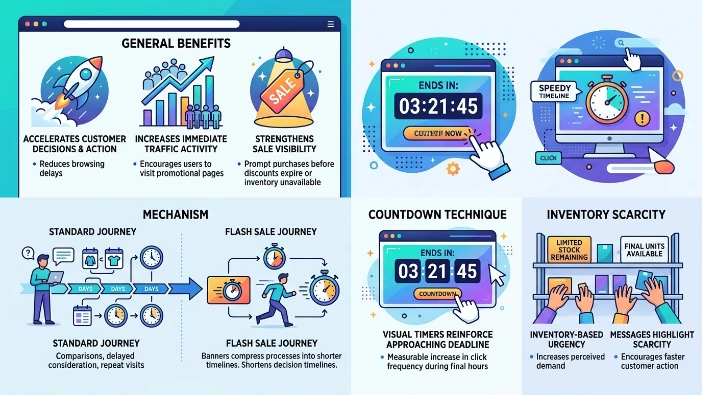
Countdown messaging is one of the most widely used urgency techniques. Timers visually reinforce the approaching deadline. This creates a measurable increase in click frequency during the final hours of a sale campaign.
Inventory-based urgency is another common method. Messages such as “Limited Stock Remaining” or “Final Units Available” highlight scarcity. Scarcity increases perceived demand and encourages faster customer action.
Event-based urgency also supports seasonal traffic growth. During Black Friday, Boxing Day, or end-of-season sales, users already expect time-sensitive offers. Banner advertising amplifies these expectations by increasing sale visibility across digital platforms.
Urgency also improves retargeting effectiveness. Customers who abandoned browsing sessions often respond more actively when banners communicate a temporary discount expiration. This reconnects existing product interest with immediate purchasing motivation.
Frequency timing matters significantly in urgency-driven campaigns. Businesses usually increase banner impressions during the final 24 hours of a flash sale. Higher visibility during the closing period increases traffic spikes and user engagement rates.
Mobile notifications and app-integrated banners further strengthen urgency. Users receive immediate reminders while browsing or using shopping applications, increasing the probability of rapid website visits.
How are flash sale banner campaigns planned?
Flash sale banner campaigns are planned through audience analysis, campaign scheduling, creative preparation, placement selection, and performance tracking. E-commerce businesses organize each phase before launch to ensure consistent messaging, efficient targeting, and stable traffic generation throughout the sales period online.
Campaign planning usually begins with sales objective definition. Businesses determine whether the goal focuses on inventory clearance, seasonal promotion, product awareness, or revenue acceleration.
Audience segmentation follows next. Different customer groups respond to different sale categories. Returning customers often engage with loyalty discounts, while new visitors respond more strongly to broad percentage-based offers.
Creative production includes banner sizing, visual formatting, messaging design, and mobile adaptation. Businesses often prepare multiple banner versions for desktop websites, mobile applications, and third-party advertising networks.
Scheduling plays a central role in flash sale execution. Many campaigns launch during high-traffic shopping periods such as evenings, weekends, or holiday events. Timing decisions are based on historical customer activity data.
Placement strategy determines where banners appear. Homepage banners target direct visitors. Display network banners expand reach externally. Search-related banners target users actively researching products.
Tracking systems measure performance continuously during the campaign. Common monitoring metrics include impressions, clicks, traffic sessions, conversion rate, revenue per visitor, and average session duration.
Optimization often occurs during active campaigns. Businesses replace underperforming visuals, adjust messaging, or increase advertising frequency based on real-time performance data.
Flash sale campaigns also require inventory coordination. Businesses align promotional traffic volume with available product stock to avoid customer frustration caused by unavailable products.
Explore More Expert Insights:
How E-commerce Businesses Close Sales From Warm Leads Using Retargeting Funnels
How Retailers Increase Final Purchase Rates Using Time-Sensitive Banner Campaigns
What industries use flash sale banner advertising most frequently?
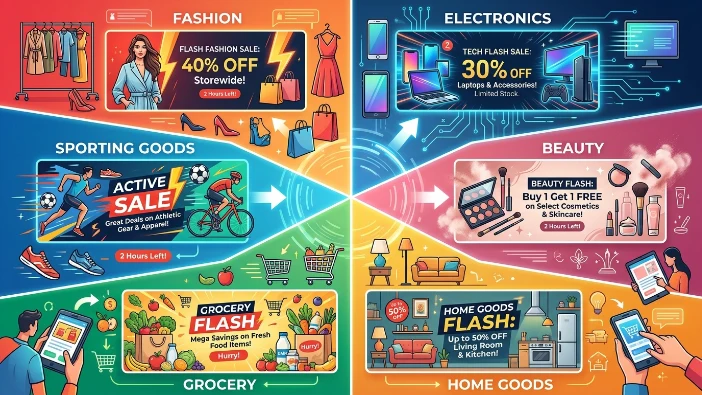
Fashion, electronics, beauty, home goods, grocery, and sporting goods industries use flash sale banner advertising frequently. These sectors depend on seasonal inventory movement, trend-driven purchasing behavior, and limited-time consumer demand to generate rapid traffic and sales increases online.
Fashion retailers rely heavily on flash sale banners due to fast-changing inventory cycles. Seasonal clothing collections, footwear launches, and clearance events require rapid visibility increases before stock replacement periods begin.
Electronics retailers use banner ads during product launch periods and promotional shopping events. Smartphone discounts, gaming accessory promotions, and laptop clearance campaigns often depend on high-volume traffic within short timeframes.
Beauty and skincare businesses use flash sale campaigns during holiday gifting seasons and new collection releases. Limited-time cosmetic bundles and skincare promotions attract repeat customers and mobile shoppers.
Home goods retailers use banners for furniture discounts, appliance promotions, and seasonal decor sales. Large-format visual banners help customers identify discounted product categories quickly.
Online grocery businesses also use flash sale banners for short-term offers on packaged foods, beverages, frozen products, and household essentials. Time-sensitive promotions increase repeat customer visits and encourage basket expansion.
Sporting goods retailers depend on event-driven shopping behavior. Fitness equipment discounts, outdoor gear promotions, and seasonal sports campaigns often generate high engagement during targeted periods.
Digital marketplaces also use flash sale banner systems extensively. Marketplace environments contain large product inventories, making banners useful for highlighting selected promotional categories efficiently.
How do businesses measure flash sale banner ad performance?
Businesses measure flash sale banner ad performance using traffic metrics, engagement data, conversion tracking, and revenue analysis. These measurements help identify which banners attract visitors effectively, maintain user interest, and contribute directly to sales activity during promotional periods online.
Click-through rate measures how many users clicked after viewing a banner. High click-through rates usually indicate strong visual relevance and effective messaging clarity.
Traffic volume measures the number of visitors generated during the flash sale campaign. Businesses compare this traffic against baseline website activity to determine campaign impact.
Bounce rate measures how quickly visitors leave after clicking the banner. High bounce rates often indicate poor landing page alignment or unclear promotional messaging.
Conversion rate measures how many visitors completed purchases after arriving through banner advertisements. This metric connects traffic activity directly with commercial outcomes.
Average order value helps businesses evaluate customer spending patterns during the flash sale period. Some campaigns generate large traffic increases but lower transaction values, while others increase both metrics simultaneously.
Impression frequency measures how often users viewed the banner before clicking. Repeated exposure often improves recognition during short-duration campaigns.
Mobile engagement metrics also play an important role. Businesses analyze mobile click rates, app interactions, and smartphone conversion performance separately from desktop traffic data.
Long-term performance analysis helps businesses improve future campaigns. Historical comparison identifies which sale durations, banner formats, and urgency techniques produced the highest traffic efficiency over time.